Work, pay & shifts
When Does a Year Have 27 Biweekly Paydays?
A year of biweekly pay usually has 26 paydays, but every so often it has 27. That extra payday isn’t a payroll quirk — it falls straight out of the calendar, and you can see it coming years in advance. This guide explains the rule, how often it happens, and why it matters for anyone budgeting by the paycheck.
Ready to try the tool this guide describes?
The arithmetic
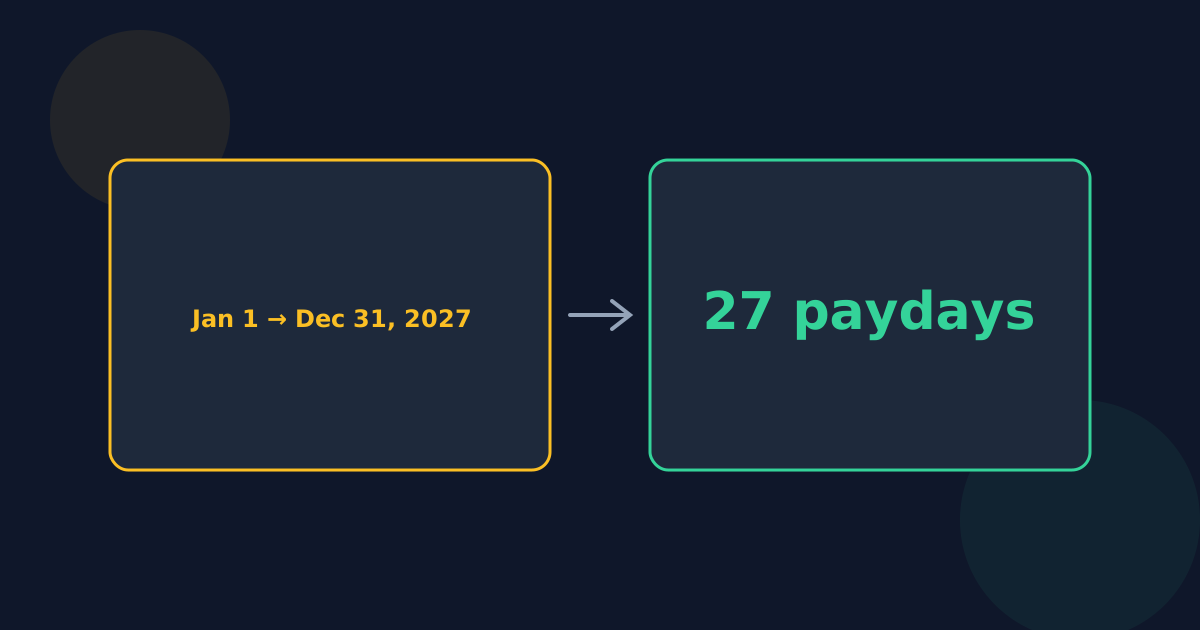
26 two-week periods are 364 days — one day short of a 365-day year and two days short of a leap year. A 27th payday fits only when the year’s first payday comes early enough: on January 1, the 27th payday is 364 days later, on December 31.
In a leap year the first payday can be January 1 or January 2. Any later, and the 27th payday spills into the next year.
How often it happens
Each year the schedule lands one day earlier in the calendar — two days after a leap day — so a payday rhythm only returns to January 1 every 11 or 12 years. For the two Friday schedules:
| Friday schedule | 27-payday years |
|---|---|
| Includes January 1, 2027 | 2027, 2038, 2049, 2060 |
| Includes January 8, 2027 | 2032, 2044, 2055 |
Spotting one ahead of time
- Find the date of your first payday next January.
- If it is January 1 — or January 1 or 2 in a leap year — that year has 27 paydays.
- Otherwise it has 26.
Why it matters
- How a salary is spread across 27 checks is up to the employer: some keep each check the same and pay more that year, others divide the salary by 27.
- Amounts budgeted per paycheck — savings transfers, loan payments — happen 27 times, which changes annual totals.
- Benefit deductions set per paycheck may be taken 27 times, or skipped once; employers handle this differently.
- The extra payday makes a third three-paycheck month that year.
27-Payday Years FAQ
- Is 2027 a 27-payday year?
- It is for biweekly schedules with a payday on Friday, January 1, 2027 — they run to Friday, December 31, 2027. The other Friday schedule has 26 paydays in 2027.
- Can a weekly schedule have 53 paydays?
- Yes, by the same arithmetic: 52 weeks is 364 days, so a weekly payday on January 1 (or January 1 or 2 in a leap year) gives 53.
- Does a 27-payday year mean a raise?
- Not necessarily. It depends on how your employer sets per-check pay; hourly workers are paid for the hours in each period either way.
- Why do I keep reading that it happens every 11 years?
- A rhythm drifts one day earlier each year and two in a leap year, so it comes back to January 1 every 11 or 12 years; 11 is the rounded figure people quote.
- Which date decides the year — the pay date or the pay period?
- For counting paydays, the pay date. A period that ends in late December but is paid in January counts in the new year.
Related guides
- Finding Biweekly PaydaysUse one known payday to list every biweekly payday: count in 14-day steps, cross month and year ends, and check the dates against a pay calendar.
- Three-Paycheck MonthsWhy two months a year get a third biweekly paycheck, how to find them for your payday, and how to budget around the extra check.
Open the tool
Jump into Biweekly Paycheck Date Calculator when you are ready to process your files.