Work, pay & shifts
Rounding Commission Splits to the Cent
Split money three ways and the exact shares usually have more than two decimal places. Round each one on its own and the total can come out a cent short — or a cent over. On one payout that is a curiosity; across a year of statements it is a reconciliation problem. This guide shows why it happens and how to round so the shares always add up.
Ready to try the tool this guide describes?
Why rounded shares don’t add up
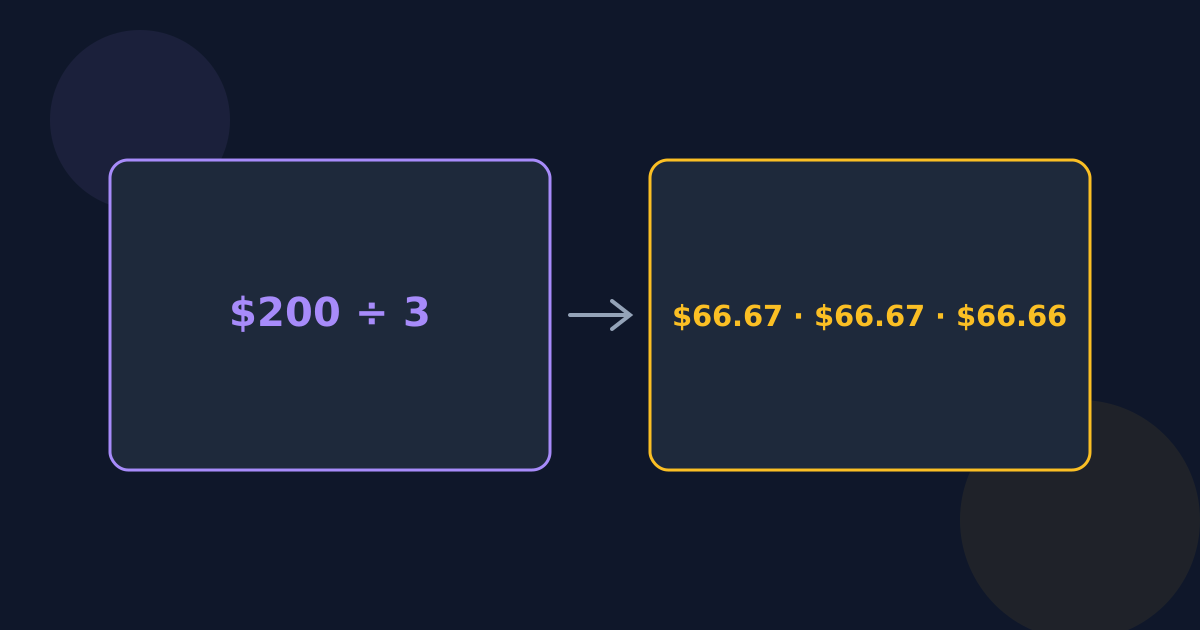
$100 split three ways is $33.333… each. Rounded to the nearest cent, that is $33.33 three times — $99.99, a cent lost. $200 split three ways is $66.666… each; rounded to the nearest cent that is $66.67 three times — $200.01, a cent created.
The largest-remainder method
- Work out each exact share.
- Round every share down to the cent.
- Count the cents left over — always fewer than the number of people.
- Give one cent each to the shares that lost the most in step 2, largest first. Break ties in a fixed order, such as the order people are listed.
Splitting $200 three ways
| Person | Exact share of $200 | Rounded down | Final |
|---|---|---|---|
| Person 1 | $66.6667 | $66.66 | $66.67 |
| Person 2 | $66.6667 | $66.66 | $66.67 |
| Person 3 | $66.6667 | $66.66 | $66.66 |
Rounding down leaves $199.98, so two cents remain. The remainders are tied, so they go to Persons 1 and 2 in order.
A weighted example
$1,000 split by weights 3 : 2 : 2 gives exact shares of $428.5714…, $285.7142…, and $285.7142…. Rounded down they total $999.99, so one cent is left. Persons 2 and 3 have the largest remainders (tied), so it goes to Person 2: $428.57, $285.72, and $285.71 — exactly $1,000.00.
Other rounding rules you may see
- Round everyone normally and put any difference on the last person.
- Round everyone down and leave the leftover cents with the company or the pool.
- Rotate who gets the extra cent from one payout to the next.
- Banker’s rounding (halves to the nearest even cent), which reduces bias over many payouts but doesn’t guarantee a single split adds up.
Make the rule part of the agreement
Any of these rules is fair if everyone knows it in advance and it’s applied the same way every time. What matters is that the payouts add up to the commission received, so the books reconcile without manual adjustments.
Rounding Splits FAQ
- Does a single cent really matter?
- For one person, rarely. For whoever reconciles payouts against the commission received, every split that doesn’t add up is an exception to investigate.
- Who should get the extra cent?
- Whoever the agreed rule says. Largest remainder is the most defensible, because the cent goes to the person whose exact share was closest to the next cent.
- Does the order people are listed in matter?
- Only to break exact ties, which happen in equal splits. Keep the order consistent between payouts.
- Why not just round to the nearest cent?
- Because the rounded shares can add up to a cent more or less than the total. $100 three ways rounds to $99.99; $200 three ways rounds to $200.01.
- Can rounding ever move more than one cent per person?
- No. With the largest-remainder method, each person receives their exact share rounded down, plus at most one cent.
Related guides
- Splitting a CommissionSplit a commission by percentages, weights, or fixed amounts — with a $10,000 three-way example, what to do when percentages don’t total 100%, and the order fees and splits should come in.
- Real Estate SplitsHow a real estate commission moves through stages — between brokerages, off-the-top referral fees, and brokerage-agent splits — with a worked example and why the order of each stage changes who pays.
Open the tool
Jump into Commission Split Calculator when you are ready to process your files.