Work, pay & shifts
How to Split a Commission
When more than one person earns a commission — a sales team, co-listing agents, a referral partner — the payout needs a rule everyone agreed to before the money arrived. This guide compares the three common ways to split a commission, works through a $10,000 example, and covers the mistakes that make a split fail to add up.
Ready to try the tool this guide describes?
Three ways to split
- Percentages: each person gets a share of 100%. Simple, but the shares have to total exactly 100%.
- Weights or points: each person gets points, and their share is their points ÷ the total. Nothing has to add up to 100, which makes it easy to add or remove someone.
- Fixed amounts: each person gets a set dollar figure, for example a flat referral fee. Whatever isn’t assigned stays unallocated until someone decides where it goes.
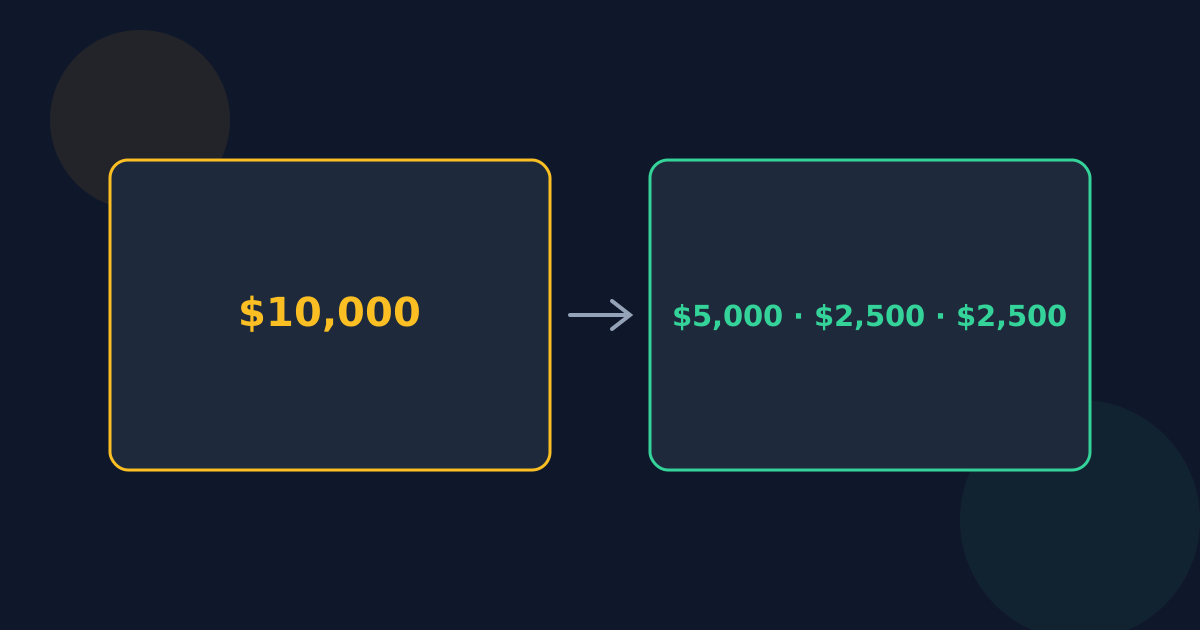
Splitting $10,000 among three people
| Split | Person 1 | Person 2 | Person 3 |
|---|---|---|---|
| 50% / 25% / 25% | $5,000.00 | $2,500.00 | $2,500.00 |
| Equal (1 : 1 : 1) | $3,333.34 | $3,333.33 | $3,333.33 |
| Weights 3 : 2 : 1 | $5,000.00 | $3,333.33 | $1,666.67 |
| Fixed $4,000 / $3,000 / $2,500 | $4,000.00 | $3,000.00 | $2,500.00 |
An equal split can’t be $3,333.33 each — that adds up to $9,999.99 — so one person receives the extra cent. The fixed amounts leave $500.00 unallocated.
When percentages don’t total 100%
Shares of 40%, 35%, and 20% add up to 95%, which leaves $500 of a $10,000 commission with no owner. Shares of 40%, 35%, and 30% add up to 105% and would pay out $10,500 — money that doesn’t exist. Either way, stop and fix the shares; don’t scale them silently.
Weights make team changes easy
A 2 : 1 : 1 split of $10,000 pays $5,000, $2,500, and $2,500. Add a fourth person at weight 1 and it becomes 2 : 1 : 1 : 1 — $4,000, $2,000, $2,000, and $2,000 — without anyone recalculating percentages.
Agree the order of operations
- Start from the commission actually received, after any chargebacks.
- Take off amounts paid “off the top”, such as a referral fee or a brokerage fee, if your agreement says so.
- Split what remains by the agreed method.
- Round to the cent with a stated rule, so the shares add up to the amount split.
Splitting a Commission FAQ
- Should a commission be split before or after fees?
- Whichever your agreement says — but say it. Taking a fee off the top shares its cost among everyone; taking it from one person’s share puts it all on them.
- What if someone leaves before the deal closes?
- That is an agreement question, not arithmetic. Many teams decide the split when the deal is opened so a later departure doesn’t reopen it.
- Is a percentage split better than weights?
- They give the same result for the same proportions. Weights are easier to adjust; percentages are easier to read on a statement.
- Can a split include people paid a fixed fee and people paid a share?
- Yes, in two stages: pay the fixed fees first, then split what remains by percentage or weight.
- Do the shares have to be whole percentages?
- No. Shares like 33.33%, 33.33%, and 33.34% are fine as long as they total exactly 100%.
Related guides
- Real Estate SplitsHow a real estate commission moves through stages — between brokerages, off-the-top referral fees, and brokerage-agent splits — with a worked example and why the order of each stage changes who pays.
- Rounding SplitsWhy rounded commission shares can add up to a cent more or less than the total, how the largest-remainder method fixes it, and other rounding rules you may see on statements.
Open the tool
Jump into Commission Split Calculator when you are ready to process your files.