Calculators & everyday math
Common Percentage Mistakes and How to Avoid Them
Percentages look simple, which is exactly why small slips go unnoticed — in a spreadsheet, a report, or a shop sign. These are the mistakes that come up most often, why they happen, and a quick check for each.
Ready to try the tool this guide describes?
Using the wrong base
Every percentage is a percentage of something. A price that rises from $50 to $60 has gone up 20% (10 ÷ 50), but the same $10 is only about 16.67% of the new price (10 ÷ 60). Before calculating, ask: percent of what?
Adding percentages that have different bases
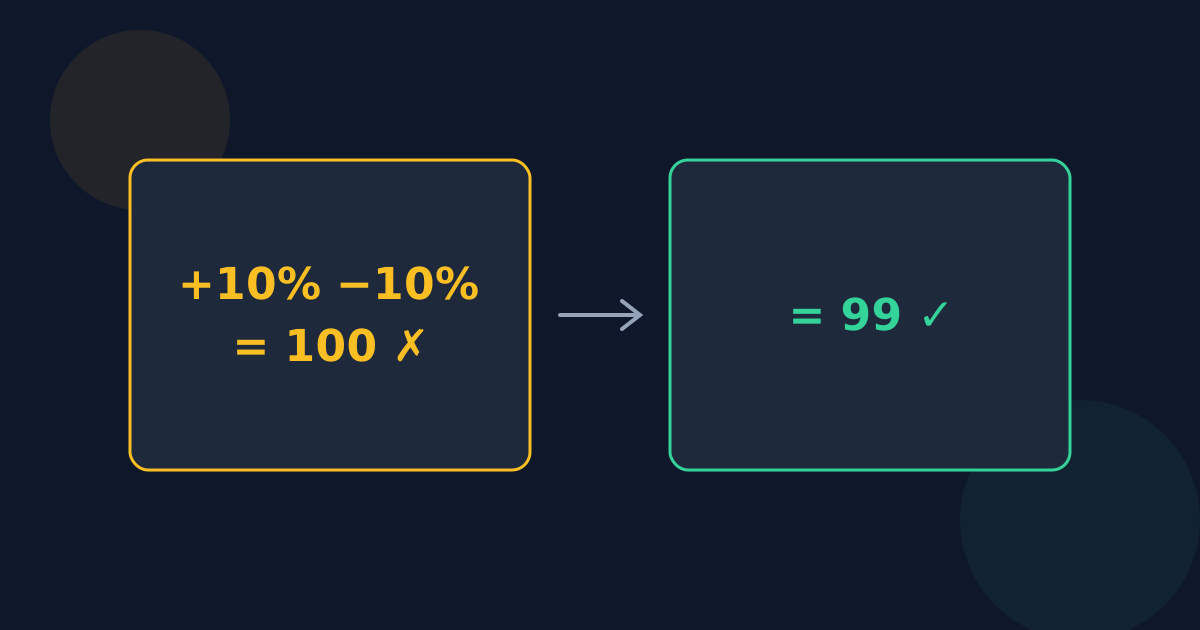
A 10% rise followed by a 10% fall does not bring you back to where you started. 100 up 10% is 110; 110 down 10% is 99, because the second 10% was taken of a bigger number. For the same reason, two 10% increases make 21%, not 20%.
Mixing up percentage points and percent
If a survey result moves from 40% to 50%, it has risen by 10 percentage points — but by 25 percent, because 10 is a quarter of 40. Both statements are true; they answer different questions. Use “percentage points” for the plain gap between two percentages.
Reversing a percentage the wrong way
If a price after 20% off is $80, the original was not $80 plus 20% ($96). It was $80 ÷ 0.8 = $100. To undo a percentage change, divide by its multiplier instead of applying the opposite percentage.
Rounding too early
Rounding in the middle of a calculation adds up. A third rounded to 33% and then applied to 1,200 gives 396, while the unrounded 33.33…% gives 400. Keep full precision until the final step.
Percentages over 100 and below zero
- An increase can be any size: going from 20 to 70 is a 250% increase.
- A positive quantity can fall by at most 100% unless it goes below zero, so “prices fell 150%” usually signals a mistake.
- Percentage change from zero is undefined — there is no base to divide by.
Common Percentage Mistakes FAQ
- What is the difference between percent and percentage points?
- Percentage points are the plain gap between two percentages: 40% to 50% is 10 points. Percent change measures that gap relative to the start: 10 ÷ 40 = 25%.
- Why doesn’t a 50% loss followed by a 50% gain break even?
- 100 down 50% is 50, and 50 up 50% is only 75. Getting from 50 back to 100 takes a 100% gain.
- How can I check a percentage calculation quickly?
- Estimate with easy percentages first — 10%, 25%, 50% — and make sure your exact answer is in the same range.
- Is 200% of a number the same as a 200% increase?
- No. 200% of 50 is 100, but a 200% increase on 50 adds 100, giving 150.
- When should I round a percentage?
- Only at the end, to a number of decimal places that suits the data. Rounding intermediate steps can shift the final answer.
Related guides
- Percentage of a NumberThe one method that always works for finding a percentage of a number, plus mental shortcuts for 10%, 15%, 25%, and more, with worked examples.
- Why Decreases Don’t Undo IncreasesWhy going up 25% and then down 25% leaves you lower than you started, how big the gap gets, and the percentage that really reverses a change.
Open the tool
Jump into Percentage Calculator when you are ready to process your files.