Calculators & everyday math
Why a Percentage Decrease Doesn’t Undo an Increase
A price goes up 25%, then comes down 25%, and ends lower than where it started. It feels like a trick, but it follows directly from how percentages work. This guide explains why, how big the gap gets, and how to work out the percentage that really does reverse a change.
Ready to try the tool this guide describes?
The example
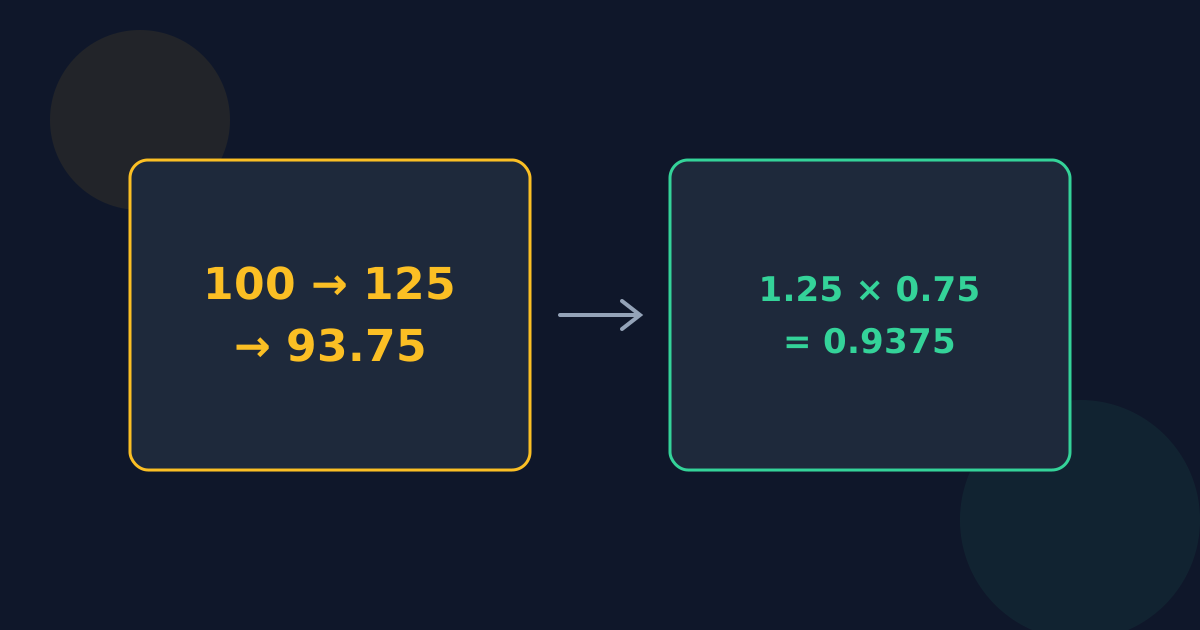
Start with 100. Up 25% gives 125. Down 25% takes off a quarter of 125, which is 31.25, leaving 93.75 — below the original 100.
Why it happens
Each percentage is taken of the number in front of it. The increase was 25% of 100; the decrease was 25% of 125, a bigger base, so it removed more than the increase added. In multiplier terms, 1.25 × 0.75 = 0.9375 — a combined 6.25% decrease, in whichever order the two changes happen.
The gap grows with the percentage
Going up and then down by the same percentage multiplies by 1 − (percentage ÷ 100)², so the loss is the square of the percentage: tiny for small changes, dramatic for large ones.
| Up, then down by | Combined multiplier | 100 ends at |
|---|---|---|
| 10% | 0.99 | 99 |
| 25% | 0.9375 | 93.75 |
| 50% | 0.75 | 75 |
| 100% | 0 | 0 |
The percentage that really reverses a change
To undo an increase, decrease by increase ÷ (100 + increase) × 100 percent. To undo a 25% rise: 25 ÷ 125 × 100 = 20%. Check: 125 down 20% is 100.
To undo a decrease, increase by decrease ÷ (100 − decrease) × 100 percent. To recover from a 20% fall: 20 ÷ 80 × 100 = 25%. After a 50% fall, you need a 100% rise to get back.
Where this shows up
- A sale price later “restored” by the same percentage ends up at a different price from the original.
- Any measurement that falls by half has to double to recover.
- Percentages quoted from different starting points can’t simply be added together or cancelled against each other.
Why Decreases Don’t Undo Increases FAQ
- If something goes up 20% and then down 20%, where does it end?
- 4% lower than where it started, because 1.2 × 0.8 = 0.96.
- Does the order matter?
- No. Down 20% then up 20% also multiplies by 0.8 × 1.2 = 0.96.
- What percentage decrease reverses a 50% increase?
- About 33.33%: 50 ÷ 150 × 100. 100 up 50% is 150, and 150 down a third is 100.
- What percentage increase reverses a 10% decrease?
- About 11.11%: 10 ÷ 90 × 100. 100 down 10% is 90, and 90 up 11.11% is back to 100.
- Is there a shortcut for the combined effect of two changes?
- Multiply the two multipliers. A 30% rise and a 30% fall give 1.3 × 0.7 = 0.91, a 9% decrease overall.
Related guides
- Decrease by a PercentageTake a percentage off a number in two steps or with one multiplier, see how repeated cuts combine, and learn to reverse a decrease correctly.
- Common Percentage MistakesWrong bases, percentages that don’t cancel, percentage points vs. percent, reversing a discount, and rounding too early — with a quick check for each.
Open the tool
Jump into Percentage Decrease Calculator when you are ready to process your files.