Work, pay & shifts
Why Rotating Shift Hours Change From Week to Week
If you work a rotation that averages 42 hours a week, you may never actually work a 42-hour week. Because rotating cycles don’t line up with 7-day weeks, the hours in any given week — or pay period — swing above and below the average. This guide shows why, with week-by-week breakdowns, and explains which number to use for which purpose.
Ready to try the tool this guide describes?
Cycles and weeks don’t line up
A week is always 7 days. A 2-2-3 cycle is 14 days, a DuPont cycle 28, a 4-on-4-off cycle 8. Unless the cycle is a whole number of weeks, and the work days are spread evenly within it, each calendar week catches a different slice of the pattern.
2-2-3 week by week
With the cycle starting on a Monday and 12-hour shifts:
| Week | Work days | Hours |
|---|---|---|
| Week 1 | 5 | 60 |
| Week 2 | 2 | 24 |
Average: 84 hours ÷ 2 weeks = 42 hours a week.
DuPont week by week
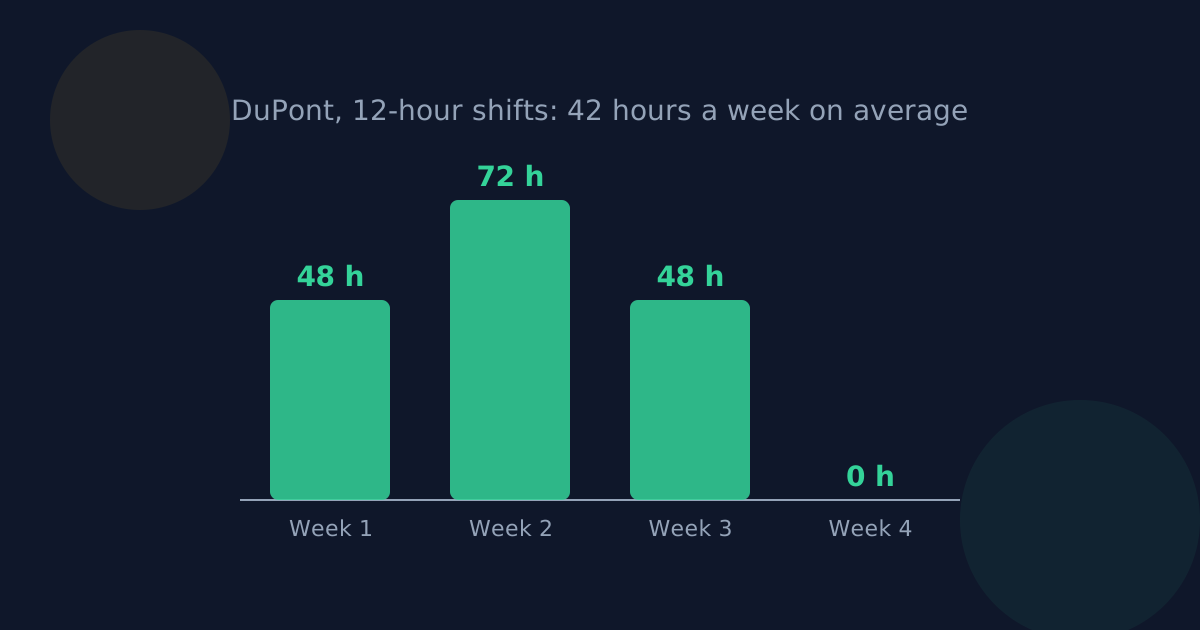
DuPont’s 28 days split into four weeks that are very different from each other:
| Week | Work days | Hours |
|---|---|---|
| Week 1 | 4 | 48 |
| Week 2 | 6 | 72 |
| Week 3 | 4 | 48 |
| Week 4 | 0 | 0 |
Average: 168 hours ÷ 4 weeks = 42 hours a week.
Pay periods have the same problem
- A biweekly pay period on 2-2-3 always holds one full 14-day cycle, so it is always 7 shifts — 84 hours with 12-hour shifts.
- A biweekly period on 4-on-4-off holds one full 8-day cycle plus 6 days, so it has 6, 7, or 8 shifts — 72, 84, or 96 hours — depending on where the period starts.
- Weekly pay on any of these rotations swings the most.
Which number to use
- For yearly planning or comparing schedules, use the long-run average.
- For a particular week or pay period, count the actual work days in it.
- When a pay period’s hours look wrong, count the shifts in that exact date range before assuming a mistake.
Why Weekly Hours Vary FAQ
- Why do my hours change every week on a rotating schedule?
- Because the rotation repeats on its own cycle, not every 7 days, so each week covers a different part of the pattern.
- How many hours are in each week of a 2-2-3 schedule?
- With 12-hour shifts and a cycle starting Monday, 60 hours one week and 24 the next — 42 on average.
- Does DuPont have a week with no shifts?
- Yes. Its 7-day break means one week in every four has no shifts when the cycle starts on a Monday.
- Is a biweekly paycheck the same every time on 2-2-3?
- The hours are: a 14-day pay period always contains one full cycle of 7 shifts.
- What number should I budget with?
- The long-run average for yearly totals, but check the actual shifts in each pay period for cash-flow planning.
Related guides
- Hours on a Rotating ScheduleFind the cycle, the hours per cycle, the average week, and the total for a set period on any rotating schedule, including partial cycles.
- Rotating Patterns ComparedThe 2-2-3 Panama, DuPont, 4-on-4-off, 24/48, and 5/2 rotations side by side: cycle length, work days, longest stretches, and average hours.
Open the tool
Jump into Rotating Shift Hours Calculator when you are ready to process your files.