Work, pay & shifts
Common Rotating Shift Patterns Compared
Operations that run around the clock — hospitals, police and fire departments, plants, utilities — rely on a handful of well-known rotations. They differ in how long the cycle is, how long the longest stretch of work or rest is, and how often weekends fall free. This guide compares the most common ones side by side, using the same arithmetic the Rotating Shift Hours Calculator uses.
Ready to try the tool this guide describes?
The patterns
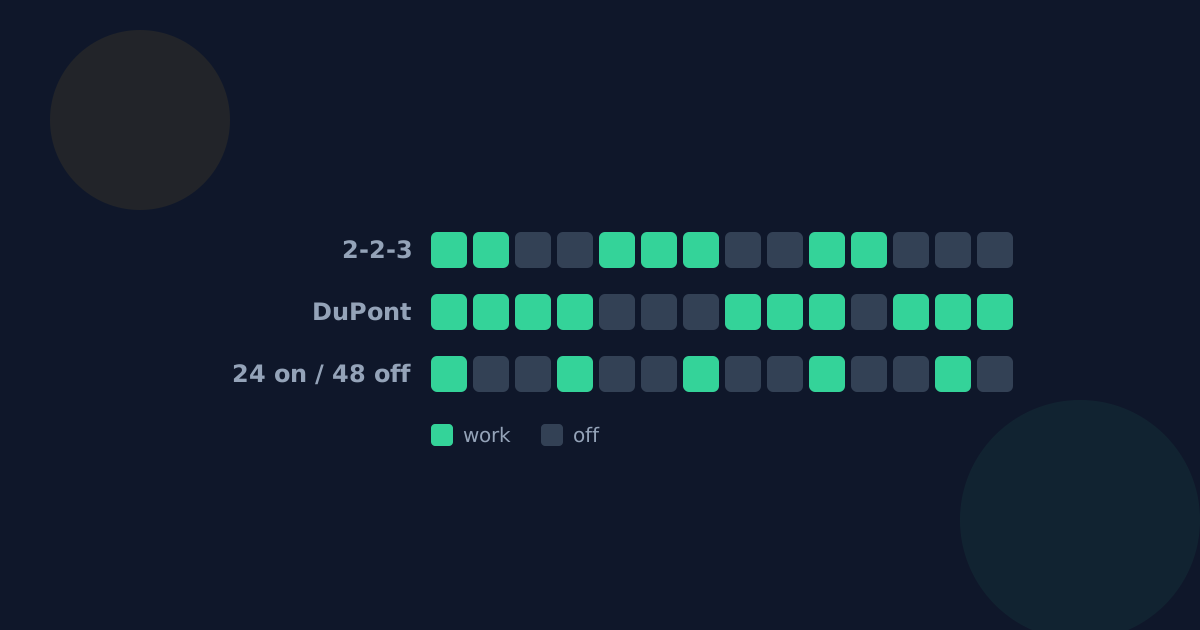
- 2-2-3 (Panama or Pitman): 2 on, 2 off, 3 on, 2 off, 2 on, 3 off — a 14-day cycle, usually with 12-hour shifts.
- DuPont: 4 on, 3 off, 3 on, 1 off, 3 on, 3 off, 4 on, 7 off — a 28-day cycle with 12-hour shifts that often alternate between days and nights.
- 4-on-4-off: four 12-hour shifts, then four days off — an 8-day cycle.
- 24 on / 48 off: one 24-hour shift, then two days off — a 3-day cycle common in fire services.
- 5 on / 2 off: the standard work week, shown for comparison.
Side by side
The three 12-hour rotations average the same 42 hours a week because each works exactly half of its days. They feel very different in practice because of how those days are grouped.
| Pattern | Cycle | Work days | Shift | Average week |
|---|---|---|---|---|
| 2-2-3 (Panama) | 14 days | 7 | 12 h | 42 hours |
| DuPont | 28 days | 14 | 12 h | 42 hours |
| 4-on-4-off | 8 days | 4 | 12 h | 42 hours |
| 24 on / 48 off | 3 days | 1 | 24 h | 56 hours |
| 5 on / 2 off | 7 days | 5 | 8 h | 40 hours |
Longest stretches of work and rest
- 2-2-3: never more than 3 days on or 3 days off in a row.
- DuPont: up to 4 days on, and one 7-day break every 28 days.
- 4-on-4-off: always 4 on and 4 off.
- 24 on / 48 off: one long shift, then 2 days off.
Weekends
On a 2-2-3 rotation whose cycle starts on a Monday, the first week works Friday to Sunday and the second has Friday to Sunday off — a full weekend off every other week. A 4-on-4-off rotation drifts one weekday every cycle, so the weekends it leaves free move around; over 8 weeks starting on a Monday work day, 3 weekends are fully off. How weekends fall on any rotation depends on which weekday the cycle starts on.
Covering 24/7 with crews
A 12-hour rotation that works half its days needs four crews to cover every hour: two on duty each day (day and night) and two off. A 24 on / 48 off rotation needs three crews, one on duty each day. The average week follows from that: 168 hours a week split across four crews is 42 hours each; across three crews it is 56.
Rotating Patterns Compared FAQ
- What is a 2-2-3 schedule?
- A 14-day rotation of 2 on, 2 off, 3 on, 2 off, 2 on, 3 off, usually with 12-hour shifts. It is also called the Panama or Pitman schedule and averages 42 hours a week.
- What is the DuPont schedule?
- A 28-day rotation of 4 on, 3 off, 3 on, 1 off, 3 on, 3 off, 4 on, 7 off with 12-hour shifts. It has 14 work days per cycle and a 7-day break.
- How many hours a week is 24 on, 48 off?
- 56 on average: one 24-hour shift every 3 days, × 7 ÷ 3.
- Which rotating schedule has the most hours?
- Of these, 24 on / 48 off, at an average of 56 hours a week. The three 12-hour rotations each average 42.
- Why do 2-2-3, DuPont, and 4-on-4-off average the same hours?
- Each works half of its days at 12 hours a shift, which always averages 3.5 shifts, or 42 hours, a week.
Related guides
- Hours on a Rotating ScheduleFind the cycle, the hours per cycle, the average week, and the total for a set period on any rotating schedule, including partial cycles.
- Why Weekly Hours VaryWhy rotations don’t match a 7-day week, the week-by-week hours for 2-2-3 and DuPont, and what that means for pay periods and averages.
Open the tool
Jump into Rotating Shift Hours Calculator when you are ready to process your files.