Work, pay & shifts
How to Calculate Hours on a Rotating Schedule
On a rotating schedule, “how many hours do I work?” has no single weekly answer, because the pattern repeats on its own cycle rather than every 7 days. The dependable approach is to work from the cycle: find its length, count the work days in it, and scale from there. This guide sets out the method, shows how to count a set period that doesn’t divide into whole cycles, and converts the result to weekly and yearly averages.
Ready to try the tool this guide describes?
Step 1: Find the cycle
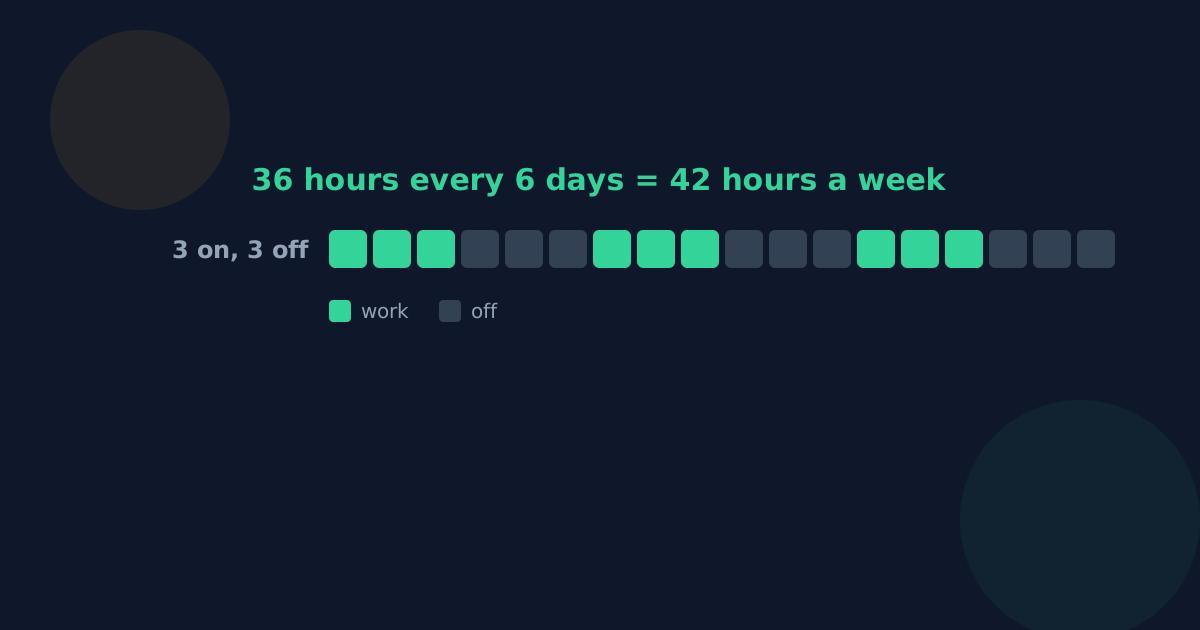
Add up the days in one full repeat of the pattern, and count the work days in it. 3 on, 3 off is a 6-day cycle with 3 work days. 2 on, 2 off, 3 on, 2 off, 2 on, 3 off is a 14-day cycle with 7 work days.
Step 2: Hours per cycle and per week
- Hours per cycle = work days per cycle × hours per shift. 3 on, 3 off with 12-hour shifts is 36 hours every 6 days.
- Average hours per week = hours per cycle ÷ cycle length × 7. 36 ÷ 6 × 7 = 42 hours.
Step 3: Total for a set period
Divide the days in the period by the cycle length. 90 days of 3 on, 3 off is exactly 15 cycles: 15 × 3 = 45 shifts, and 45 × 12 = 540 hours.
When the period isn’t whole cycles
Take 28 days of 3 on, 3 off: 4 full cycles (24 days, 12 shifts) plus 4 leftover days. How many of those 4 are work days depends on where in the cycle the period starts:
- Starting on the first work day: 3 of the 4 leftover days are work days — 15 shifts, 180 hours.
- Starting on the first day off: only 1 is — 13 shifts, 156 hours.
The Rotating Shift Hours Calculator counts partial cycles from the first work day of the pattern and shows the long-run average alongside.
Simple on/off rotations compared
Any rotation with equal days on and off averages half the week’s days: 3.5 shifts, or 42 hours with 12-hour shifts.
| Rotation | Cycle | Work days per cycle | Hours per cycle (12 h) | Average week |
|---|---|---|---|---|
| 2 on, 2 off | 4 days | 2 | 24 | 42 hours |
| 3 on, 3 off | 6 days | 3 | 36 | 42 hours |
| 4 on, 3 off | 7 days | 4 | 48 | 48 hours |
| 5 on, 5 off | 10 days | 5 | 60 | 42 hours |
| 7 on, 7 off | 14 days | 7 | 84 | 42 hours |
From weekly average to a year
Multiply the average week by 365 ÷ 7. 42 hours a week comes to 2,190 hours in a 365-day year — the same as 182.5 twelve-hour shifts.
Hours on a Rotating Schedule FAQ
- How do I calculate hours on a rotating schedule?
- Find the cycle length and the work days in it, multiply the work days by the hours per shift, and scale by the number of cycles in your period.
- How many hours a week is 3 on, 3 off with 12-hour shifts?
- 42 on average: 36 hours every 6 days × 7 ÷ 6.
- What if my period ends partway through a cycle?
- Count the full cycles, then count the work days in the leftover days from where your period starts in the pattern.
- How many hours a year is a 42-hour average week?
- About 2,190 hours in a 365-day year (42 × 365 ÷ 7).
- Does the order of blocks matter?
- Not for whole cycles. It only matters for a period that ends partway through a cycle.
Related guides
- Rotating Patterns ComparedThe 2-2-3 Panama, DuPont, 4-on-4-off, 24/48, and 5/2 rotations side by side: cycle length, work days, longest stretches, and average hours.
- Why Weekly Hours VaryWhy rotations don’t match a 7-day week, the week-by-week hours for 2-2-3 and DuPont, and what that means for pay periods and averages.
Open the tool
Jump into Rotating Shift Hours Calculator when you are ready to process your files.