Shipping & packaging
Why Pallet Cube Utilization Rarely Reaches 100%
A pallet can look completely loaded and still use well under its whole cube. The shortfall comes from three places, and each one can be measured.
Ready to try the tool this guide describes?
The height remainder
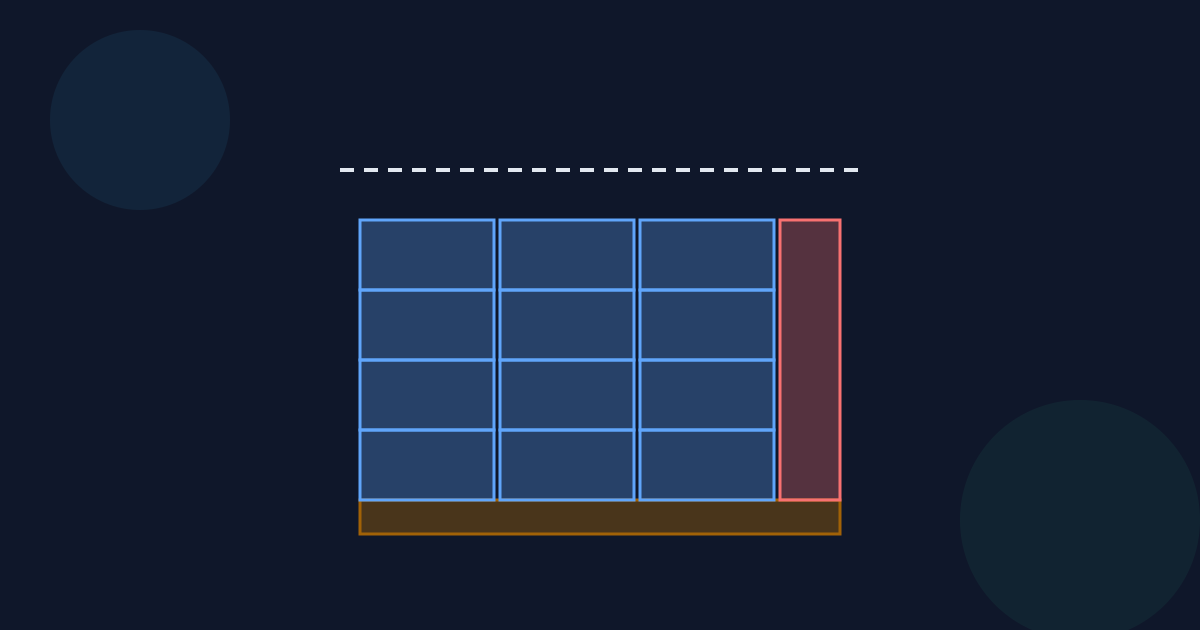
Layers come in whole carton heights. With 54 in of allowance and 10 in cartons, 5 layers reach 50 in and leave 4 in that no layer fits into — 7.41% of the cube is gone before anything else.
The footprint remainder
A carton footprint rarely divides a deck exactly. On a 48 × 40 in deck, 15 × 11 in cartons fit 9 to a layer facing one way, covering 77.34% of the deck. A two-block pattern — two rows lengthwise, the rest turned — fits 10 and covers 85.94%.
The effects multiply
Cube utilization is the deck share times the height share. Ten cartons covering 85.94% of the deck, stacked to 50 of 54 in, use 79.57% of the cube. With the one-way pattern of 9, the same stack uses 71.61%.
The numbers together
| 15 × 11 × 10 in cartons on 48 × 40 in | Deck covered | Height used | Cube used |
|---|---|---|---|
| 9 per layer, one way, 5 layers | 77.34% | 50 of 54 in | 71.61% |
| 10 per layer, two-block, 5 layers | 85.94% | 50 of 54 in | 79.57% |
Gaps you didn’t plan
Hand-stacked cartons sit slightly apart, and bulging cartons push the outline out. Those gaps show up when you compare the cartons’ own volume with the load’s outline, not in either figure alone.
What you can change
- The carton size, so footprints tile the deck and heights divide the allowance.
- The layer pattern, to recover a row the one-way pattern wastes.
- Nothing, sometimes: a product’s carton may be fixed, and a known shortfall is still useful for planning space.
Why Pallet Cube Stays Under 100% FAQ
- Is 100% pallet cube utilization possible?
- Only when the carton footprint tiles the deck exactly and the carton height divides the allowance exactly — for example 16 × 12 × 9 in cartons, 10 to a 48 × 40 in layer, six layers under 54 in.
- Why does my load look full but measure under 80%?
- Usually a mix of an empty strip along the deck, unused height under the limit, and gaps between cartons. Each one is small; together they add up.
- Does a mixed layer pattern improve cube utilization?
- It can. With 15 × 11 in cartons on a 48 × 40 in deck, a two-block pattern fits 10 instead of 9, raising cube use from 71.61% to 79.57% over five layers.
- Does the same thing happen in a container?
- Yes, on a larger scale: floor patterns leave strips along the walls and layers stop short of the ceiling, so the cargo rarely fills the whole inside volume.
- Should I always aim for the highest utilization?
- Not at any cost. Stability, carton strength, and handling come first; utilization tells you how much space that choice uses.
Related guides
- Calculating Pallet Cube UtilizationFind the cube available above a pallet deck under your height limit, measure what the load fills, and turn it into a utilization percentage.
- Carton Volume vs Load EnvelopeTwo ways to measure how much of a pallet’s cube a load uses — its outer envelope or the cartons’ own volume — and what the gap between them means.
Open the tool
Jump into Pallet Cube Utilization Calculator when you are ready to process your files.