Work, pay & shifts
Why Contractor Rates Are Higher Than Salary Hourly Pay
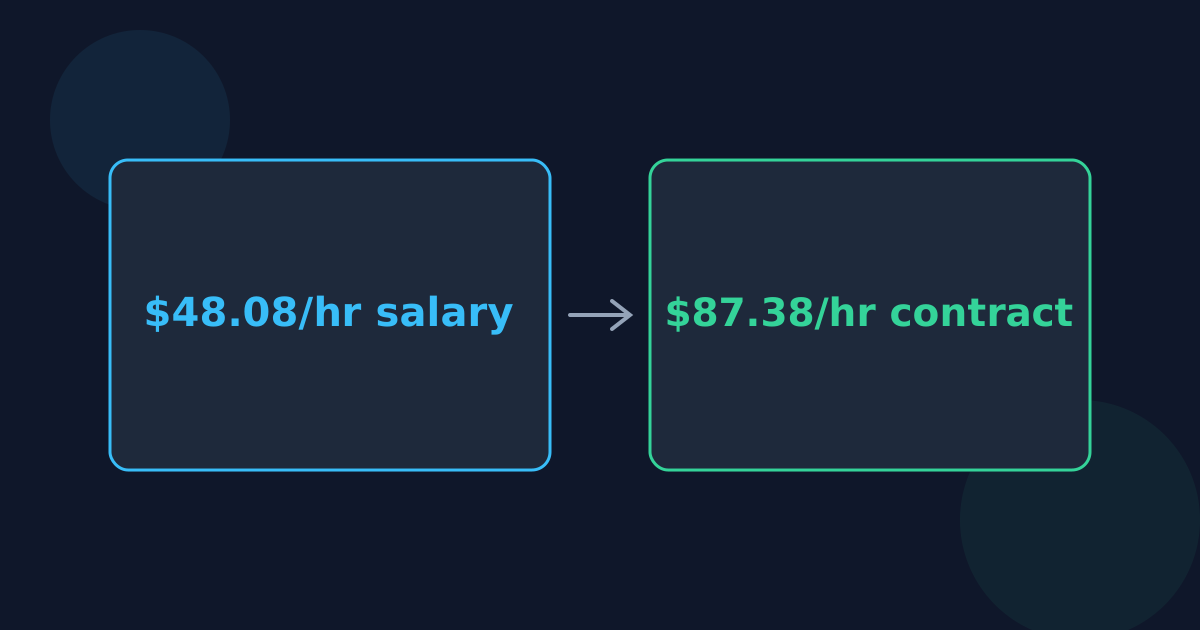
A $100,000 salary is $48.08 an hour over a standard 2,080-hour year. A contractor doing the same job often charges far more — and isn’t necessarily earning more. This guide adds up the difference one piece at a time.
Ready to try the tool this guide describes?
Salary ÷ 2,080 is only the salary
$100,000 ÷ 2,080 hours = $48.08 an hour. That is the employee’s pay per paid hour, including paid holidays. It leaves out everything the employer pays on top, and assumes every week of the year is paid.
Adding up the difference
Starting from a $100,000 salary and 40-hour weeks, with 6 unbilled weeks as a contractor:
| What’s included | Contract rate | Against $48.08 |
|---|---|---|
| Salary, over 46 billed weeks | $54.35/hr | 1.13× |
| + $15,000 of benefits | $62.50/hr | 1.3× |
| + 4% retirement and 7.65% employer costs | $68.84/hr | 1.43× |
| + $10,000 of overhead | $74.27/hr | 1.54× |
| + only 85% of hours billable | $87.38/hr | 1.82× |
Each line includes everything above it. The biggest single steps here are unbilled time and benefits.
Why a single multiplier misleads
Rules of thumb like “charge 1.5×” or “double your salary rate” hide all of these assumptions. In this example the honest answer ranges from 1.13× to 1.82× depending on what is counted — and adding a profit margin pushes it higher still. Someone with generous employer benefits and long gaps between contracts needs a much higher multiple than someone with few benefits and back-to-back work.
What the employee really earns per hour worked
An employee with 4 weeks of paid leave works 48 weeks but is paid for 52. Per hour actually worked, $100,000 is $52.08, not $48.08 — one more reason the like-for-like comparison is wider than it first looks.
Contractor vs Salary Hourly FAQ
- Is 1.5× a good rule of thumb for contract rates?
- It can be close for some situations and badly wrong for others. Working it out from your own benefits, costs, and billable hours is more reliable.
- Do contractors earn more than employees?
- Sometimes, sometimes not. A higher hourly rate has to pay for benefits, overhead, and unpaid weeks first; what is left over is the real comparison.
- Why do agencies charge clients even more?
- An agency’s rate adds its own margin and costs on top of what the contractor is paid.
- What costs does an employer pay on top of salary?
- Commonly benefits such as health cover, retirement contributions, the employer’s share of payroll taxes, and paid leave, along with equipment and training.
- Why is unbilled time such a big factor?
- Every week without billing has to be paid for by the weeks with it. Going from 52 paid weeks to 46 billed ones, and from 100% to 85% billable time, raises the rate needed by about a third.
Related guides
- Salary to Contract RateConvert an annual salary into an hourly contract rate step by step: what the job is really worth, the hours you can bill as a contractor, and how to compare a contract offer.
- Margin vs MarkupA 20% margin and a 20% markup give different contract rates. The two formulas, a comparison table at 10% to 50%, how to convert between them, and which one a quote is using.
Open the tool
Jump into Salary-to-Contract Rate Calculator when you are ready to process your files.