Work, pay & shifts
How to Convert a Salary to a Contract Rate
Switching from a salaried job to contracting — or weighing a contract offer against a permanent one — means comparing an annual salary with an hourly rate that carries none of the employer’s costs. This guide converts one into the other in steps, using your own figures rather than a rule of thumb.
Ready to try the tool this guide describes?
What the salaried job is worth
| Part | A year |
|---|---|
| Salary | $100,000.00 |
| Employer-paid benefits | $15,000.00 |
| Retirement contribution (4%) | $4,000.00 |
| Other employer costs (7.65%) | $7,650.00 |
| Compensation to replace | $126,650.00 |
“Other employer costs” here stands for the employer’s share of payroll taxes; use whatever applies to you.
Hours you can bill as a contractor
Start from 52 weeks and take off the weeks you won’t bill — holidays, vacation, sickness, and gaps between contracts. 6 weeks leaves 46. At 40 hours a week, if 85% of working time is billable, that is 46 × 40 × 85% = 1,564 billable hours.
From cost to rate
- Replace pay and benefits: $126,650 ÷ 1,564 hours = $80.98 an hour.
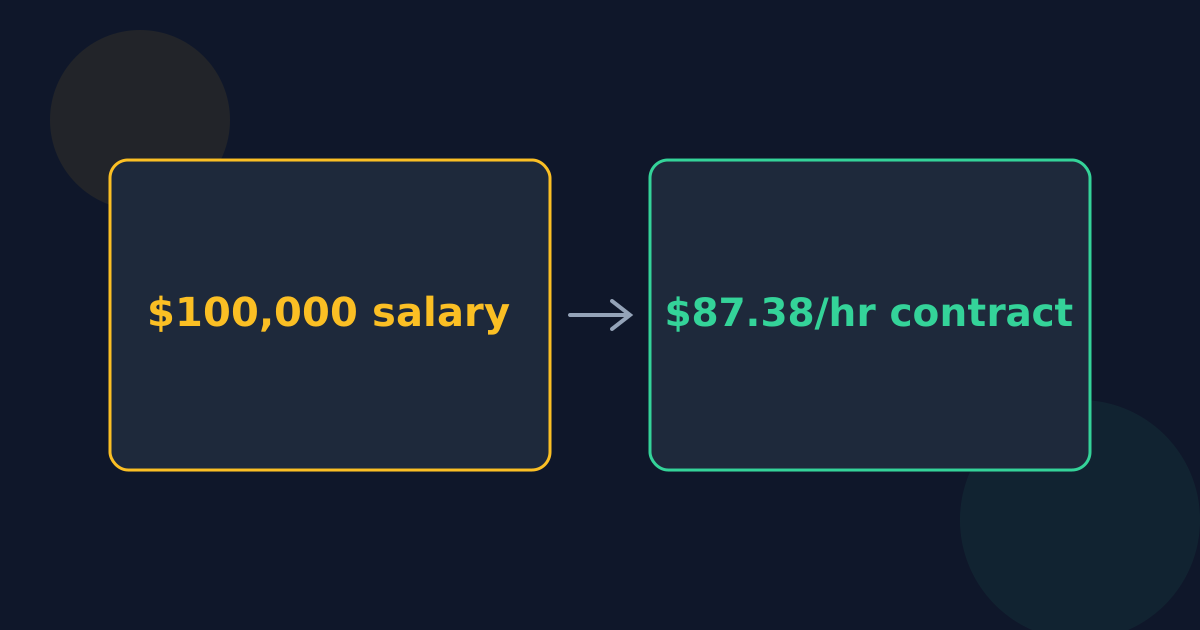
- Add self-employment overhead — insurance, equipment, accounting — of $10,000: $136,650 ÷ 1,564 = $87.38 an hour.
- Optionally add a margin or markup for risk and profit.
Each rate is rounded up to the next cent so it covers the yearly total.
Comparing a contract offer
A contract at $75 an hour, over the same 1,564 billable hours, brings in $117,300 a year — less than the $136,650 the salaried job and its costs are worth here. A higher hourly figure isn’t automatically a better deal.
Salary to Contract Rate FAQ
- How many hours a year should I assume as a contractor?
- Your own estimate of weeks billed × hours a week × the billable share. For a full-time contractor, 1,500–1,800 is a common planning range, but gaps between contracts can lower it.
- Should I include paid holidays from my salaried job?
- They are already in the salary. What matters for the contract rate is that you won’t be paid for holidays as a contractor, so count them as unbilled weeks.
- Does this include tax?
- No. Taxes on contract income depend on where you live and how you contract, and are not calculated.
- How do I value my benefits?
- Use what your employer pays for them, from a total-compensation statement if you have one, or what equivalent cover would cost you to buy.
- Should I add a margin on top?
- Many contractors do, for the risk of gaps between contracts and to build savings. Decide whether you mean a margin or a markup — they give different rates.
Related guides
- Contractor vs Salary HourlySalary ÷ 2,080 hours leaves out benefits, employer costs, overhead, and unbilled time. See each one added in turn, and why a single contractor multiplier can mislead.
- Margin vs MarkupA 20% margin and a 20% markup give different contract rates. The two formulas, a comparison table at 10% to 50%, how to convert between them, and which one a quote is using.
Open the tool
Jump into Salary-to-Contract Rate Calculator when you are ready to process your files.