Work, pay & shifts
Margin vs Markup for Contract Rates
“Add 20%” is ambiguous. As a markup, 20% is added on top of cost; as a margin, 20% of the final rate is left over after cost. The two give different rates, and confusing them is a common way to underprice. This guide sets out both and how to move between them.
Ready to try the tool this guide describes?
Two formulas
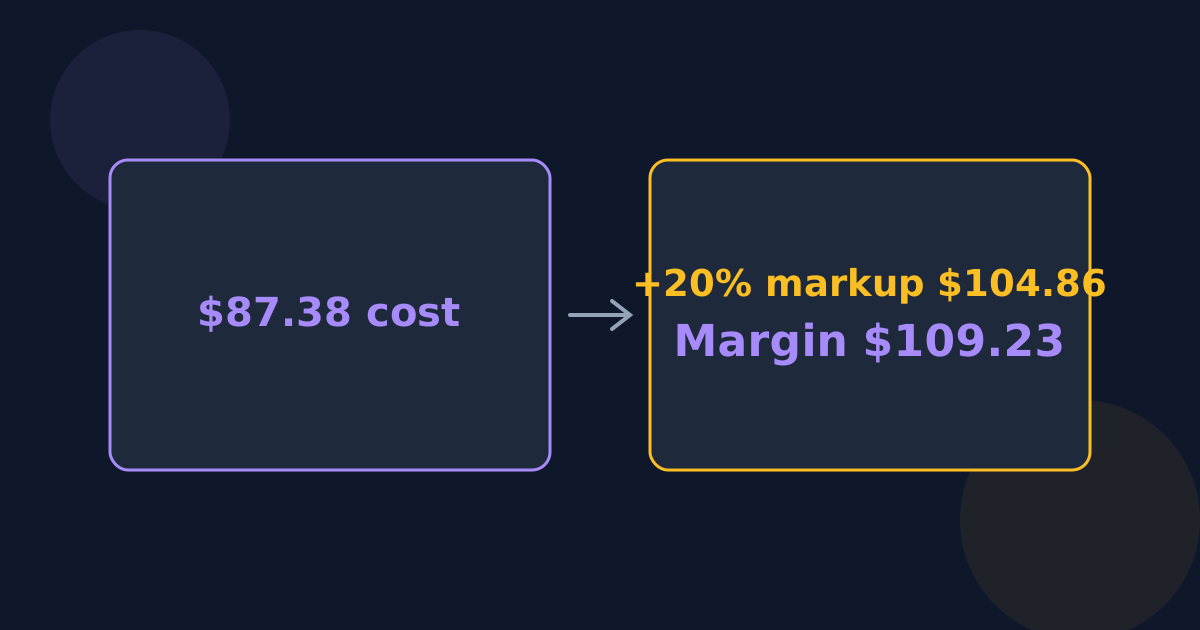
- Markup: rate = cost × (1 + markup). A 20% markup on $87.38 is $104.86.
- Margin: rate = cost ÷ (1 − margin). A 20% margin on $87.38 needs $109.23 — and 20% of $109.23 is the $21.85 left after cost.
The same percentage, two rates
A cost rate of $87.38 an hour:
| Percentage | As a markup | As a margin |
|---|---|---|
| 10% | $96.12/hr | $97.09/hr |
| 20% | $104.86/hr | $109.23/hr |
| 25% | $109.23/hr | $116.51/hr |
| 50% | $131.07/hr | $174.76/hr |
Rates are rounded up to the next cent. A 25% markup and a 20% margin give the same rate.
Converting between them
- Margin = markup ÷ (1 + markup): a 25% markup is a 20% margin.
- Markup = margin ÷ (1 − margin): a 20% margin is a 25% markup.
- A margin can never reach 100% — that would need an infinite rate. A markup can be any size.
Which one is being quoted?
Agencies and finance teams usually talk in margins, because a margin is a share of revenue. Pricing rules of thumb (“cost plus 20%”) are usually markups. When someone names a percentage, ask which one — at 50% the difference is more than $40 an hour in this example.
Margin isn’t take-home profit
The margin here is what remains after the costs you entered. Tax, unbilled time you didn’t plan for, and late payments still come out of it.
Margin vs Markup FAQ
- Is a 20% margin the same as a 20% markup?
- No. On a $87.38 cost, a 20% markup gives $104.86 and a 20% margin gives $109.23. A 20% margin equals a 25% markup.
- Can a margin be more than 100%?
- No. A margin is a share of the price, so it must be less than 100%. Markups can be larger.
- Which should I use for a contract rate?
- Either, as long as you know which. If you think in “what share of my rate is buffer”, use margin; if you think in “how much to add to cost”, use markup.
- How do I turn a markup into a margin?
- Divide the markup by one plus the markup: 25% ÷ 1.25 = a 20% margin.
- Why does a margin give a higher rate than the same markup?
- A margin is measured against the final rate, which is larger than the cost, so it takes a bigger addition to cost for the same percentage.
Related guides
- Salary to Contract RateConvert an annual salary into an hourly contract rate step by step: what the job is really worth, the hours you can bill as a contractor, and how to compare a contract offer.
- Contractor vs Salary HourlySalary ÷ 2,080 hours leaves out benefits, employer costs, overhead, and unbilled time. See each one added in turn, and why a single contractor multiplier can mislead.
Open the tool
Jump into Salary-to-Contract Rate Calculator when you are ready to process your files.