Calculators & everyday math
How to Decrease a Number by a Percentage
Taking a percentage off a number is the mirror image of adding one: find the amount and subtract it, or multiply by a single factor. This guide covers both methods, what repeated cuts add up to, and how to reverse a decrease correctly.
Ready to try the tool this guide describes?
Two steps: find the decrease, then subtract it
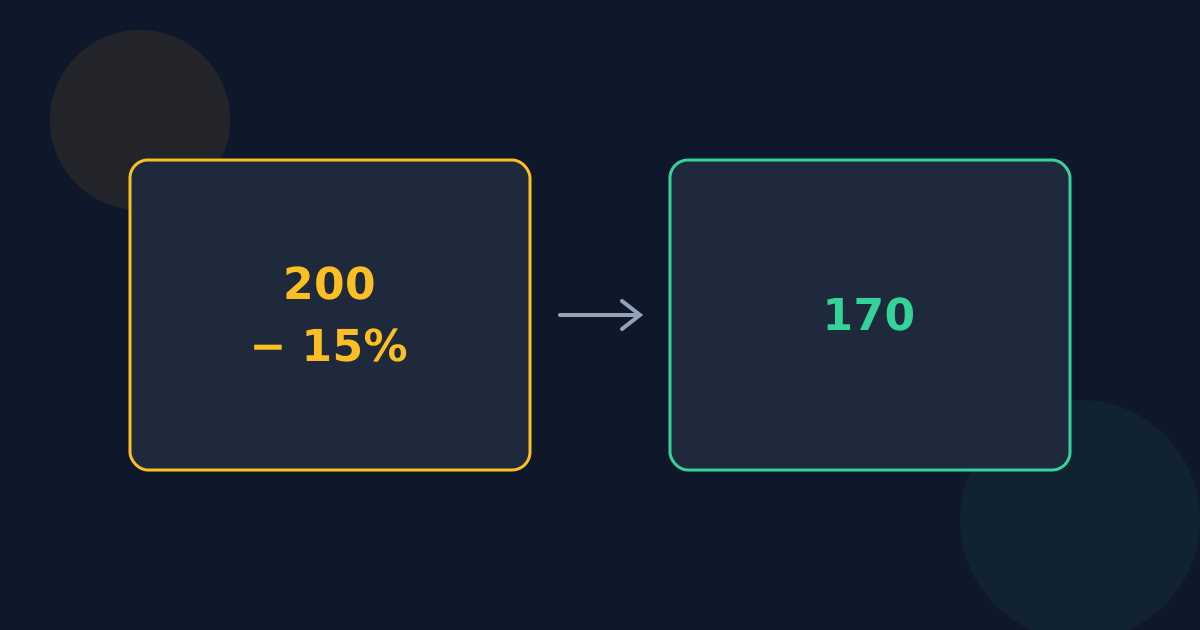
- Find the percentage of the starting value: 15% of 200 is 30.
- Subtract it: 200 − 30 = 170.
One step: use a multiplier
Decreasing by a percentage is multiplying by 1 − percentage ÷ 100. A 15% decrease multiplies by 0.85, and a 40% decrease by 0.6, so 200 × 0.85 = 170. The multiplier also tells you what is left: after a 15% cut, 85% remains.
| Decrease | Multiply by | 200 becomes |
|---|---|---|
| 5% | 0.95 | 190 |
| 12.5% | 0.875 | 175 |
| 25% | 0.75 | 150 |
| 50% | 0.5 | 100 |
| 90% | 0.1 | 20 |
| 100% | 0 | 0 |
Several decreases in a row
Chained decreases multiply too. Two 10% cuts multiply by 0.9 × 0.9 = 0.81 — a 19% decrease overall, not 20%. Each new cut is taken of an already smaller number, so repeated decreases remove less than adding up the percentages suggests.
Reversing a decrease
To find the value before a known decrease, divide by the multiplier: if 170 is what remains after a 15% cut, the start was 170 ÷ 0.85 = 200. Adding 15% to 170 would give 195.5 — the wrong answer, because the 15% was taken of 200, not 170.
Decrease by a Percentage FAQ
- What is the formula to decrease a number by a percentage?
- New value = starting value × (1 − percentage ÷ 100). For 200 and 15%: 200 × 0.85 = 170.
- How do I take 30% off a number?
- Multiply it by 0.7. 30% off 90 is 90 × 0.7 = 63.
- Are two 10% decreases the same as one 20% decrease?
- No, together they make 19%: 100 becomes 90 and then 81.
- What does a 100% decrease give?
- Zero. A decrease of more than 100% gives a negative number, which only makes sense for quantities that can go below zero.
- How do I find the original number before a percentage decrease?
- Divide what remains by 1 − the percentage ÷ 100. 63 after a 30% decrease came from 63 ÷ 0.7 = 90.
Related guides
- Why Decreases Don’t Undo IncreasesWhy going up 25% and then down 25% leaves you lower than you started, how big the gap gets, and the percentage that really reverses a change.
- Percentage Decrease ExamplesWorked percentage decreases for budgets, prices, and time, what a 100% decrease means, and when a decrease of more than 100% is real or a mistake.
Open the tool
Jump into Percentage Decrease Calculator when you are ready to process your files.