Work, pay & shifts
Unpaid Days in a Salaried Pay Period
Unpaid leave inside a salaried pay period — a few days off without pay, a gap between two jobs, an unpaid holiday — leaves the period short. The arithmetic is the same proration used for a start or end date, applied to the days that are paid. This guide shows what one unpaid day is worth under each common method, how to handle half days and leave that spans two periods, and where the arithmetic stops and policy begins.
Ready to try the tool this guide describes?
Count the days that are paid
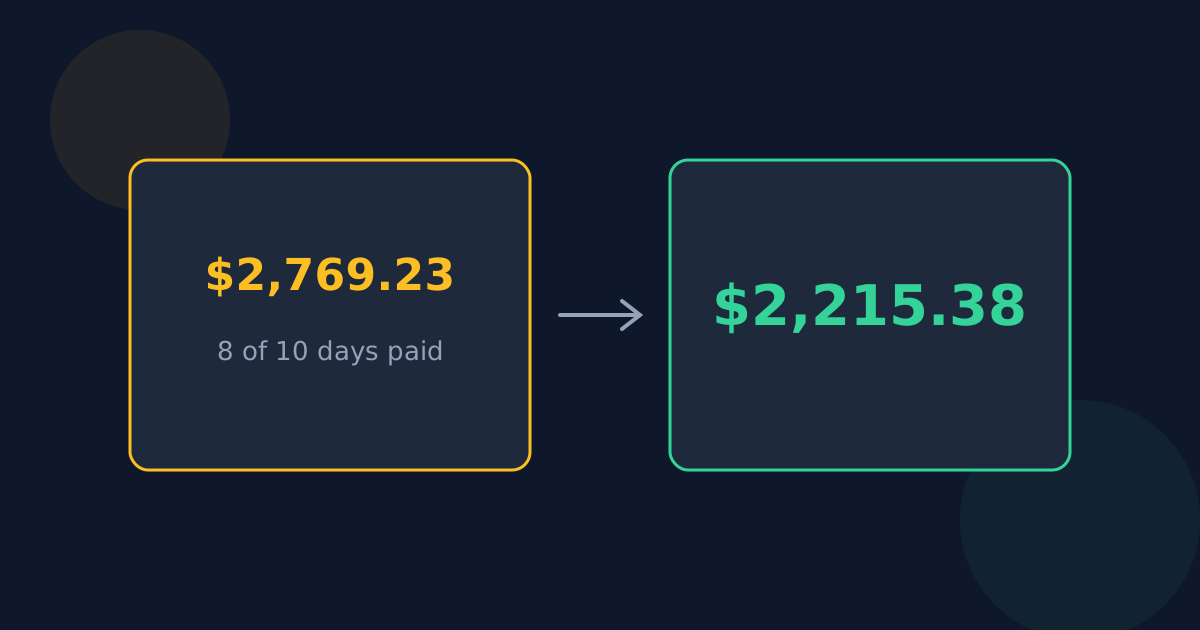
Prorate on the paid days, not the missing ones: working days in the period minus unpaid days. On a $72,000 salary paid biweekly ($2,769.23 a period, 10 working days), 2 unpaid days leave 8 paid days: $2,769.23 × 8 ÷ 10 = $2,215.38, so $553.85 is not earned.
What one unpaid day is worth
Under the share-of-period method, the value of a day depends on how many working days the period has. Under the annual daily rate it is always salary ÷ 260. On $72,000 a year:
| Period | Working days | One day, share of period | One day, salary ÷ 260 |
|---|---|---|---|
| Biweekly ($2,769.23) | 10 | $276.92 | $276.92 |
| Semimonthly ($3,000.00) | 10 | $300.00 | $276.92 |
| Semimonthly ($3,000.00) | 12 | $250.00 | $276.92 |
| Monthly ($6,000.00) | 21 | $285.71 | $276.92 |
| Monthly ($6,000.00) | 23 | $260.87 | $276.92 |
Half days and hours
A half day is half of a day in either method, so it can be entered as 0.5 days. If the period is counted in hours, prorate those instead: 4 unpaid hours in an 80-hour biweekly period leave 76 of 80 hours, or $2,769.23 × 76 ÷ 80 = $2,630.77.
Leave that spans two periods
Each period is prorated on its own. Three unpaid days — the last day of one biweekly period and the first two of the next — make one period 9 of 10 days ($2,492.31) and the next 8 of 10 ($2,215.38). Adding the days together and prorating once would only work if both periods had the same number of working days.
Where the arithmetic ends
Whether an employer may reduce a salary for days not worked, and in what amounts, depends on how the job is classified and on the law and agreements that apply where you work. This guide covers only the calculation; it doesn’t say whether a deduction is allowed.
Unpaid Days on a Salary FAQ
- How much is one unpaid day on a salary?
- Either the period salary ÷ working days in the period, or annual salary ÷ 260, depending on your employer’s method. On $72,000 paid biweekly both give $276.92.
- Is an unpaid day worth the same in every pay period?
- Only with a fixed daily rate. With the share-of-period method it changes with the number of working days in each semimonthly or monthly period.
- How do I count a half day of unpaid leave?
- As 0.5 days, or as the unpaid hours if the period is measured in hours.
- What if unpaid leave falls across two pay periods?
- Prorate each period separately with the days that fall in it.
- Can an employer deduct unpaid days from a salary?
- That depends on the job’s classification and the rules where you work. This guide shows the arithmetic only.
Related guides
- Salary per Pay PeriodDivide an annual salary into weekly, biweekly, semimonthly, or monthly pay, why biweekly and semimonthly differ, and what a 27-paycheck year does.
- Salary Proration MethodsShare of the pay period, salary ÷ 260 working days, and salary ÷ 2,080 hours on the same partial periods — why they disagree and by how much.
Open the tool
Jump into Partial Pay Period Salary Calculator when you are ready to process your files.