Work, pay & shifts
How to Calculate Salary per Pay Period
An offer letter states a salary per year, but pay arrives per period — and the number of periods depends on how often you’re paid. This guide divides an annual salary into weekly, biweekly, semimonthly, and monthly amounts, explains why biweekly and semimonthly are not the same thing, and covers the rounding and 27-paycheck years that make the per-period figure slightly uneven.
Ready to try the tool this guide describes?
Pay periods in a year
The gross salary for one period is the annual salary divided by the number of periods in a year, rounded to the cent. The frequency is usually printed on your pay stub or in your employment paperwork.
| Frequency | Paychecks a year | $60,000 a year | $85,000 a year |
|---|---|---|---|
| Weekly | 52 | $1,153.85 | $1,634.62 |
| Biweekly (every two weeks) | 26 | $2,307.69 | $3,269.23 |
| Semimonthly (twice a month) | 24 | $2,500.00 | $3,541.67 |
| Monthly | 12 | $5,000.00 | $7,083.33 |
Biweekly is not twice a month
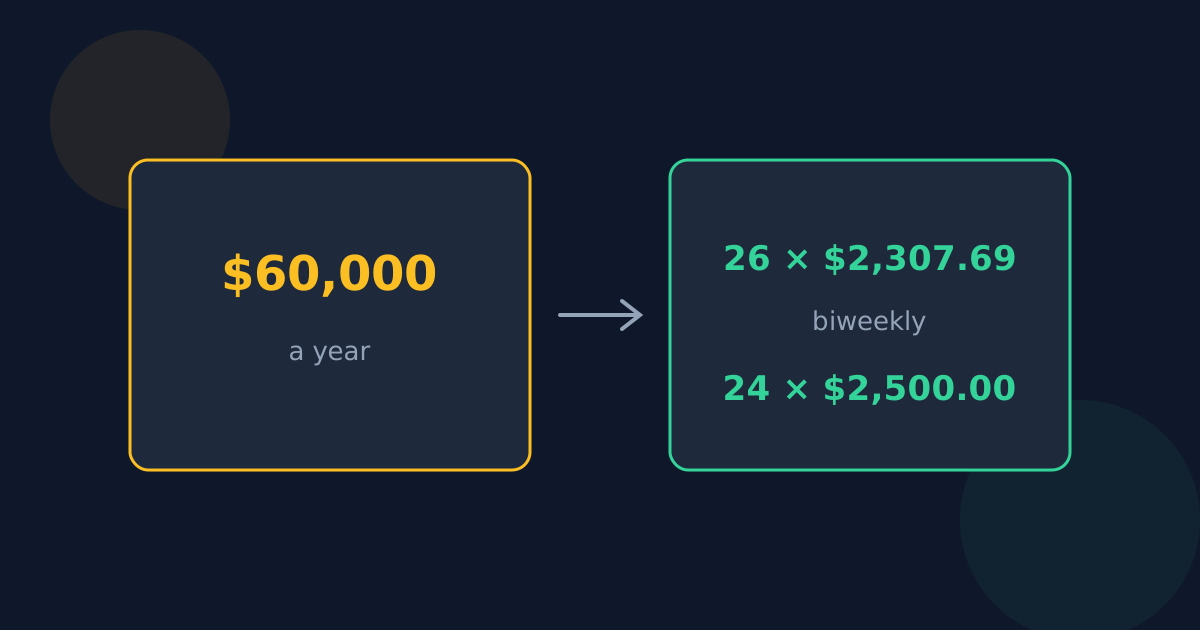
Biweekly pay comes every 14 days, on the same weekday, so there are 26 paychecks a year. Semimonthly pay comes on two fixed dates each month, such as the 15th and the last day, so there are 24. The same $60,000 salary is $2,307.69 per biweekly check but $2,500.00 per semimonthly check, because it is split 26 ways instead of 24.
Biweekly paydays drift through the calendar, so most years have two months with three paychecks. The salary per check doesn’t change in those months; there are just more checks.
Rounding to the cent
Most salaries don’t divide evenly. $60,000 ÷ 26 is $2,307.6923…, which rounds to $2,307.69, and 26 checks of $2,307.69 add up to $59,999.94 — six cents short of the annual figure. How those cents are handled, if at all, depends on the payroll system; some add them to one check, others leave them.
Years with 27 biweekly paydays
A year is 365 or 366 days, one or two days longer than 26 two-week periods, so the paydays creep forward and roughly once every 11 years a calendar year contains 27 biweekly paydays.
Employers handle that year in different ways. If each check stays at salary ÷ 26, the year pays 27 × $2,307.69 = $62,307.63 on a $60,000 salary. If the salary is spread over 27 checks instead, each one is $60,000 ÷ 27 = $2,222.22. Which approach applies is set by the employer’s payroll policy.
Salary per Pay Period FAQ
- How much is $60,000 a year biweekly?
- $60,000 ÷ 26 = $2,307.69 per paycheck before taxes and deductions.
- How many paychecks are there in a year with biweekly pay?
- Usually 26, and occasionally 27 when the calendar fits an extra payday into the year.
- Is semimonthly pay the same as biweekly pay?
- No. Semimonthly is twice a month on set dates (24 checks a year); biweekly is every two weeks (26 checks a year).
- How do I turn a monthly salary into an annual one?
- Multiply by 12. A $5,000.00 monthly salary is $60,000 a year.
- Why don’t my paychecks add up exactly to my salary?
- Each check is rounded to the cent. 26 checks of $2,307.69 come to $59,999.94 on a $60,000 salary.
Related guides
- Salary Proration MethodsShare of the pay period, salary ÷ 260 working days, and salary ÷ 2,080 hours on the same partial periods — why they disagree and by how much.
- Unpaid Days on a SalaryThe arithmetic for unpaid days inside a salaried pay period: what one day is worth under each method, half days, and leave across two periods.
Open the tool
Jump into Partial Pay Period Salary Calculator when you are ready to process your files.