Work, pay & shifts
Salary Proration Methods Compared
When a salaried employee is paid for only part of a period, there are two common ways to work out the amount: take a share of that period’s salary, or price each day at a fixed daily rate from the annual salary. They sound equivalent and often aren’t. This guide runs both methods — and the hourly version — on the same days so you can see when they agree and how far apart they get.
Ready to try the tool this guide describes?
The methods
- Share of the period: period salary × days paid ÷ working days in the period.
- Annual daily rate: annual salary ÷ 260 working days × days paid. 260 is 52 weeks of 5 days.
- Annual hourly rate: annual salary ÷ 2,080 hours × hours paid. 2,080 is 52 weeks of 40 hours.
Six days on $60,000, period by period
Each row pays for 6 working days (3 in the weekly row) on a $60,000 salary. The daily-rate column is the same in every row — $230.77 a day — while the share-of-period column moves with the number of working days in the period.
| Period | Working days | Days paid | Share of the period | Salary ÷ 260 |
|---|---|---|---|---|
| Weekly | 5 | 3 | $692.31 | $692.31 |
| Biweekly | 10 | 6 | $1,384.61 | $1,384.62 |
| Semimonthly | 9 | 6 | $1,666.67 | $1,384.62 |
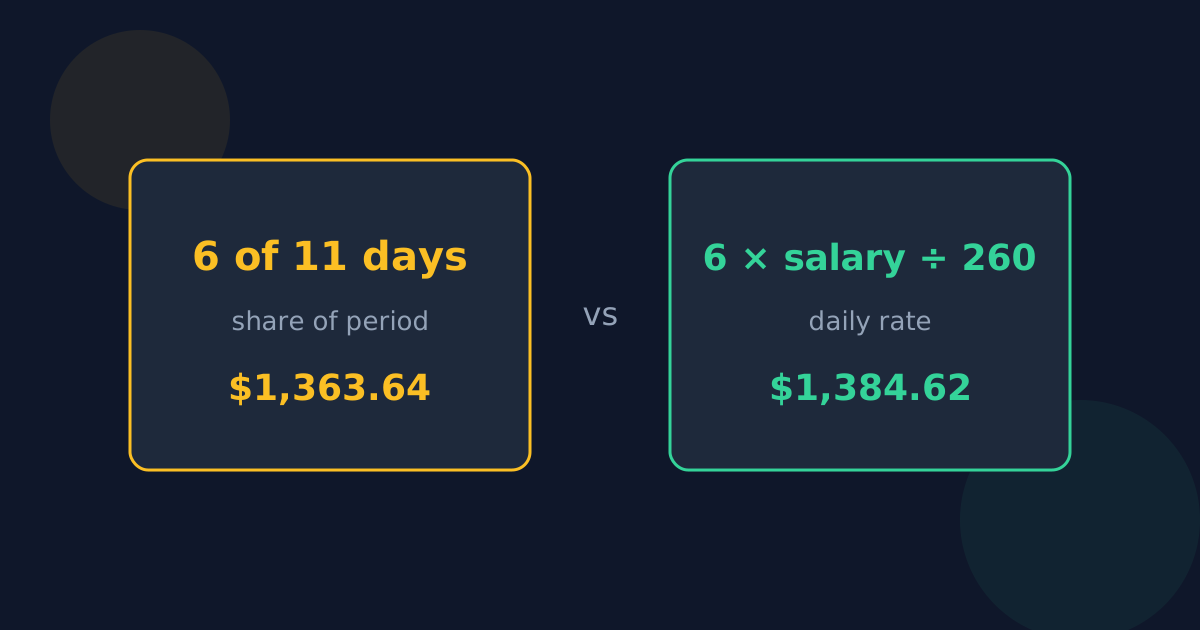
| Semimonthly | 11 | 6 | $1,363.64 | $1,384.62 |
| Semimonthly | 12 | 6 | $1,250.00 | $1,384.62 |
| Monthly | 20 | 6 | $1,500.00 | $1,384.62 |
| Monthly | 23 | 6 | $1,304.35 | $1,384.62 |
Why semimonthly and monthly periods disagree
Weekly and biweekly periods always contain the same number of working days, so a share of the period and a fixed daily rate land within a cent of each other. A semimonthly period, though, is $2,500.00 whether it has 9 working days or 12, so a day in it is worth anywhere from $277.78 to $208.33. The annual daily rate ignores the period and charges $230.77 every time.
That means the daily-rate method can even pay more than a full period: 12 working days at $230.77 is $2,769.23, more than the $2,500.00 semimonthly salary. Employers that use a daily rate typically use it only for partial periods for that reason.
Prorating by hours
A $52,000 salary is $25.00 an hour at ÷ 2,080. In a biweekly period of 80 scheduled hours, 60 hours paid gives $1,500.00 either way. In a semimonthly period of 88 scheduled hours ($2,166.67), 48 hours paid is $1,181.82 by share of the period but $1,200.00 at $25.00 an hour.
For an 8-hour day the hourly method is the daily method in disguise: salary ÷ 2,080 × 8 is the same as salary ÷ 260.
Which one applies to you
There is no single standard. The method is set by the employer’s payroll policy, an employment contract, or a collective agreement, and some employers use other divisors (such as calendar days, or 261 working days in some years). If you’re checking a first or last paycheck, work out both figures: the actual amount is usually one of them, and the gap tells you how much the choice is worth.
Salary Proration Methods FAQ
- What is the most common way to prorate a salary?
- There isn’t one universal method. Share of the pay period and an annual daily rate (salary ÷ 260) are both widely used.
- Why divide an annual salary by 260?
- 260 is the number of weekdays in 52 weeks (52 × 5). It gives a fixed value for one working day.
- Do the methods ever give the same answer?
- Yes — with weekly or biweekly pay and a normal 5-day week they agree to within a cent, because each period has a fixed number of working days.
- Can a daily-rate proration pay more than a full period’s salary?
- Yes, in a long semimonthly or monthly period. 12 days at $60,000 ÷ 260 is $2,769.23, more than a $2,500.00 semimonthly salary.
- Is dividing by 2,080 hours different from dividing by 260 days?
- Not for 8-hour days: 8 hours at salary ÷ 2,080 equals one day at salary ÷ 260. They differ only when days aren’t 8 hours.
Related guides
- Salary per Pay PeriodDivide an annual salary into weekly, biweekly, semimonthly, or monthly pay, why biweekly and semimonthly differ, and what a 27-paycheck year does.
- Unpaid Days on a SalaryThe arithmetic for unpaid days inside a salaried pay period: what one day is worth under each method, half days, and leave across two periods.
Open the tool
Jump into Partial Pay Period Salary Calculator when you are ready to process your files.