Calculators & everyday math
Simple vs. Compound Interest: How They Differ
Simple interest is paid only on the original amount. Compound interest is also paid on interest that has already been added, so it grows faster the longer it runs. This guide compares the two side by side and shows where each one appears.
Ready to try the tool this guide describes?
The two formulas
P is the starting amount, r the annual rate as a decimal, and t the number of years.
- Simple interest: I = P × r × t. The balance grows by the same amount every year.
- Compound interest (once a year): A = P × (1 + r)^t. Each year’s interest is added to the balance and earns interest itself.
$1,000 at 5%, side by side
| Years | Simple interest balance | Compound balance (annual) |
|---|---|---|
| 1 | $1,050.00 | $1,050.00 |
| 5 | $1,250.00 | $1,276.28 |
| 10 | $1,500.00 | $1,628.89 |
| 20 | $2,000.00 | $2,653.30 |
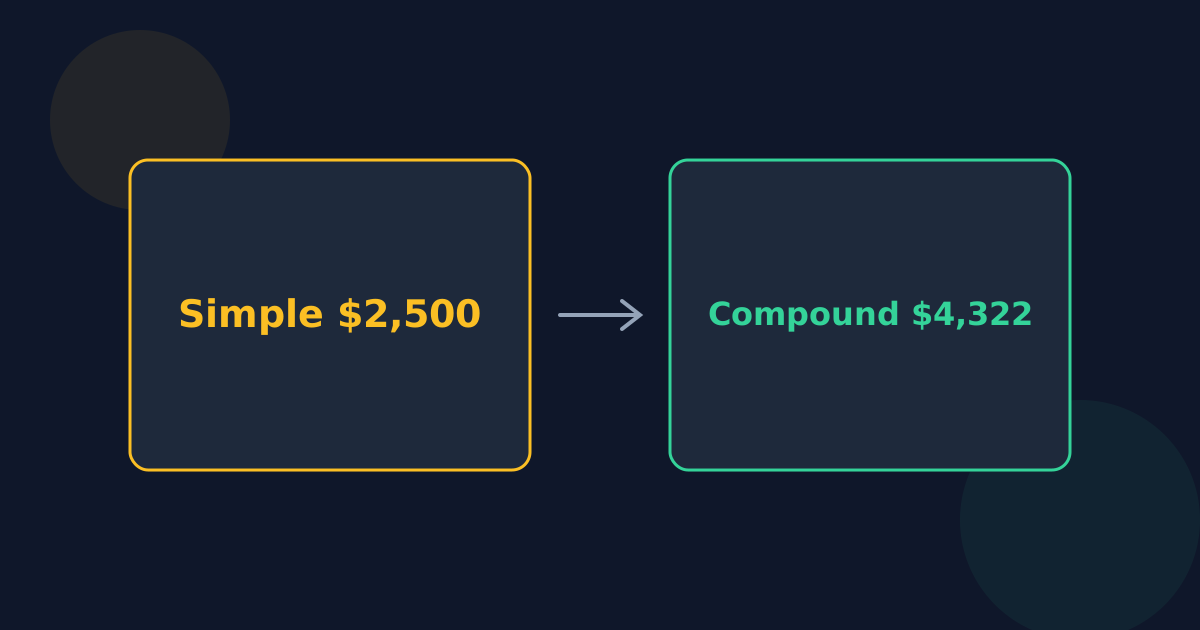
| 30 | $2,500.00 | $4,321.94 |
After one year they match; after 30 years compound interest has earned more than twice as much interest.
Where each one is used
- Simple interest appears where interest is paid out rather than added to the balance — for example, a bond that pays its interest in cash.
- Savings accounts and certificates of deposit usually compound, adding interest to the balance.
- Loan balances also compound when unpaid interest is added to what is owed.
The rule of 72
A quick estimate of how long compound growth takes to double: divide 72 by the annual rate. At 5%, 72 ÷ 5 = 14.4 years; the exact answer with annual compounding is 14.21 years. Simple interest at 5% takes exactly 20 years to double.
Simple vs. Compound Interest FAQ
- What is the difference between simple and compound interest?
- Simple interest is calculated on the starting amount only; compound interest is calculated on the starting amount plus interest already added.
- Are they ever equal?
- For a single compounding period, yes — after one year with annual compounding both give the same result.
- How long does money take to double at 5%?
- About 14.2 years with annual compounding, and 20 years with simple interest.
- Is the rule of 72 exact?
- No. It is a quick estimate that works best for moderate rates, roughly 4% to 12%, and drifts further from the exact answer outside that range.
- Does the Compound Interest Calculator do simple interest?
- No. For simple interest, multiply the starting amount by the rate and the years; the Percentage Calculator can help with the rate step.
Related guides
- Compounding FrequencyAnnual, quarterly, monthly, and daily compounding compared, the effective annual rate, and why more frequent compounding adds less each step.
- Compound Interest FormulaEach part of A = P(1 + r/n)^(nt), a step-by-step example, rearranging it to find the starting amount or the time, and common mistakes.
Open the tool
Jump into Compound Interest Calculator when you are ready to process your files.