Calculators & everyday math
How Compounding Frequency Changes Growth
The same annual rate grows a balance slightly faster when interest is added more often, because each addition starts earning interest sooner. The effect is real but shrinks quickly: daily compounding is only a little ahead of monthly. This guide shows the numbers and explains the effective annual rate.
Ready to try the tool this guide describes?
$10,000 at 6% for 10 years
| Compounded | Balance | Effective annual rate |
|---|---|---|
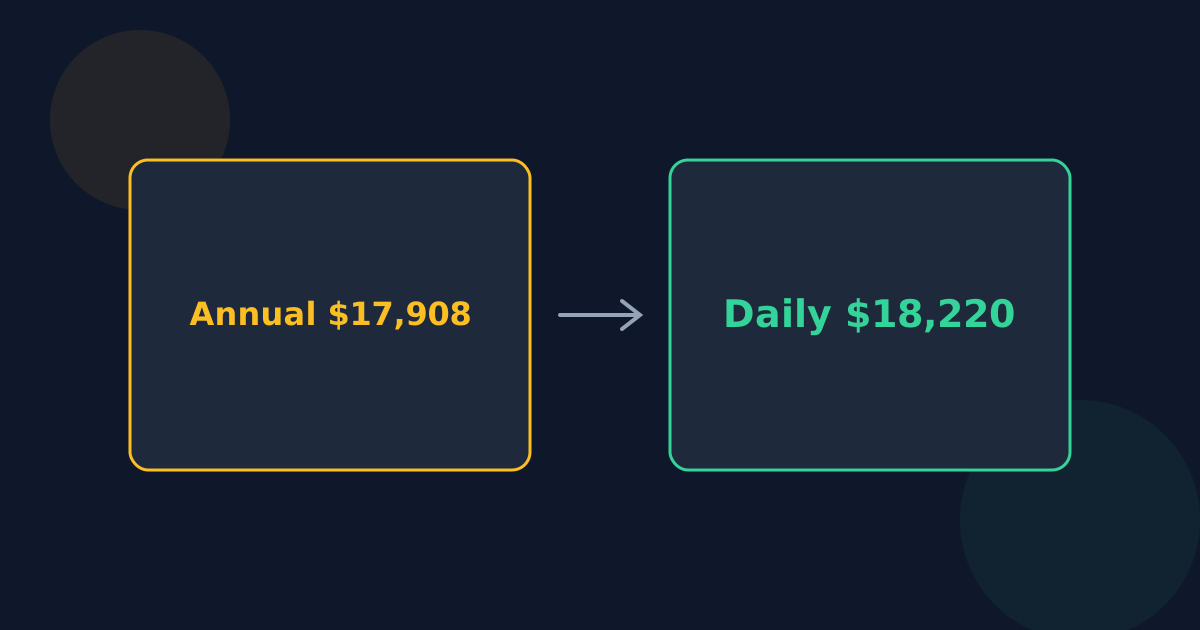
| Annually | $17,908.48 | 6% |
| Semiannually | $18,061.11 | 6.09% |
| Quarterly | $18,140.18 | 6.1364% |
| Monthly | $18,193.97 | 6.1678% |
| Daily (365) | $18,220.29 | 6.1831% |
Going from annual to monthly adds $285.49; going from monthly to daily adds only $26.32.
The effective annual rate
The effective annual rate is the once-a-year rate that gives the same growth: (1 + r/n)^n − 1. Bank savings products often quote it as the APY (annual percentage yield), while the stated rate before compounding is the nominal rate. Comparing effective rates puts accounts with different compounding schedules on equal terms.
The limit: continuous compounding
Compounding more and more often approaches a ceiling given by P × e^(rt). For $10,000 at 6% over 10 years that is $18,221.19 — just 90 cents more than daily compounding. The Compound Interest Calculator stops at daily compounding.
Higher rates widen the gap
At low rates the frequency barely matters; at high rates, such as some credit-card rates, it makes a noticeable difference.
| Nominal rate | Effective rate, monthly | Effective rate, daily |
|---|---|---|
| 2% | 2.0184% | 2.0201% |
| 5% | 5.1162% | 5.1267% |
| 10% | 10.4713% | 10.5156% |
| 20% | 21.9391% | 22.1336% |
Compounding Frequency FAQ
- Does daily compounding earn much more than monthly?
- Only a little. At 6% over 10 years, $10,000 earns $26.32 more with daily compounding than monthly.
- What is the difference between APR and APY?
- APR is a nominal annual rate; APY is the effective rate after compounding. APY is higher whenever interest compounds more than once a year.
- What is continuous compounding?
- The mathematical limit of compounding infinitely often, calculated as P × e^(rt).
- Why does frequency matter more at high rates?
- Each period’s interest is larger, so earning interest on it sooner makes a bigger difference.
- How many days does daily compounding use?
- The Compound Interest Calculator uses 365. Some institutions use 360 or 366 in leap years, which changes the result slightly.
Related guides
- Simple vs. Compound InterestHow simple and compound interest are calculated, how far apart they grow over time, where each is used, and the rule of 72.
- Compound Interest FormulaEach part of A = P(1 + r/n)^(nt), a step-by-step example, rearranging it to find the starting amount or the time, and common mistakes.
Open the tool
Jump into Compound Interest Calculator when you are ready to process your files.