Calculators & everyday math
The Compound Interest Formula Explained
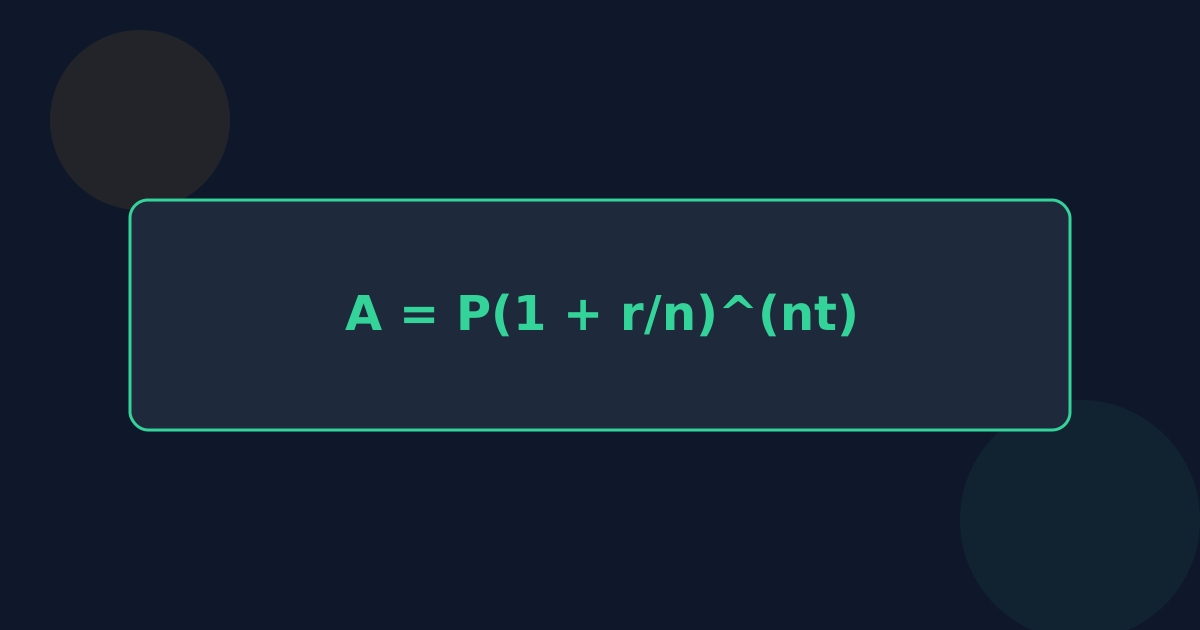
The compound interest formula, A = P(1 + r/n)^(nt), packs four inputs into one line. Once each piece makes sense, the formula can also be turned around to find the starting amount needed or the time a balance takes to grow. This guide walks through it and flags the most common mistakes.
Ready to try the tool this guide describes?
Each part of the formula
- A — the balance at the end.
- P — the principal, the starting amount.
- r — the annual interest rate as a decimal (4% is 0.04).
- n — how many times per year interest is added (12 for monthly).
- t — the time in years.
- r/n is the rate for each period, and nt is the total number of periods.
A worked example
$2,500 at 4% compounded quarterly for 6 years:
- Rate per quarter: r/n = 0.04 ÷ 4 = 0.01.
- Number of quarters: nt = 4 × 6 = 24.
- Growth factor: 1.01^24 = 1.2697346485.
- Balance: A = 2,500 × 1.2697346485 = $3,174.34, so the interest is $674.34.
Solving for the starting amount
Rearranged, P = A ÷ (1 + r/n)^(nt). To have $5,000 in 5 years at 4% compounded monthly, the growth factor is (1 + 0.04/12)^60 = 1.2209965939, so the starting amount is $5,000 ÷ 1.2209965939 = $4,095.02. This is often called the present value.
Solving for the time
Taking logarithms gives t = ln(A ÷ P) ÷ (n × ln(1 + r/n)). For a balance to double at 6% compounded monthly: t = ln 2 ÷ (12 × ln 1.005) = 11.58 years.
Common mistakes
- Using the percentage instead of the decimal: 5, not 0.05, gives a wildly wrong answer.
- Mixing periods: with monthly compounding both the rate division and the exponent use 12.
- Rounding r/n early: 0.04 ÷ 12 is 0.003333…, and cutting it to 0.0033 visibly changes a long-term result.
- Forgetting that A includes the principal: interest earned is A − P.
Compound Interest Formula FAQ
- What does n mean in the compound interest formula?
- The number of times interest is added per year: 1 for annually, 4 for quarterly, 12 for monthly, 365 for daily.
- How do I calculate only the interest?
- Work out A with the formula, then subtract P.
- Can t be a fraction of a year?
- Yes, mathematically. Many accounts only credit interest at the end of each full period, though.
- Does the formula include regular deposits?
- No. It covers a single starting amount. Regular deposits need a separate annuity formula.
- What is the formula for continuous compounding?
- A = P × e^(rt), the limit as n grows without bound.
Related guides
- Simple vs. Compound InterestHow simple and compound interest are calculated, how far apart they grow over time, where each is used, and the rule of 72.
- Compounding FrequencyAnnual, quarterly, monthly, and daily compounding compared, the effective annual rate, and why more frequent compounding adds less each step.
Open the tool
Jump into Compound Interest Calculator when you are ready to process your files.