Work, pay & shifts
Percentage vs. Flat-Rate Shift Differentials
Two job postings can offer “10% shift differential” and “$2.00 an hour shift differential” for the same evening shift. Which is worth more depends entirely on the base rate — and on what happens to it over time. This guide compares the two methods side by side, shows the break-even rate where they are equal, and walks through what changes after a raise.
Ready to try the tool this guide describes?
How each method works
- A flat differential adds the same dollar amount to every qualifying hour, whatever the base rate: $2.00 an hour is $2.00 whether you earn $15 or $40.
- A percentage differential is a share of the base rate, so it rises and falls with pay: 10% is $1.50 at $15.00 and $4.00 at $40.00.
The break-even rate
The two are equal when base rate × percentage ÷ 100 = flat amount. Rearranged, the break-even base rate is flat amount ÷ percentage × 100.
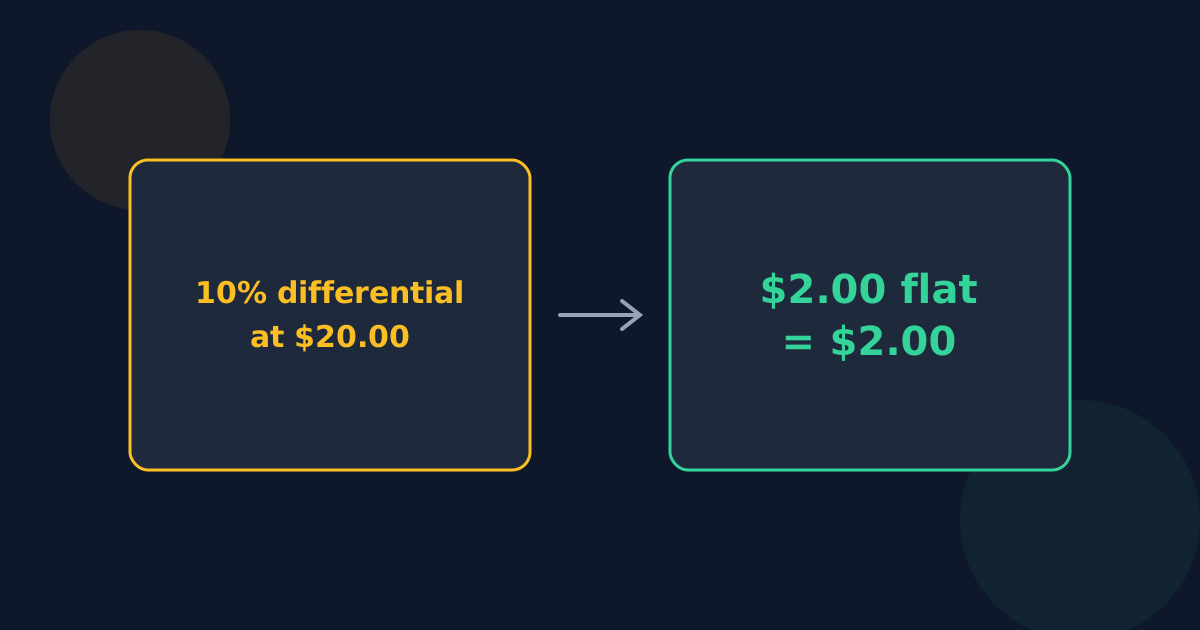
- $2.00 flat vs. 10%: $2.00 ÷ 10 × 100 = $20.00. Below $20.00 the flat amount pays more; above it, the percentage does.
- $2.00 flat vs. 8%: $2.00 ÷ 8 × 100 = $25.00.
- $1.50 flat vs. 5%: $1.50 ÷ 5 × 100 = $30.00.
10% vs. $2.00 at different base rates
| Base rate | 10% differential | $2.00 flat | Pays more |
|---|---|---|---|
| $15.00 | $1.50 | $2.00 | Flat |
| $18.00 | $1.80 | $2.00 | Flat |
| $20.00 | $2.00 | $2.00 | Equal |
| $25.00 | $2.50 | $2.00 | Percentage |
| $35.00 | $3.50 | $2.00 | Percentage |
What happens after a raise
A percentage differential grows automatically with a raise; a flat one stays put unless the employer changes it. Take a 3% raise from $22.00 to $22.66 an hour:
- A 10% differential goes from $2.20 to $2.266 an hour. Over 1,000 differential hours a year, that is $2,200.00 before the raise and $2,266.00 after.
- A $2.00 flat differential stays at $2.00 — $2,000.00 over the same 1,000 hours.
Differentials with both parts
Some policies combine the two, such as 5% plus $1.00 an hour. Work out each part and add them: at $24.00, 5% is $1.20, so the differential is $2.20 an hour. The Weekend Pay Premium Calculator accepts both parts at once; for a shift differential, add the two parts yourself before entering them as a flat amount.
Percentage vs. Flat Differentials FAQ
- Which is better, a percentage or a flat shift differential?
- It depends on your base rate. A percentage pays more above the break-even rate (flat ÷ percentage × 100) and less below it. At 10% vs. $2.00, the break-even is $20.00 an hour.
- Does a flat differential go up when I get a raise?
- Not by itself. A flat amount stays the same unless the policy changes; a percentage differential rises with the base rate.
- How do I compare two offers with different differentials?
- Convert both to dollars per hour at each job’s own base rate, then multiply by the differential hours you expect. The Effective Hourly Rate guide shows how to compare the full week.
- What is 12% of $17.35 an hour?
- $2.082 an hour. Over 40 hours that is $83.28.
- Can a differential be both a percentage and a flat amount?
- Yes, some policies combine them. Add the two parts: 5% plus $1.00 at a $24.00 base is $2.20 an hour.
Related guides
- Calculating a Shift DifferentialTurn a flat or percentage shift differential into dollars per hour, multiply by the qualifying hours, and check the result against a pay stub.
- Effective Rate With a DifferentialThe rate on differential hours versus the average across a mixed week, how the share of differential hours moves it, and how to compare job offers.
Open the tool
Jump into Shift Differential Calculator when you are ready to process your files.