Work, pay & shifts
Effective Hourly Rate With a Shift Differential
“Effective hourly rate” gets used for two different numbers when a shift differential is involved: what each differential hour pays, and what you earn per hour on average across a week that mixes differential and regular hours. They answer different questions. This guide explains both, shows how the share of differential hours moves the average, and uses it to compare two job offers.
Ready to try the tool this guide describes?
The rate on the differential hours
This one is simple: base rate + differential per hour. A $19.00 base with a $1.75 differential pays $20.75 for every qualifying hour. It is the right number to compare against another job’s hourly rate for the same shift.
The average across a mixed week
Most people don’t work only differential hours. To find the average, divide total pay by total hours:
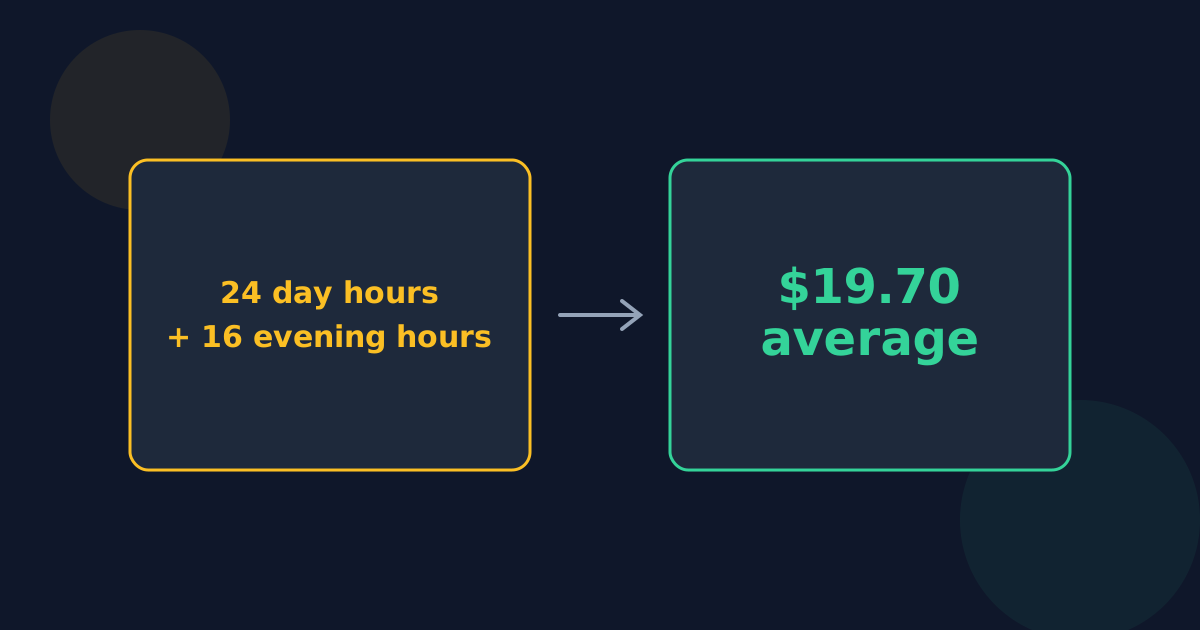
- Base pay: 40 hours × $19.00 = $760.00.
- Differential pay: 16 evening hours × $1.75 = $28.00.
- Total: $760.00 + $28.00 = $788.00.
- Average: $788.00 ÷ 40 hours = $19.70 an hour.
How the share of differential hours moves the average
The average equals the base rate plus the differential times the share of hours that earn it. With a $20.00 base and a $2.00 differential:
| Hours with the differential | Average hourly rate |
|---|---|
| 0% | $20.00 |
| 25% | $20.50 |
| 50% | $21.00 |
| 75% | $21.50 |
| 100% | $22.00 |
Comparing two job offers
Job A pays $21.00 an hour on day shifts only. Job B pays $19.50 with a $2.50 night differential, and 3 of your 5 weekly shifts would be nights — 60% of the hours. Job B’s average is $19.50 + $2.50 × 0.6 = $21.00, the same as Job A. With 2 night shifts instead of 3, it drops to $20.50; with 4, it rises to $21.50.
Which number to use
- Use the rate on differential hours to check a pay stub line or compare the same shift at two employers.
- Use the weekly average for budgeting, or to compare jobs where the mix of shifts differs.
- Neither includes overtime, taxes, or deductions — they are the gross hourly figures from the rates you enter.
Effective Rate With a Differential FAQ
- What is an effective hourly rate?
- Either the rate for a differential hour (base + differential) or the average across all hours (total pay ÷ total hours). Be clear which one you mean when comparing.
- How do I find my average hourly rate with a differential?
- Add base pay for all hours to differential pay for the qualifying hours, then divide by all hours. 40 hours at $19.00 with 16 hours earning $1.75 extra averages $19.70.
- Is there a shortcut for the average?
- Yes: base rate + differential × the share of hours that earn it. Half the hours with a $2.00 differential on a $20.00 base averages $21.00.
- Why is my average lower than the rate on my evening hours?
- Because the regular hours pull it down. Only the hours that earn the differential are paid at the higher rate.
- Does the average include overtime?
- Not in these examples. They use base and differential pay only; overtime rules vary and are not assumed.
Related guides
- Calculating a Shift DifferentialTurn a flat or percentage shift differential into dollars per hour, multiply by the qualifying hours, and check the result against a pay stub.
- Percentage vs. Flat DifferentialsHow percentage and flat-rate differentials compare at different base rates, the break-even rate where they match, and what changes after a raise.
Open the tool
Jump into Shift Differential Calculator when you are ready to process your files.