Work, pay & shifts
How to Calculate Shift Differential Pay
A shift differential is extra pay per hour for working a less popular shift — evenings, nights, weekends, or rotating hours. Employers state it one of two ways: a flat amount such as “$2.00 an hour,” or a percentage of the base rate such as “8%.” Either way, the calculation takes three steps. This guide walks through them with a real example and explains how to check the answer against a pay stub.
Ready to try the tool this guide describes?
Step 1: Turn the differential into dollars per hour
A flat differential is already in dollars per hour. A percentage differential needs one multiplication: base rate × percentage ÷ 100.
- 10% of a $20.00 base rate is $2.00 an hour.
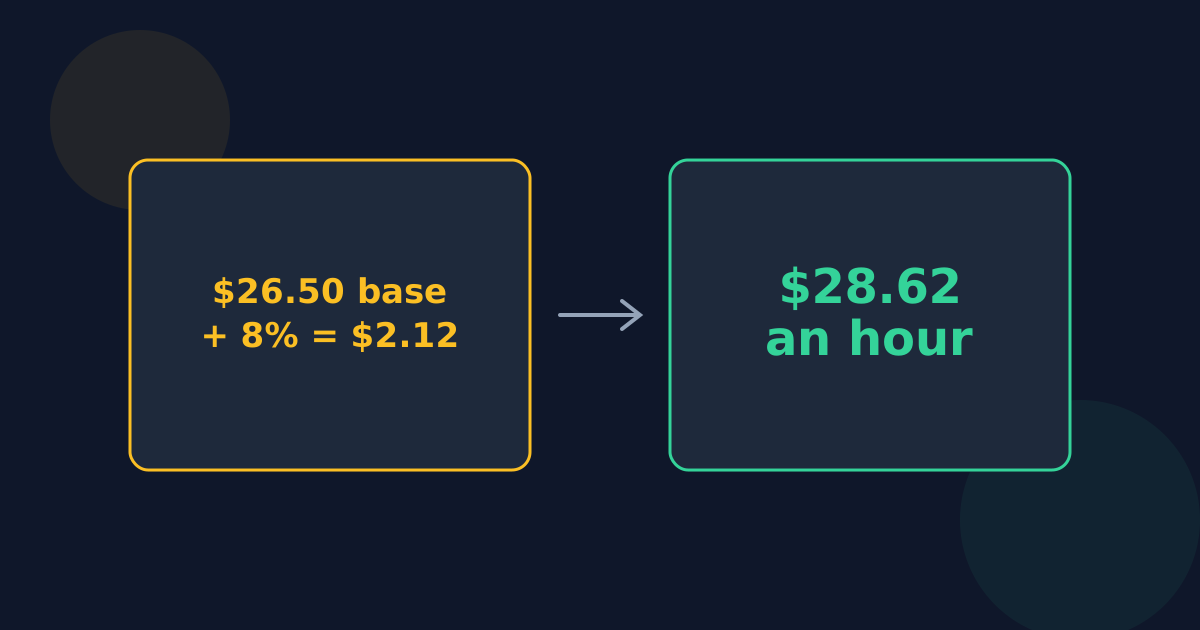
- 8% of a $26.50 base rate is $2.12 an hour.
- 12% of a $17.35 base rate is $2.082 an hour — a fraction of a cent, which matters later.
Step 2: Multiply by the hours that earn it
Only the hours your employer pays the differential on count. If you worked 40 hours but 32 of them were on the evening shift, use 32. With the 8% differential on $26.50: $2.12 × 32 hours = $67.84 of differential pay.
Step 3: Add it to your base pay
- Base pay for those hours: $26.50 × 32 = $848.00.
- Differential pay: $67.84.
- Total for those hours: $848.00 + $67.84 = $915.84.
- Effective hourly rate on those hours: $26.50 + $2.12 = $28.62.
More worked examples
| Base rate | Differential | Hours | Differential pay | Total pay |
|---|---|---|---|---|
| $20.00 | $2.00/hr | 8 | $16.00 | $176.00 |
| $20.00 | 10% | 8 | $16.00 | $176.00 |
| $26.50 | 8% | 32 | $67.84 | $915.84 |
| $17.35 | 12% | 40 | $83.28 | $777.28 |
| $31.50 | $3.25/hr | 36 | $117.00 | $1,251.00 |
When the rate has a fraction of a cent
A percentage often gives a rate that isn’t a whole number of cents. Payroll systems handle it in different ways, and the choice can move the result by a few cents. Using the exact $2.082 for 40 hours gives $83.28. Rounding the rate to $2.08 first gives $83.20 — 8 cents less. The Shift Differential Calculator keeps the exact rate and rounds only the pay, and it shows the exact rate in its working so you can compare.
Checking the result against a pay stub
- Look for a separate line such as “shift diff,” “evening premium,” or “night differential,” and compare its hours with the hours you entered.
- If the stub’s differential hours are lower, your employer may count only hours inside a set window rather than the whole shift.
- Some stubs fold part of a premium into other lines, such as overtime. If the totals don’t match, compare each line’s hours and rate rather than the grand total.
Calculating a Shift Differential FAQ
- What is a shift differential?
- Extra pay per hour for working a particular shift, such as evenings, nights, or weekends. It is added on top of the base rate, either as a flat amount or as a percentage of the base rate.
- Is a 10% differential the same as $2 an hour?
- Only at a $20.00 base rate. At $18.00 it is $1.80 an hour, and at $25.00 it is $2.50.
- Should the differential rate be rounded before multiplying?
- Employers differ. Keeping the exact rate and rounding the pay is the most precise; rounding the rate first can change the result by a few cents — $2.082 × 40 is $83.28, but $2.08 × 40 is $83.20.
- How do I calculate a differential for only part of a shift?
- Multiply the differential by just the qualifying hours. If 3 hours of an 8-hour shift earn a $2.00 differential, the differential pay is $6.00.
- What is my effective hourly rate with a differential?
- The base rate plus the differential per hour. A $26.50 base with a $2.12 differential is $28.62 an hour for those hours.
Related guides
- Percentage vs. Flat DifferentialsHow percentage and flat-rate differentials compare at different base rates, the break-even rate where they match, and what changes after a raise.
- Effective Rate With a DifferentialThe rate on differential hours versus the average across a mixed week, how the share of differential hours moves it, and how to compare job offers.
Open the tool
Jump into Shift Differential Calculator when you are ready to process your files.