Home, moving & space
Refrigerator Door-Swing Clearance Explained
A refrigerator that fits its alcove can still be a daily annoyance if its door won’t open far enough to pull out a drawer, or bangs the island when it does. Door swing depends on three things: how far the door sits from the alcove’s edge, how wide and thick it is, and where its hinge pivots. This guide explains each, with numbers for one refrigerator, and when the manufacturer’s figures are the only way to know.
Ready to try the tool this guide describes?
Space in front: about a door’s width
Opened to 90°, a side-hinged door sticks straight out in front of the refrigerator by roughly its own width. Where exactly it ends depends on the hinge. If the pivot is at the back of the door, the door starts a little further back; if it is at the front, a little further forward; and partway through the swing, the door’s far corner reaches a touch further than it does at 90°.
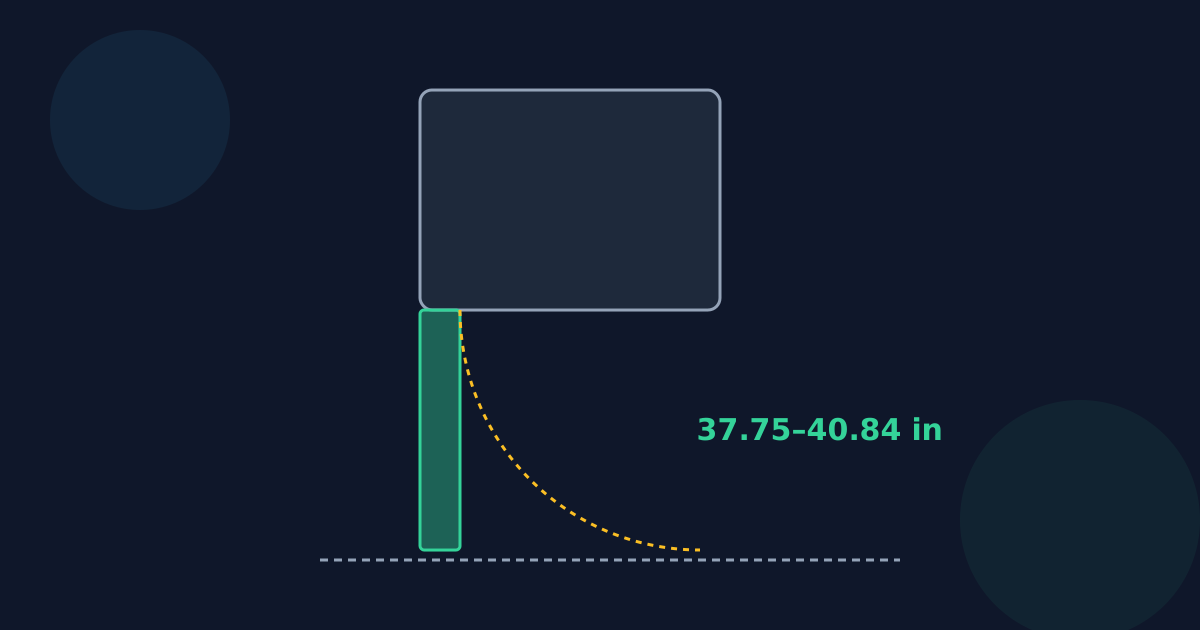
For a 35.75 in door, 3 in thick, with a 2.5 in handle, on a refrigerator whose doors sit 5 in past the alcove, that range is 37.75 to 40.84 in in front of the alcove. With 48 in of floor there is room either way. With 36 in, there isn’t, whatever the hinge. With 40 in, only the manufacturer’s “depth with door open 90°” can settle it.
Narrower doors need less room
| Door width | Reach past the alcove at 90° |
|---|---|
| 17.875 in | 19.88 in to 23.05 in |
| 24 in | 26 in to 29.13 in |
| 30 in | 32 in to 35.1 in |
| 35.75 in | 37.75 in to 40.84 in |
Doors 3 in thick with 2.5 in handles, their front 5 in past the alcove. The range covers a hinge pivoting anywhere within the door’s thickness.
The hinge side: walls and handles
As a door swings open, its edge swings out past the side of the cabinet by up to its own thickness, and the handle — on the face that turns toward the hinge side — further still. If the refrigerator sits in an alcove with open floor beyond it and its doors are fully in front of the alcove, none of that touches anything. If the doors are recessed into the alcove, or a wall carries on forward beside the hinge, the side gap matters.
With a wall beside the hinge and only 0.63 in of space, a door with a 2.5 in handle can’t open to 90° however the hinge is built. With 3 in or more of door thickness plus handle, it can whatever the hinge. In between, the manual’s hinge-side clearance decides.
Shifting toward the latch side
If there is spare width, moving the refrigerator away from the hinge-side wall helps. A 33 in refrigerator in a 37 in alcove has 2 in each side when centred; with a wall beside the hinge and a 3 in door, moving it 1 in toward the latch side gives the hinge side the 3 in it needs, while still leaving 1/8 in on the other side.
Past 90°: drawers and shelves
Many refrigerators need the door to open well past 90° before crisper drawers and some shelves slide out. The installation manual gives the side clearance for that, and it is often several inches more than for 90°. If you can’t meet it, the refrigerator still works; removing a drawer for cleaning just means taking the door off its stop, or moving the refrigerator out.
Fridge Door Swing FAQ
- How do I find the depth with the door open?
- It is on most spec sheets, often in a diagram, measured from the back of the refrigerator. Add your rear gap and subtract the alcove’s depth to see how far past the alcove it reaches.
- Do French doors need less room in front?
- Yes. Each door is about half the refrigerator’s width, so it reaches about half as far — but each still needs room on its own hinge side.
- Can I reverse a refrigerator door?
- Many single-door refrigerators can be switched to hinge on the other side; the manual says how. It is worth doing when one side has a wall and the other doesn’t.
- Why does the calculator give a range instead of one number?
- Because hinges differ. Without the manufacturer’s figure it shows the least and most the door could reach, and only calls it a fit when even the most has room.
- Does the handle count when the door is closed?
- Yes, for the space in front: the handles stick out past the doors. When the door is open they point sideways, toward the hinge side.
Related guides
- Measuring a Fridge SpaceMeasure a refrigerator alcove properly: width at three heights, height to the cabinet above, depth to the front edge, and the space around the doors.
- Installation ClearancesWhat a refrigerator’s side, top, and rear installation clearances are for, why they differ between models, where to find yours, and how they change the fit.
Open the tool
Jump into Appliance Alcove & Door-Swing Clearance Calculator when you are ready to process your files.