Home, moving & space
Appliance Ventilation and Installation Clearance Guide
Every refrigerator manual lists installation clearances — small gaps at the sides, top, and back — and they are easy to ignore when the appliance slides in with nothing to spare. They exist for air, heat, power, and service. This guide explains what each clearance is for, why the numbers differ between models, where to find yours, and how to check a space against them.
Ready to try the tool this guide describes?
What the clearances are for
- Air: most refrigerators shed heat through coils at the back or bottom. The gaps let warm air out and cool air in.
- Power and water: the plug, cord, and water line need room behind the refrigerator without being crushed.
- Doors and hinges: the hinge side often needs a little extra so the door can swing.
- Service: some gap makes it possible to pull the refrigerator out later.
Why there isn’t one standard number
Designs differ. Built-in and counter-depth models are made to vent out of the front and can sit tight to cabinets; many freestanding models expect more room at the top or back. Two refrigerators the same width can ask for very different gaps, which is why a clearance from one manual — or a figure from a forum — doesn’t transfer to another model.
The Appliance Alcove & Door-Swing Clearance Calculator doesn’t assume any clearance for this reason. Without the figures from your manual, it tells you whether the body fits and says that the operating clearance can’t be confirmed yet.
Where to find your model’s figures
- The installation instructions that come with the refrigerator, usually in their own booklet.
- The spec sheet or “dimensions and installation” document on the maker’s website, under the full model number.
- The cut-out or alcove dimensions in that document, which already include the clearances.
How a clearance changes the answer
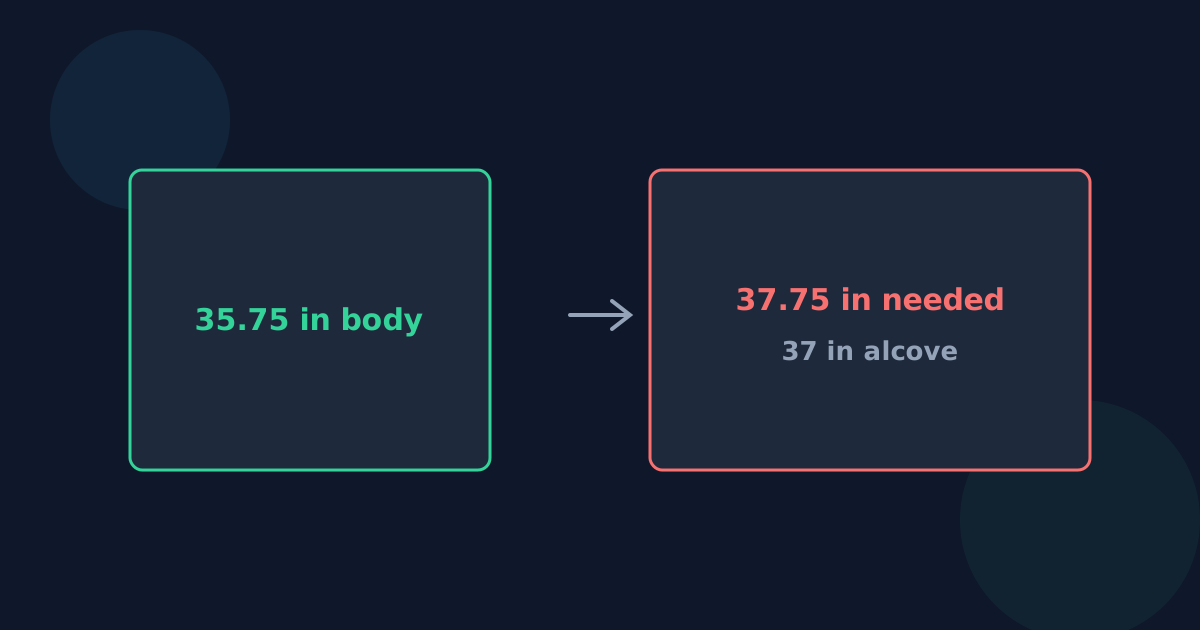
Clearances turn a physical fit into a different question. A 35.75 in wide, 70 in high refrigerator fits a 37 in wide, 72 in high space with room to spare. If its manual asks for 1 in at each side, it needs 37.75 in, and the same space is too narrow. If it asks for 1/8 in at the sides but 1.5 in on top, a 71 in high space is half an inch short on top even though the body clears it by an inch.
| Manual asks for | Space | Result |
|---|---|---|
| 1/8 in sides, 1 in top | 37 × 72 in | Fits with the clearances |
| 1 in sides, 1 in top | 37 × 72 in | Not enough width with the clearances |
| 1/8 in sides, 1.5 in top | 37 × 71 in | Not enough height with the clearances |
A 35.75 × 29 × 70 in refrigerator. The body fits all three spaces.
If the space is too tight
- Choose a model whose clearances fit the space; counter-depth and built-in models are designed for tight installs.
- Remove trim or a filler strip if the cabinets allow it.
- Raise the cabinet above, if it can be moved, to free top clearance.
- Don’t block vents to make it fit; the manual’s figures are what the maker tested.
Installation Clearances FAQ
- What happens if a refrigerator has too little clearance?
- It may run hotter and longer, use more energy, and be noisier, depending on how it vents. The manual’s clearances are the ones the maker designed for.
- Is the rear clearance measured from the wall or the outlet?
- Usually from the wall, with the outlet and water valve fitted in a recess or within the gap. Check the manual’s drawing.
- Do counter-depth refrigerators need less clearance?
- Often, because many vent at the front. It depends on the model, so use its own figures.
- Do the cut-out dimensions include the clearances?
- Usually, yes — that is their purpose. If a manual gives a cut-out size, compare your space with that.
- Do other appliances have installation clearances too?
- Yes. Ranges, dishwashers, washers, and dryers all have their own, often with extra rules for gas and venting. Use each one’s manual.
Related guides
- Measuring a Fridge SpaceMeasure a refrigerator alcove properly: width at three heights, height to the cabinet above, depth to the front edge, and the space around the doors.
- Fridge Door SwingHow far a refrigerator door reaches when it opens to 90°, why the hinge position changes it, and how walls, handles, and French doors affect the room it needs.
Open the tool
Jump into Appliance Alcove & Door-Swing Clearance Calculator when you are ready to process your files.