Calculators & everyday math
Percentage Formulas Explained: Part, Whole, and Rate
Almost every everyday percentage question is one of three questions in disguise, all built from the same relationship between a part, a whole, and a rate. Once you can tell which one you’re being asked, the formula follows. This guide lays out all three, plus the formula for change over time.
Ready to try the tool this guide describes?
One relationship behind them all
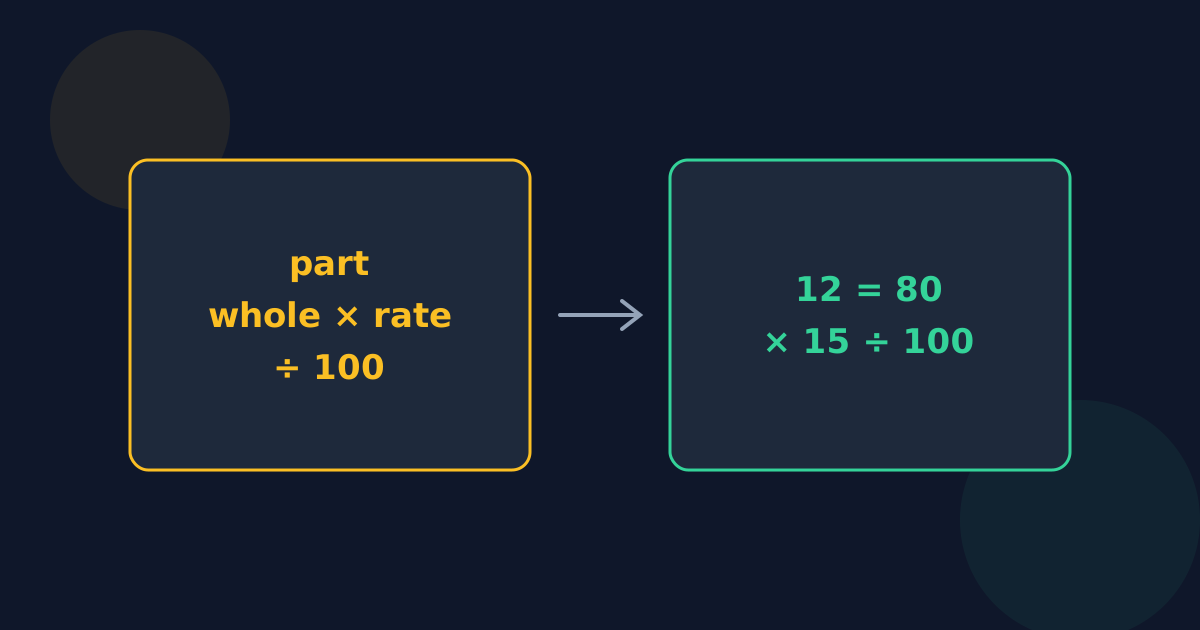
part = whole × rate ÷ 100
In “12 is 15% of 80”, 80 is the whole, 15 is the rate (the percentage), and 12 is the part. Every basic percentage question gives you two of these and asks for the third.
The three questions
| You know | You want | Formula | Example |
|---|---|---|---|
| Rate and whole | Part | part = whole × rate ÷ 100 | 15% of 80 = 80 × 15 ÷ 100 = 12 |
| Part and whole | Rate | rate = part ÷ whole × 100 | 12 out of 80 = 12 ÷ 80 × 100 = 15% |
| Part and rate | Whole | whole = part ÷ rate × 100 | 12 is 15% of 12 ÷ 15 × 100 = 80 |
Telling the questions apart
- “What is 15% of 80?” — the percentage is given and “of” points to the whole. You want the part.
- “What percent of 80 is 12?” or “12 out of 80 is what percent?” — you want the rate.
- “12 is 15% of what?” — the whole is missing. This is the one people get wrong most often, because it means dividing by the percentage rather than multiplying.
The fourth formula: change over time
When something moves from an old value to a new one, the rate you want is measured from the old value: percentage change = (new − old) ÷ old × 100.
It is the rate formula in disguise — the part is the change and the whole is the starting value. From 80 to 92 the change is 12, and 12 ÷ 80 × 100 = 15%.
Percentage Formulas FAQ
- How do I find what percent one number is of another?
- Divide the part by the whole and multiply by 100. 18 out of 24 is 18 ÷ 24 × 100 = 75%.
- How do I find the whole when I know a percentage of it?
- Divide the part by the percentage and multiply by 100. If 30 is 40% of a number, the number is 30 ÷ 40 × 100 = 75.
- Why multiply by 100?
- A rate like 12 ÷ 80 = 0.15 is a fraction of 1. Percent means “per hundred”, so multiplying by 100 turns 0.15 into 15%.
- Does “of” always mean multiply?
- In percentage questions, yes: “15% of 80” means 0.15 × 80.
- Which value is the whole in a percentage change?
- The starting value. That is why a rise from 80 to 92 is 15%, while a fall from 92 back to 80 is about 13.04%.
Related guides
- Percentage of a NumberThe one method that always works for finding a percentage of a number, plus mental shortcuts for 10%, 15%, 25%, and more, with worked examples.
- Calculate Percentage ChangeThe percentage change formula with worked examples, how to read positive and negative results, a spreadsheet formula, and checks that catch errors.
Open the tool
Jump into Percentage Calculator when you are ready to process your files.