Calculators & everyday math
Percentage Decrease Examples, Including Over 100%
Worked percentage decreases from everyday situations — a smaller budget, a shorter commute, less screen time — plus what happens at exactly 100%, and why a decrease of more than 100% is sometimes real and sometimes a mistake.
Ready to try the tool this guide describes?
Everyday examples
| Situation | Start | Decrease | Result |
|---|---|---|---|
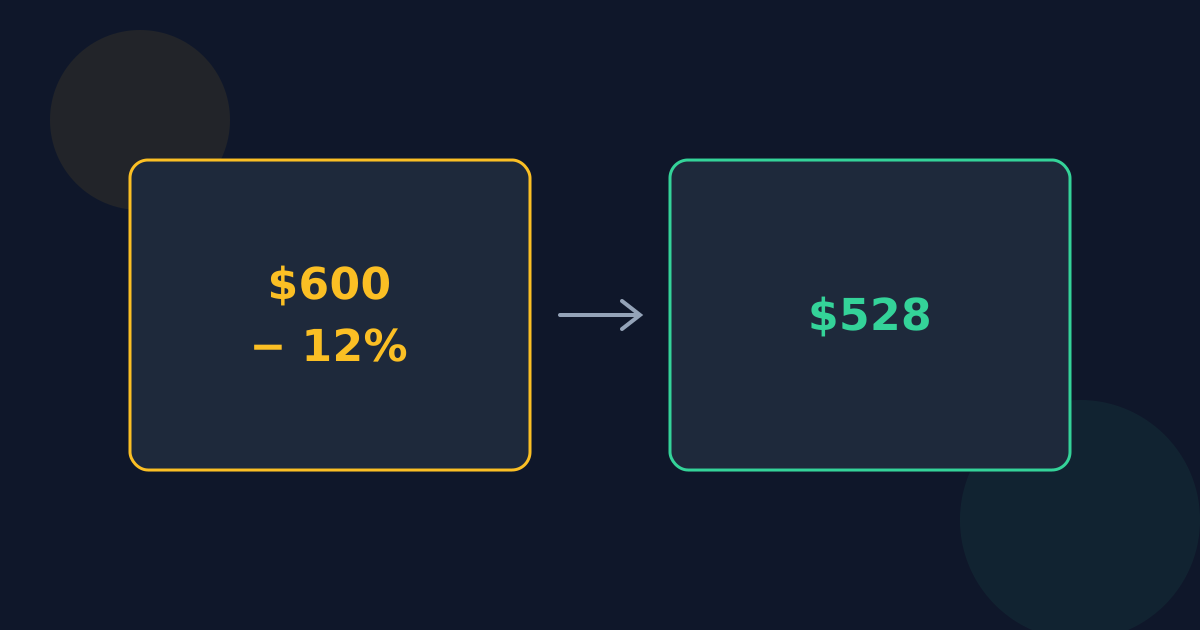
| Monthly grocery budget cut | $600 | 12% | $528 |
| Commute shortened | 45 minutes | 20% | 36 minutes |
| Screen time reduced | 5.5 hours | 30% | 3.85 hours |
| Recipe scaled down | 750 g | 40% | 450 g |
| Water use reduced | 180 liters | 15% | 153 liters |
Exactly 100%
A 100% decrease removes the whole value, whatever it was: 750 g reduced by 100% leaves 0 g. It is the largest decrease possible for anything that can’t go below zero — a price, a weight, a number of people.
More than 100%
A decrease of more than 100% only gives a meaningful result for quantities that can be negative. A profit of $200 that falls by 150% becomes a loss of $100: 200 − 300 = −100.
For a price or a count, a “150% decrease” is almost always a misstatement. Often someone meant that the old value was 150% higher than the new one: a price that fell from $250 to $100 dropped by 60%, but $250 is 150% more than $100.
Working back from a decrease
If you know the result and the percentage, divide by the multiplier to get the start: $528 after a 12% cut came from $528 ÷ 0.88 = $600.
A decrease in a percentage itself — say an error rate falling from 8% to 6% — can be described two ways: a drop of 2 percentage points, or a 25% decrease. Say which one you mean.
Percentage Decrease Examples FAQ
- How do I work out a percentage decrease on a price?
- Multiply the price by 1 − the percentage ÷ 100. A 12% decrease on $600 is $600 × 0.88 = $528.
- Can something decrease by more than 100%?
- Only if it can go below zero, like a profit turning into a loss. A price or a weight can fall by at most 100%.
- What is the percentage decrease from 250 to 100?
- 60%: the drop of 150 divided by the starting 250, times 100.
- What is the difference between a 2-point drop and a 25% drop?
- From 8% to 6% is a drop of 2 percentage points, which is a 25% decrease relative to the starting 8%.
- Is a 50% decrease the same as halving?
- Yes. A 50% decrease multiplies by 0.5, so any value is halved.
Related guides
- Decrease by a PercentageTake a percentage off a number in two steps or with one multiplier, see how repeated cuts combine, and learn to reverse a decrease correctly.
- Why Decreases Don’t Undo IncreasesWhy going up 25% and then down 25% leaves you lower than you started, how big the gap gets, and the percentage that really reverses a change.
Open the tool
Jump into Percentage Decrease Calculator when you are ready to process your files.