Work, pay & shifts
On-Call, Standby, and Call-In Pay Terms Explained
On-call, standby, call-in, callback, call-out minimum — the terms overlap, and employers, contracts, and industries use them in slightly different ways. This guide sets out what each one usually refers to and how it is usually expressed in numbers, so you can match the words in an agreement to the figures on a pay stub. It describes common usage, not legal definitions.
Ready to try the tool this guide describes?
On call and standby
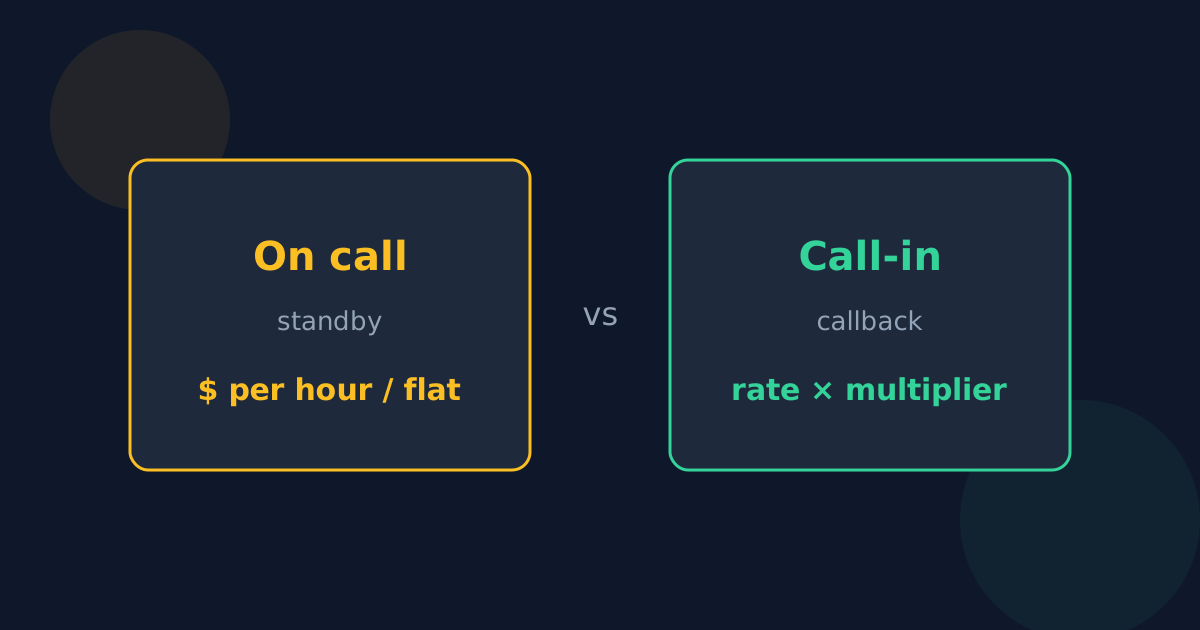
Both usually mean being available to work if needed, outside your scheduled hours. Many employers use the words interchangeably. Some distinguish standby at the workplace, where you wait on site, from on call at home, where you only need to be reachable and able to respond within a set time.
Whether time spent waiting counts as working time depends on how restricted you are while on call and on the rules where you work. This guide doesn’t answer that question; it only explains the vocabulary.
Call-in and callback
Call-in pay is pay for the time you actually work after being called. Callback is often used for being called back to work after you’ve already left at the end of a shift. Both are usually paid at your normal rate or at a multiple of it, such as 1.5 ×.
Minimum call-out pay
Some agreements guarantee a minimum number of paid hours each time you’re called in, so a short call doesn’t pay only a few minutes. If a 45-minute call has a 3-hour minimum at $30.00 an hour, it pays 3 × $30.00 = $90.00 instead of 0.75 × $30.00 = $22.50. Whether a minimum exists, and how long it is, comes from the agreement itself.
The terms side by side
| Term | Usually refers to | Usually expressed as |
|---|---|---|
| On-call pay | Being available outside scheduled hours | $ per hour, % of the normal rate, or a flat amount |
| Standby pay | Often the same as on-call pay; sometimes waiting on site | $ per hour or a flat amount |
| Call-in pay | Time actually worked after being called | Normal rate × a multiplier |
| Callback pay | Being called back after leaving work | Normal rate × a multiplier, often with a minimum |
| Minimum call-out | A guaranteed minimum for each call-in | A number of hours |
| Shift differential | Extra pay for working certain shifts | $ per hour or % of the normal rate |
Questions to answer from your agreement
- When does an on-call period start and end?
- What is the standby rate, and is it per hour, a percentage, or a flat amount?
- Does standby pay stop while you’re working a call-in?
- What multiplier applies to called-in hours, and is there a minimum per call?
On-Call Pay Terms FAQ
- Is standby pay the same as on-call pay?
- Often, yes. Some employers use standby for waiting on site and on call for being reachable from home.
- What is callback pay?
- Pay for being called back to work after you’ve already left, usually at a multiple of the normal rate and sometimes with a minimum number of hours.
- What is a minimum call-out guarantee?
- A promise in some agreements to pay a minimum number of hours for each call-in, even if the work takes less time.
- Does on-call time count as hours worked?
- It depends on how restricted you are while on call and on the rules where you work. This guide doesn’t decide that.
- Is call-in work always paid at time-and-a-half?
- No. The multiplier, if any, is set by the employer or agreement; straight time is also common.
Related guides
- Calculating On-Call PayWork out standby pay per hour, as a percentage, or as a flat amount, add called-in work, and decide whether standby stops during a call-in.
- Comparing On-Call ArrangementsPut a flat on-call stipend, an hourly standby rate, and a percentage of your rate on the same footing, with break-even points and call-ins.
Open the tool
Jump into On-Call / Standby Pay Calculator when you are ready to process your files.