Work, pay & shifts
Comparing On-Call Pay: Flat, Hourly, or Percentage
A flat stipend for a week on call, a few dollars per on-call hour, or a percentage of your normal rate: the arrangements look different, and which one pays more depends on how many hours you’re on call and how often you’re called in. This guide puts them on the same footing — dollars per on-call hour — and finds the break-even points.
Ready to try the tool this guide describes?
Turn everything into a rate per on-call hour
Divide a flat amount by the hours it covers. A week on call outside a 40-hour schedule is 168 − 40 = 128 hours, so a $250.00 weekly stipend is $250.00 ÷ 128 ≈ $1.95 per on-call hour. A percentage becomes a rate by multiplying it by your normal rate.
Break-even between flat and hourly
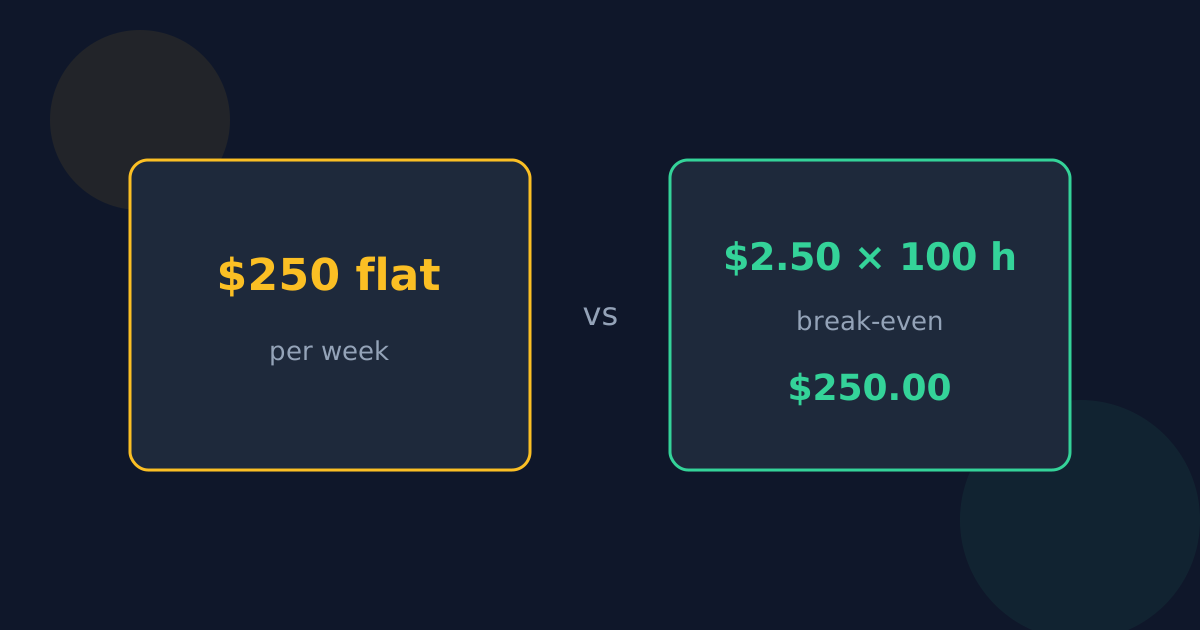
A flat amount and an hourly rate pay the same when the on-call hours equal the flat amount ÷ the hourly rate. $250.00 against $2.50 an hour breaks even at 100 hours: below that the stipend pays more, above it the hourly rate does.
| On-call hours | Flat $250.00 | At $2.50 an hour |
|---|---|---|
| 40 | $250.00 | $100.00 |
| 80 | $250.00 | $200.00 |
| 100 | $250.00 | $250.00 |
| 128 | $250.00 | $320.00 |
When call-ins are frequent
If standby pay stops while you’re working, every called-in hour removes an hour of standby from an hourly or percentage arrangement but leaves a flat stipend unchanged. Over the 128-hour week at $2.50 an hour, with called-in work at 1.5 × $30.00:
| Hours called in | Hourly standby (stops) | Flat standby | Called-in pay |
|---|---|---|---|
| 0 | $320.00 | $250.00 | $0.00 |
| 10 | $295.00 | $250.00 | $450.00 |
| 20 | $270.00 | $250.00 | $900.00 |
Percentages and pay raises
A percentage standby rate rises with your pay: 10% is $2.80 an hour at $28.00 and $3.20 at $32.00. A flat amount or a fixed hourly standby rate stays where it is until the arrangement itself changes.
Comparing offers fairly
- Use the same on-call hours for every option, based on a typical rotation rather than the best or worst week.
- Include a realistic number of call-ins and the stop-or-continue rule for each arrangement.
- Look at the total for the period as well as the per-hour figure; a low per-hour rate over many hours can still add up.
Comparing On-Call Arrangements FAQ
- Is a flat on-call stipend better than an hourly standby rate?
- It depends on the hours. A flat amount pays more for short on-call periods and less for long ones; the break-even is the flat amount ÷ the hourly rate.
- How do I find the break-even point between two arrangements?
- Divide the flat amount by the hourly rate. $250.00 ÷ $2.50 = 100 on-call hours.
- What is the hourly value of a weekly on-call stipend?
- Divide it by the on-call hours in the week. $250.00 over 128 hours is about $1.95 an hour.
- Does a percentage standby rate go up when I get a raise?
- Yes, because it is calculated from your normal rate. A flat or fixed hourly standby rate doesn’t.
- Should called-in hours be part of the comparison?
- Yes. If standby stops during call-ins, frequent call-ins reduce hourly standby pay but not a flat stipend.
Related guides
- Calculating On-Call PayWork out standby pay per hour, as a percentage, or as a flat amount, add called-in work, and decide whether standby stops during a call-in.
- On-Call Pay TermsWhat on-call, standby, call-in, callback, and minimum call-out pay usually mean, and how each is usually expressed on a pay stub.
Open the tool
Jump into On-Call / Standby Pay Calculator when you are ready to process your files.