Work, pay & shifts
How to Calculate On-Call Pay
On-call pay usually has two parts: a standby amount for being available, and normal (or premium) pay for any time you’re actually called in to work. Working out the total means getting three things straight — which hours count, which rate applies to each, and whether standby pay continues while you’re working. This guide walks through a full on-call weekend.
Ready to try the tool this guide describes?
Step 1: count the on-call hours
Count from the moment the on-call period starts to the moment it ends. A weekend from Friday 5:00 PM to Monday 8:00 AM is 63 hours. Include any hours you were called in — they happened during the on-call period.
Step 2: find the standby rate
- A rate per hour is used as it is, for example $3.25 an hour.
- A percentage of your normal rate becomes dollars by multiplying: 10% of $32.50 is $3.25 an hour.
- A flat amount covers the whole period, whatever its length; divide it by the hours to compare it with an hourly rate.
Step 3: price the called-in hours
Called-in work is normally paid at your normal rate times a multiplier set by your agreement — 1 for straight time, 1.5 for time-and-a-half. Five hours at 1.5 × $32.50 = $48.75 an hour is $243.75.
Step 4: decide whether standby stops
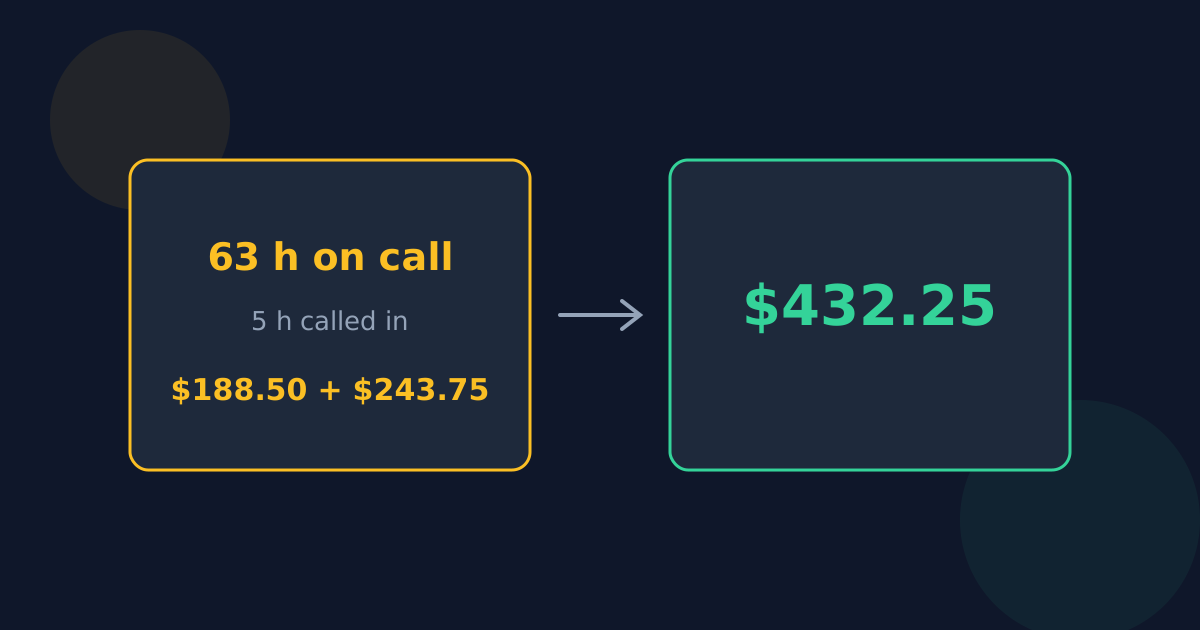
Some arrangements stop standby pay while you’re working, because you’re now paid for work instead. Others pay standby for the whole on-call period regardless. For the 63-hour weekend at $3.25 standby with 5 hours called in at 1.5 × $32.50:
| Standby during call-in | Standby hours | Standby pay | Called-in pay | Total | Average per on-call hour |
|---|---|---|---|---|---|
| Stops | 58 | $188.50 | $243.75 | $432.25 | $6.86 |
| Continues | 63 | $204.75 | $243.75 | $448.50 | $7.12 |
Checking it against a pay stub
- Look for separate lines for standby (or on-call) pay and for called-in hours; they may be paid at different rates and sometimes in different periods.
- Check the hours on each line, not only the totals — a missing call-in or an on-call period counted from the wrong time is the usual source of a difference.
- Any minimum number of paid hours per call-in is a separate rule; if your agreement has one, it can make the called-in pay higher than hours × rate.
Calculating On-Call Pay FAQ
- Which hours count as on-call hours?
- The whole on-call period, from when it starts to when it ends, including any time you were called in to work.
- How do I turn a percentage standby rate into dollars?
- Multiply your normal hourly rate by the percentage. 10% of $32.50 is $3.25 an hour.
- Are called-in hours paid at overtime rates?
- It depends on your agreement and the rules that apply where you work. Use the multiplier your employer actually pays.
- Why is my average on-call rate so much lower than my normal rate?
- Most on-call hours earn only the standby rate. Averaged over a 63-hour weekend, $432.25 is about $6.86 an hour.
- Does it matter whether standby pay stops while I’m working?
- Yes. In the weekend example, continuing standby adds 5 × $3.25 = $16.25.
Related guides
- On-Call Pay TermsWhat on-call, standby, call-in, callback, and minimum call-out pay usually mean, and how each is usually expressed on a pay stub.
- Comparing On-Call ArrangementsPut a flat on-call stipend, an hourly standby rate, and a percentage of your rate on the same footing, with break-even points and call-ins.
Open the tool
Jump into On-Call / Standby Pay Calculator when you are ready to process your files.