Shipping & packaging
Mixed-Orientation Pallet Layers Explained
A mixed-orientation layer turns some cartons 90° so the layer uses space that a single orientation would waste. The simplest kind splits the pallet into two blocks, one for each orientation.
Ready to try the tool this guide describes?
How a two-block pattern works
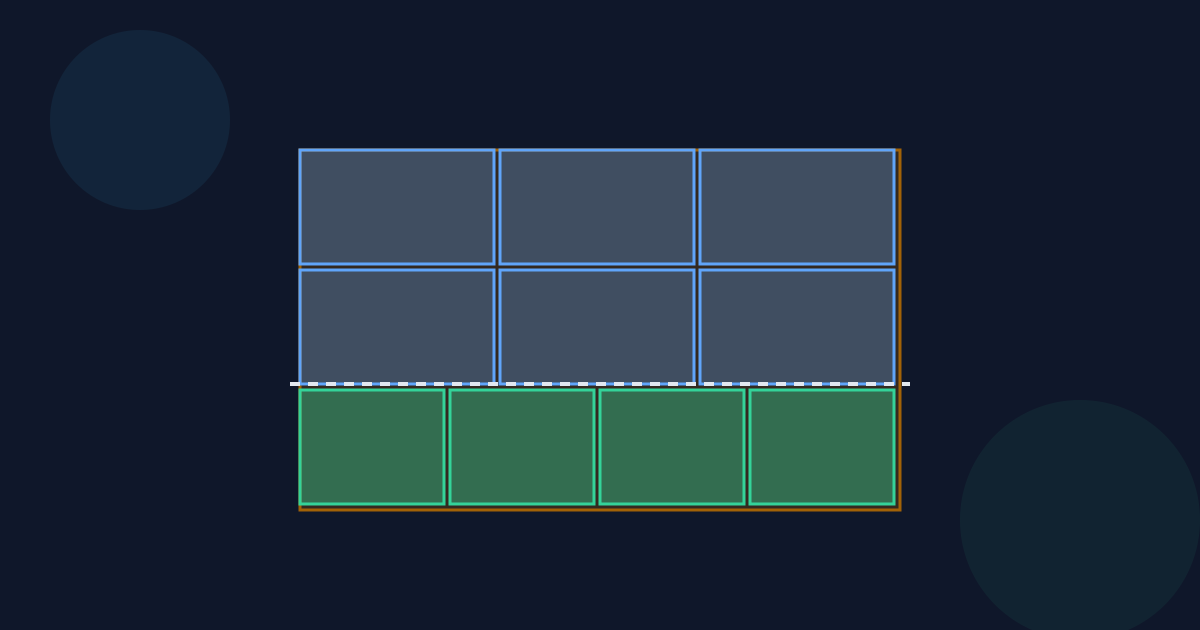
Pick a split line across the pallet’s width, or along its length. On one side, cartons face one way; on the other, they’re turned 90°. Each block is a simple grid, so the count is easy to check.
A worked example
On a 48 × 40 in pallet, 16 × 12 in cartons lengthwise fit 3 along the 48 in side. Two rows use 24 in of the width, leaving a 16 in strip. Turned, the cartons are 12 in along the length and 16 in across, so the strip takes one row of 4. That is 6 + 4 = 10, against 9 with every carton lengthwise — and it covers the whole deck.
When mixing doesn’t help
When one orientation already fills the pallet well, there is no strip left to use.
| Carton footprint on 48 × 40 in | Best single orientation | Best two-block |
|---|---|---|
| 16 × 12 in | 9 | 10 |
| 20 × 15 in | 6 | 6 |
| 12 × 10 in | 16 | 16 |
Spacing between the blocks
If cartons need spacing, it applies where the two blocks meet as well as between cartons within a block. With 0.5 in spacing, the 16 × 12 in example drops to 6 in a single orientation and 8 with a mix.
Beyond two blocks
More complex patterns — pinwheels and three- or four-block layouts — can sometimes fit one or two more cartons. They are harder to build and to check, so a two-block result is the best of the patterns checked, not proof that nothing better exists.
Mixed-Orientation Layers FAQ
- What is a two-block pallet pattern?
- A layer split into two areas, with cartons facing one way in one area and turned 90° in the other.
- When does a mixed pattern fit more cartons?
- When a single orientation leaves a strip too narrow for another row but wide enough for turned cartons.
- Do mixed patterns change how a layer holds together?
- They change how cartons bear on each other. Whether the load is stable depends on how it is built and secured, which a count doesn’t show.
- Is the best two-block pattern the best possible?
- Not necessarily. Pinwheel and multi-block patterns can occasionally do better.
- How does spacing affect mixed patterns?
- The spacing is needed between the blocks too, which can cost a row.
Related guides
- Planning a Pallet LayerHow to plan the carton pattern for one pallet layer: measure the footprint, try both orientations, check mixed patterns, and keep cartons within the edges.
- Gaps Between CartonsWhy spacing between cartons can cost whole rows on a pallet layer, how to calculate cartons per row with gaps, and when the gap is worth it.
Open the tool
Jump into Pallet Layer Calculator when you are ready to process your files.