Shipping & packaging
Loading Mixed Cargo Sizes in One Container
One kind of carton fills a container in neat repeating walls. Mix three sizes and each one brings its own leftovers — and the plan has to decide where each kind goes.
Ready to try the tool this guide describes?
Give each kind its own section
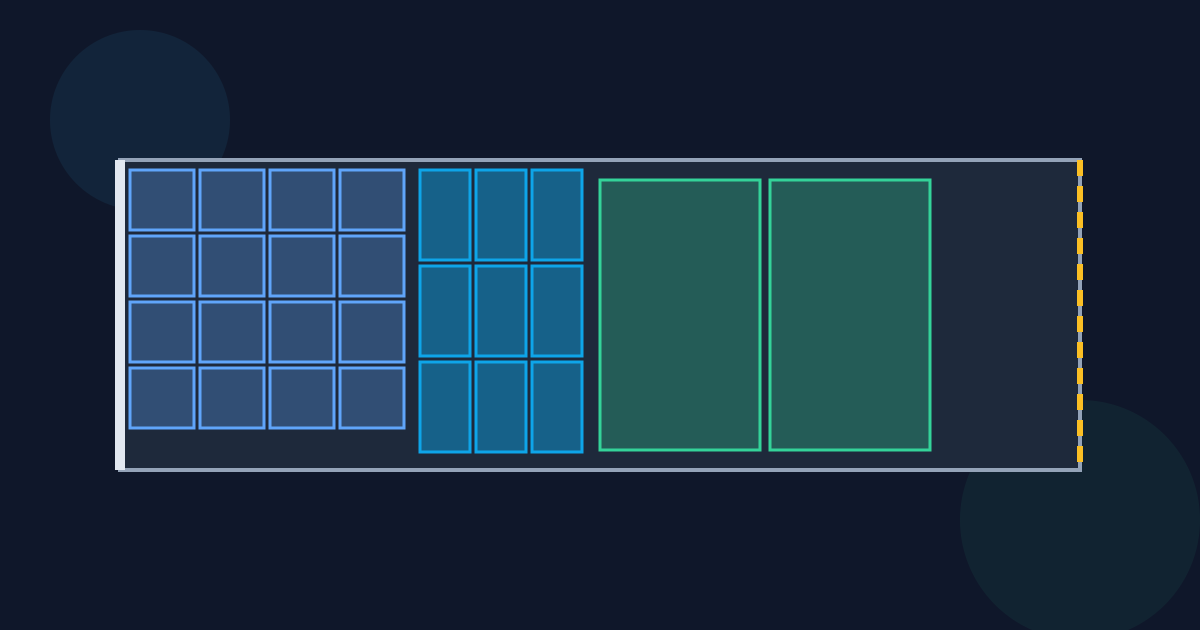
The simplest mixed plan keeps each kind of cargo in its own section of the container, one after another from the closed end. Each section is easy to count, check, and unload.
Each kind picks its own position
Within its section, each kind can face whichever way uses the least floor. In an example container 232 × 92 × 94 in inside, 20 × 16 × 12 in cartons fit 28 to a wall when turned — 4 across and 7 high — so 40 of them take just 2 walls, 32 in of floor.
Partly filled walls
A section rarely ends on a full wall. Fifty 24 × 18 × 20 in cartons at 20 to a wall take 3 walls, but the last wall holds only 10, so half of it — 10 cartons’ worth of space — is empty in a plan that starts the next kind on a new wall.
A three-kind example
| Type | One item | Quantity | Position | Floor used |
|---|---|---|---|---|
| A | 24 × 18 × 20 in | 60 | Upright, 20 per wall | 0 to 72 in |
| B | 20 × 16 × 12 in | 40 | Upright, turned, 28 per wall | 72 to 104 in |
| C | 48 × 40 × 50 in, not stackable | 4 | Upright, 2 per wall | 104 to 200 in |
Where the space goes
- Strips along the walls that each kind’s width leaves.
- Half-empty last walls at the end of a section.
- Space above any cargo that can’t be stacked on.
Does the order change the count?
It can. When everything fits, the order only moves the sections around — the three kinds above use 200 in in any order. When the length runs out, whatever goes last is what gets left behind.
Mixed Cargo Sizes in One Container FAQ
- Should different cargo sizes be mixed in one wall?
- Mixing can fill gaps, but it makes the load harder to build, count, and secure. Separate sections are simpler and easier to check.
- Why does a section waste space at its end?
- Because the last wall is usually only partly full. The next kind starts on a fresh wall, leaving the rest of that wall empty.
- Can small cartons fill gaps around large items?
- In practice, sometimes. A wall-by-wall plan doesn’t place them there, so any such gains are extra to the plan.
- How many kinds of cargo can one plan hold?
- As many as fit, but each kind adds leftovers. A plan with a few large sections is easier to load than one with many small ones.
- What if the last kind doesn’t all fit?
- It is the one left over. Change the order, the quantities, or the container before relying on the plan.
Related guides
- Planning a Container LoadA step-by-step way to plan where mixed cargo goes in a container: list it, check each item against the inside and the door, order it, and build it in walls.
- Non-Stackable Cargo in a Load PlanWhat cargo that can’t be stacked on costs in floor space and volume, how to plan around it, and why its height matters as much as its footprint.
Open the tool
Jump into Container Loading Calculator when you are ready to process your files.