Text & writing
How Long Should a Paragraph Be?
There is no single correct paragraph length. What works depends on the kind of writing, where it will be read, and who is reading it. This guide covers the principle most style advice agrees on, published guidance you may be asked to follow, and typical expectations in academic, web, email, and fiction writing.
Ready to try the tool this guide describes?
The rule that matters more than length
Most writing advice defines a paragraph by its job rather than its size: one paragraph develops one main idea. When the idea changes, a new paragraph starts. Length follows from that — a simple point may need two sentences, a complex argument may need eight.
A useful test is to summarize each paragraph in one short sentence. If you need two sentences joined by “and also”, the paragraph probably holds two ideas.
Published guidance
Some organizations set explicit limits. The UK government’s guidance for writing on GOV.UK says paragraphs should have no more than 5 sentences each, alongside advice to split sentences longer than 25 words. Guidance like this is designed for broad public audiences reading on screens, and it is a ceiling rather than a target.
If a teacher, publisher, or client gives a paragraph requirement, it overrides general advice. Requirements are sometimes stated in paragraphs (“a five-paragraph essay”) rather than sentences or words.
Typical expectations by context
| Context | Typical expectation |
|---|---|
| Academic essays and reports | Fuller paragraphs that state a point, support it with evidence, and connect it to the argument. |
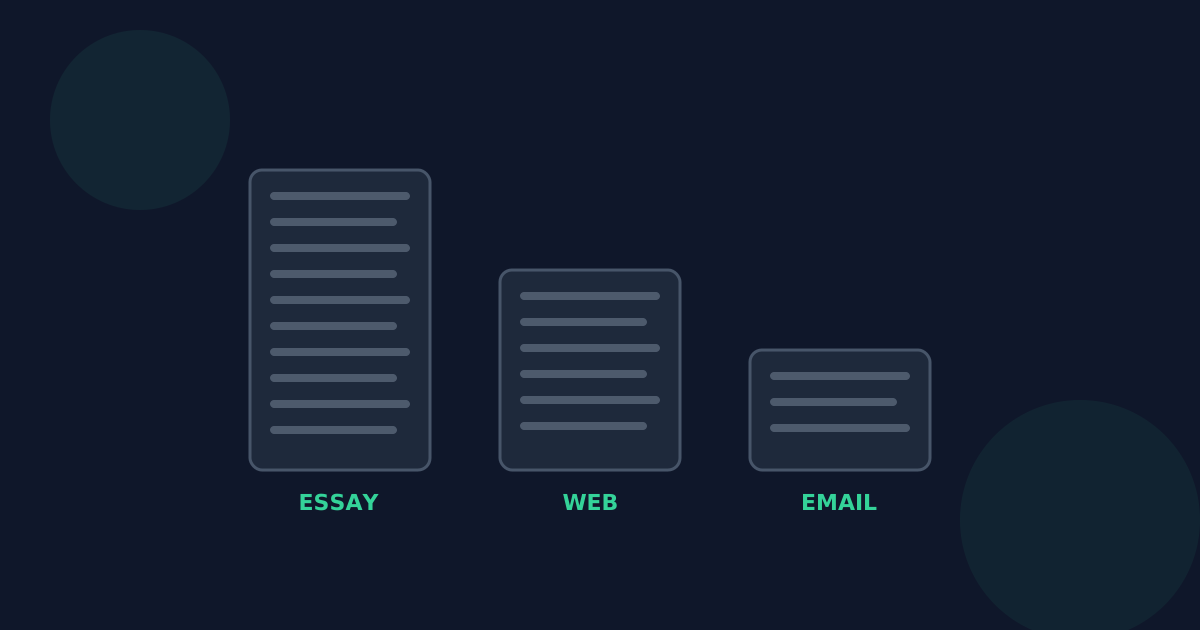
| Web articles and blog posts | Shorter paragraphs that can be scanned on a phone; one-sentence paragraphs are used for emphasis. |
| Short paragraphs, with the request or key point near the top. | |
| Instructions and documentation | Very short paragraphs or numbered steps, one action each. |
| Fiction | Highly variable; by convention, a new paragraph starts each time a different character speaks. |
Signs a paragraph is too long or too short
- Too long: it covers several ideas, the topic sentence is hard to find, or it fills a phone screen with no break.
- Too short: consecutive one-sentence paragraphs that belong to the same idea, making the text feel disjointed.
- Uneven: one paragraph is several times longer than its neighbors — often a sign it contains two points.
How Long Should a Paragraph Be? FAQ
- How many sentences should a paragraph have?
- There is no universal number. Paragraphs should cover one main idea; GOV.UK’s public-sector guidance sets a ceiling of five sentences, and many writers use three to five as a rough rule of thumb for general audiences.
- Is a one-sentence paragraph acceptable?
- Yes, used sparingly. It can emphasize a key point or a transition. Many consecutive one-sentence paragraphs usually mean related ideas should be combined.
- Should paragraphs be shorter online?
- Generally, yes. Screens — especially phones — show fewer words per line, so the same paragraph occupies more vertical space and can look like a wall of text.
- What is the five-paragraph essay?
- A common school format with an introduction, three body paragraphs each making one point, and a conclusion. It is a teaching structure, not a rule for all essays.
- Does dialogue follow different paragraph rules?
- In most fiction, yes. A new paragraph starts whenever the speaker changes, even if the line of dialogue is very short.
Related guides
- Paragraph Length and ReadabilityHow paragraph breaks help readers scan and understand, why paragraphs feel longer on phones, and practical ways to split long paragraphs or combine short ones while editing.
- How Paragraphs Are CountedHow paragraph counters find paragraphs in plain text — line breaks versus blank lines — and how text from Word, Google Docs, Markdown, email, and PDFs affects the count.
Open the tool
Jump into Paragraph Counter when you are ready to process your files.