Home, moving & space
Elevator Door Clearance vs Cabin Dimensions
An elevator cabin can be big enough for a sofa while its door is too small to let the sofa in, and the reverse happens too. The door limits the cross-section that passes; the cabin limits the length that fits with the doors shut. This guide shows how the two interact, why an item that fits the cabin can still be stuck in the lobby, and the few cases where the numbers prove it can’t go in at all.
Ready to try the tool this guide describes?
Two openings, two limits
Carried straight in, an item’s width across and its height must pass the door, and its length in the direction of travel must fit the cabin’s depth. A typical passenger elevator door is much narrower than its cabin, so the door usually decides how an item is held, and the cabin depth decides whether it can be held that way.
That is why the same item can be turned three ways and give three answers. A 72 × 20 × 30 in dresser is far too long to lie in a 54 in deep cabin, but stood on end it is only 20 in from front to back, and its 30 in side clears a 36 in door with 6 in to spare.
Examples against one elevator
| Item (L × W × H) | Result | Tightest point |
|---|---|---|
| 72 × 20 × 30 in dresser | Likely fits | Door width: 6 in to spare |
| 84 × 38 × 34 in sofa | Likely fits | Door height: 0 in (exactly the same size) |
| 50 × 30 × 34 in cabinet | Likely fits | Cabin depth (doors closed): 4 in to spare |
| 80 × 60 × 12 in mattress | Additional measurements required | Cabin depth (doors closed): 6 in too big |
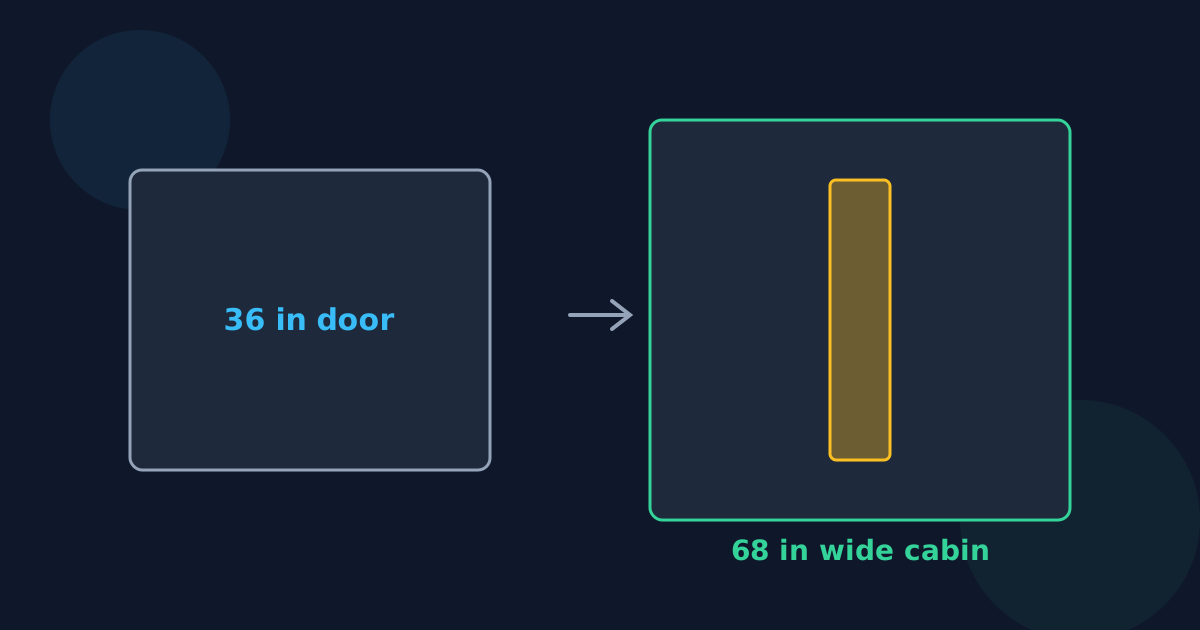
A 36 × 84 in door opening and a 68 in wide, 54 in deep, 92 in high cabin, with a straight run in front of the doors confirmed. The mattress may be tilted; the others are kept level.
When the cabin fits but the door doesn’t
The queen mattress shows the trap. Stood on its end it is 60 in wide and 12 in thick, and the cabin is 68 in wide, so it could stand in there sideways. But a 60 in width won’t pass a 36 in door, and carried through edge first it is 60 in long in a 54 in cabin. It would only end up sideways by turning once inside, which needs room a straight measurement can’t show. That is a question for a test run with the building’s permission, not a calculator.
When the numbers rule it out
Some items can’t go in at any angle, and there are simple tests for that. A box can only fit inside another box if its thinnest side is no wider than the inside’s smallest size, its three sizes add up to no more than the inside’s three sizes, and it is no longer corner to corner.
A 100 × 70 × 60 in crate fails the first test against that 68 × 54 × 92 in cabin: its thinnest side, 60 in, is wider than the cabin’s 54 in depth. No tilting changes that.
What to do with a borderline result
- Remeasure the tightest point to the nearest quarter inch. A fit with 0 in to spare is a coin toss.
- Ask whether legs, feet, or handles come off — they often decide a door-height or door-width fit.
- Ask the building about a freight elevator, a stretcher recess, or using the stairs for that piece.
Elevator Door vs Cabin FAQ
- Why can a long sofa fit a small elevator stood on end?
- Because standing it up turns its length into height, and elevator cabins are taller than they are deep. It then needs the door to be as tall as the sofa is long.
- Is the door or the cabin usually the limit?
- For wide, boxy furniture, the door. For long items like sofas, beds, and mattresses, the cabin depth — unless the item can stand on end.
- Can I count on tilting a mattress diagonally inside?
- Not from measurements alone. It depends on how it enters and on the door’s position, which is why the calculator asks for more measurements rather than saying yes.
- Does the elevator door open wider than its frame?
- No — the narrower of the open doors and the frame is the clear width. Measure the opening, not the door panels.
- What if the item fits the cabin with no room for the movers?
- Then someone has to ride separately or the item goes up alone with the building’s permission. Plan that before moving day, not in the lobby.
Related guides
- Measuring an ElevatorThe five elevator measurements that decide whether furniture fits — door opening, cabin width, depth, and height between handrails — and where to take each.
- Furniture in Apartment ElevatorsBooking the elevator, protecting it, lining long pieces up in a narrow lobby, and reading the rated-load plate when moving furniture in an apartment building.
Open the tool
Jump into Elevator Furniture Fit Calculator when you are ready to process your files.