Work, pay & shifts
Call-Out Pay Rules: Multipliers and Allowances
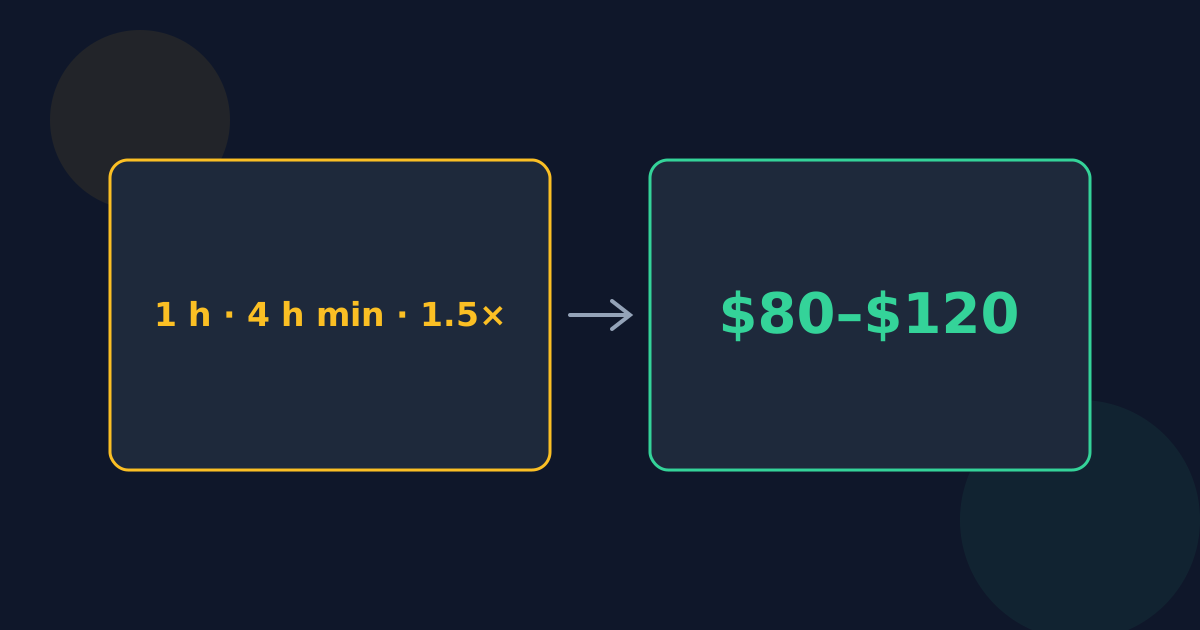
Two call-out policies with the same 4-hour minimum and the same time-and-a-half can pay very different amounts for a 1-hour call. The difference is in how the multiplier and any flat allowance combine with the minimum. This guide puts the common rules side by side so you can match your policy wording to the right calculation.
Ready to try the tool this guide describes?
The rules side by side
At $20 an hour, a 4-hour minimum, a 1.5× call-out multiplier, and — where shown — a $50 allowance:
| Rule | 1 hour worked | 5 hours worked |
|---|---|---|
| Multiplier on every paid hour | $120.00 | $150.00 |
| Multiplier on hours worked; top-up at the normal rate | $90.00 | $150.00 |
| Whichever is more: 4 hours at $20, or hours worked at $30 | $80.00 | $150.00 |
| $50 allowance on top (multiplier on every hour) | $170.00 | $200.00 |
| $50 allowance counted toward the minimum (multiplier on every hour) | $120.00 | $200.00 |
Does the multiplier reach the topped-up hours?
For a 1-hour call, three top-up hours are paid either at $30 or at $20. That one choice is worth $30. A third wording compares two totals instead — the minimum at straight time against the hours worked at the premium rate — and pays the larger, which is the least generous of the three for a short call.
An allowance on top, or toward the minimum?
A flat allowance paid on top always adds its full amount. One that counts toward the minimum is still paid, but it is subtracted from the top-up first: on a 1-hour call with a $90 top-up, the $50 allowance covers part of it and $40 of top-up is added, so the total doesn’t change. Once you work past the minimum there is no top-up, and the allowance adds its full $50 either way.
Reading your policy wording
- “A minimum of four hours’ pay at time and one-half” — the multiplier applies to every paid hour.
- “Time worked at time and one-half, with a minimum of four hours’ pay” — check whether the minimum is at straight time or the premium rate.
- “Four hours at straight time or time worked at time and one-half, whichever is greater” — the whichever-is-more rule.
- “A call-out allowance of $50 in addition to…” — on top; “…which shall count toward…” — toward the minimum.
Multipliers and overtime
A 1.5× call-out multiplier can be the overtime premium itself rather than an extra on top of it. Before adding overtime for the same hours, check whether your policy or agreement says premiums are paid on top of each other or not — many agreements prohibit paying two premiums for the same hours.
Call-Out Pay Rules FAQ
- What does “four hours at time and a half” mean for a 1-hour call-out?
- Usually that all 4 paid hours are at 1.5×: at $20 an hour, 4 × $30 = $120.
- What does “whichever is greater” mean in a call-out clause?
- Work out both amounts and pay the larger. For 1 hour at $20 with a 4-hour minimum: 4 × $20 = $80 against 1 × $30 = $30, so $80.
- Can a call-out allowance replace the minimum?
- If it counts toward the minimum, an allowance at least as large as the top-up means no top-up is added. It never reduces the pay for hours worked.
- Does the call-out multiplier apply to the allowance?
- No. A flat allowance is a fixed amount; the multiplier applies only to hourly pay.
- Which call-out rule is most common?
- It varies by industry and agreement. Read the exact wording, and if it is ambiguous, ask for a worked example of a short call.
Related guides
- Calculating Call-Out PayThe greater-of rule for call-out minimums step by step, with a table showing why pay stays flat until the minimum is passed and what that does to your rate.
- Multiple Call-OutsSeparate minimums, a shared window, or actual time for later calls: how two call-outs in one night are paid, with a worked example and pyramiding explained.
Open the tool
Jump into Call-Out Minimum Pay Calculator when you are ready to process your files.