Work, pay & shifts
Calendar Days vs. Working Days for Prorated Pay
The same start date can produce two different prorated amounts depending on whether the period is counted in calendar days or working days. Neither method is wrong — employers choose one — but the gap can be large, and it depends on where weekends fall. This guide compares the two on real dates so you can see when they agree, when they don’t, and why month length matters.
Ready to try the tool this guide describes?
Two ways to count a period
- Calendar days count every day, weekends included. A two-week period is 14 days.
- Working days count only scheduled work days, usually Monday to Friday. A two-week period is 10 days.
Same period, different start dates
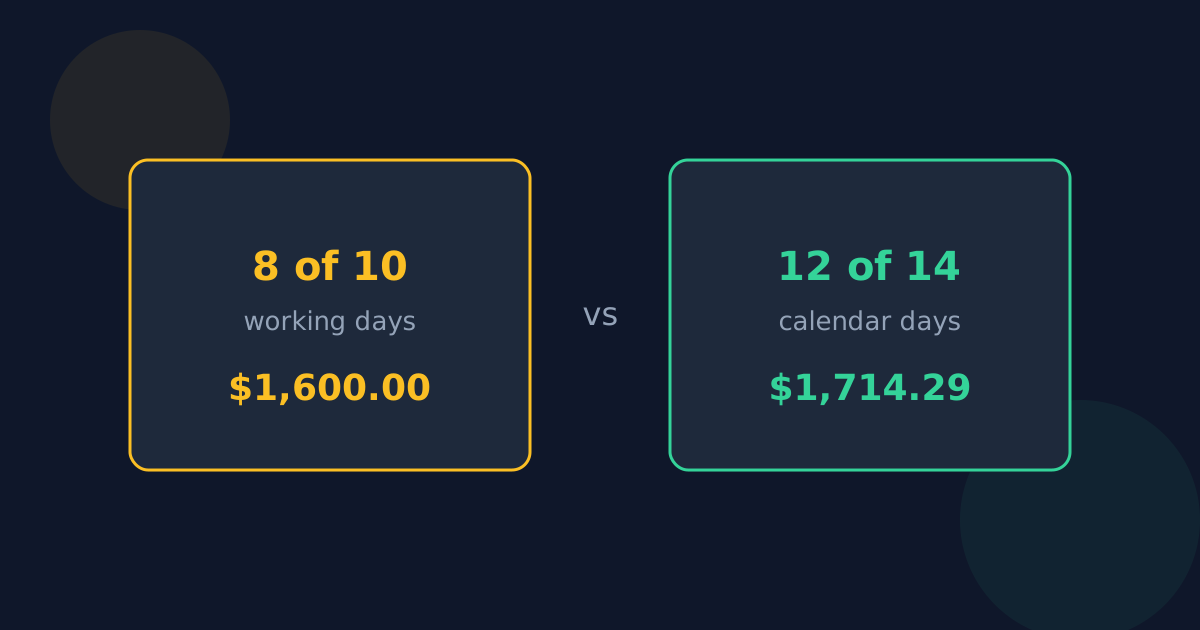
A $2,000.00 pay period from Monday, October 5 to Sunday, October 18, 2026 — 10 working days, 14 calendar days:
| First paid day | Working days | By working days | Calendar days | By calendar days |
|---|---|---|---|---|
| Mon, Oct 5 | 10 | $2,000.00 | 14 | $2,000.00 |
| Wed, Oct 7 | 8 | $1,600.00 | 12 | $1,714.29 |
| Sat, Oct 10 | 5 | $1,000.00 | 9 | $1,285.71 |
| Mon, Oct 12 | 5 | $1,000.00 | 7 | $1,000.00 |
| Wed, Oct 14 | 3 | $600.00 | 5 | $714.29 |
Why weekends make the difference
Starting on Monday, October 12 gives the same answer both ways, because the paid part is exactly one week — half the working days and half the calendar days. Starting on Saturday, October 10 does not: the calendar method pays for that weekend, and the working-day method doesn’t, a difference of $285.71. The more weekend days fall inside the paid part, the more the calendar method pays compared with the working-day method.
Monthly pay and month length
For a monthly amount, the value of one day changes with the month. On $4,000.00 a month:
- By calendar days, a day is worth $142.86 in February 2026 (28 days) and $129.03 in March 2026 (31 days).
- By working days, a day is worth $200.00 in February 2026 (20 working days) and $181.82 in March 2026 (22 working days).
Which one to use
Use whatever your employer, offer letter, or payroll policy specifies, and apply it consistently: the days to pay and the days in the full period must be counted the same way. If a policy doesn’t say, the working-day and calendar-day results bracket what you might see.
Calendar vs. Working Days FAQ
- Is prorated pay based on calendar days or working days?
- Either, depending on the employer. Both are common, and they can give different amounts for the same dates.
- Why is calendar-day proration higher when I start on a Saturday?
- Because it counts the weekend days as paid days, while the working-day method doesn’t count them at all.
- When do both methods give the same result?
- When the paid part covers the same share of working days as calendar days — for example exactly one full week of a two-week period.
- How many working days are in February 2026?
- 20, counting Monday to Friday. March 2026 has 22.
- Can I mix calendar and working days?
- No. Count the days to pay and the days in the full period the same way, or the proportion is wrong.
Related guides
- How to Prorate PayThe proration formula with worked examples by working days and by hours, monthly salaries, and how rounding to the cent works.
- Starting or Leaving Mid-PeriodWorked examples of prorated pay for a first paycheck and a last paycheck, when proration applies, and what else a first or final check can include.
Open the tool
Jump into Pay Period Proration Calculator when you are ready to process your files.