Text & writing
Accents, Punctuation, and Other Alphabets in URL Slugs
Titles are full of characters that do not belong in a tidy web address: accented letters, apostrophes, ampersands, emoji, and whole alphabets other than English. How a slug generator treats each one decides whether the result is readable. This guide explains the common approaches and their trade-offs.
Ready to try the tool this guide describes?
Accented Latin letters
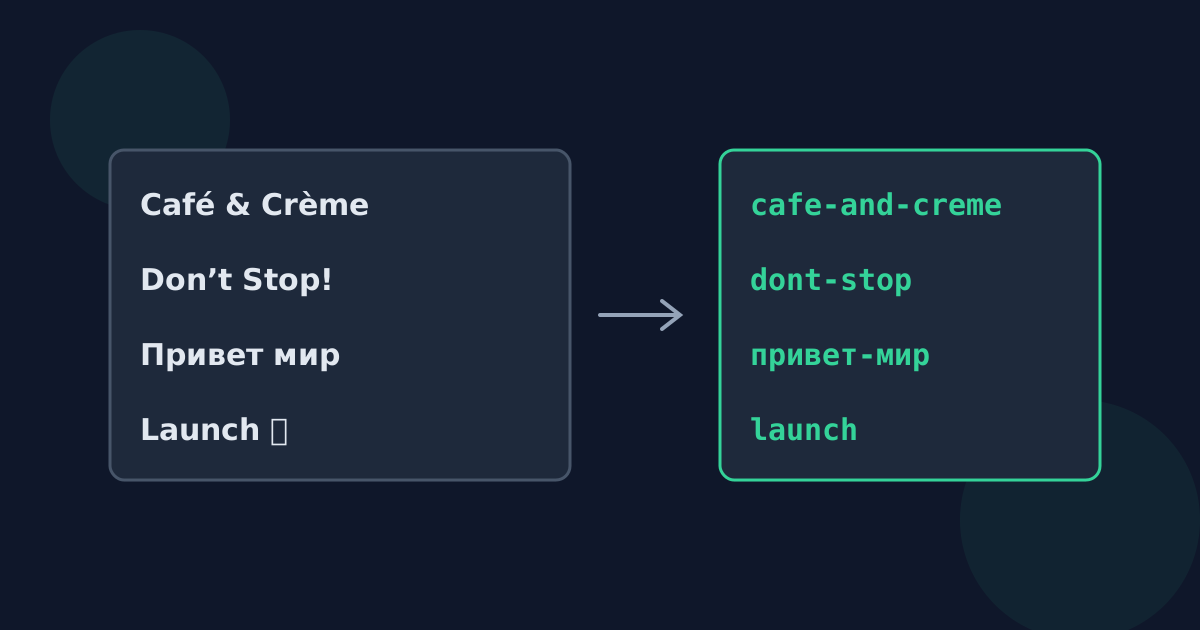
Letters such as é, ü, and ñ are usually simplified to their base letter — Café becomes cafe, Müller becomes muller. A few letters are spelled out instead: ß becomes ss and æ becomes ae. The result is plain, easy to type, and works everywhere, at the cost of sometimes changing a word slightly.
Punctuation and symbols
| In the title | Common slug treatment | Example |
|---|---|---|
| Apostrophes | Removed, not replaced | Don’t Stop → dont-stop |
| Ampersand between words | Written as “and” | Salt & Pepper → salt-and-pepper |
| Other punctuation | Becomes a hyphen, then doubled hyphens collapse | Q&A: Why? → q-a-why |
| Emoji | Removed | Launch 🚀 Day → launch-day |
| Numbers | Kept | Top 10 Tips → top-10-tips |
Other alphabets
Titles in Russian, Greek, Arabic, Hindi, Chinese, or Japanese raise a real choice. Modern browsers display these characters in the address bar, and many platforms accept them, so keeping them — Привет мир becomes привет-мир — gives a slug that native readers understand. When shared as plain text, though, they are often percent-encoded into long strings of codes.
The alternatives are transliteration (writing the words in Latin letters, such as privet-mir), which needs language-specific rules, or dropping non-ASCII letters, which can leave an empty slug. Sites that must support only plain ASCII addresses often use a short English or numeric slug for such pages instead.
Choosing a policy
- Pick one rule for the whole site and apply it consistently.
- Check what your platform or CMS already does — it may convert characters automatically when you save a page.
- Review generated slugs for titles in other languages rather than trusting an automatic result blindly.
Accents and Symbols in Slugs FAQ
- Should accents be removed from URL slugs?
- Usually, yes, for Latin letters. Café becomes cafe, which is easier to type and works everywhere.
- Can a URL contain Chinese, Cyrillic, or Arabic letters?
- Yes. Browsers support them, although they are percent-encoded when copied as plain text. Some sites prefer ASCII-only slugs for that reason.
- What happens to apostrophes in slugs?
- They are normally removed without adding a hyphen, so don’t becomes dont rather than don-t.
- Why is my generated slug empty?
- The title had no letters or numbers the generator could keep — for example only emoji, or only letters from another script with an ASCII-only setting.
- What is transliteration?
- Writing words from one alphabet in another, such as Привет as privet. It needs rules for each language, so many slug tools keep the original letters instead.
Related guides
- What Makes a Good URL SlugHow to write short, readable, lowercase URL slugs, what to leave out, and why changing a slug after publishing needs a redirect.
- Hyphens vs. UnderscoresWhy hyphens are the standard word separator in web addresses, how underscores are treated, and when underscores still make sense.
Open the tool
Jump into URL Slug Generator when you are ready to process your files.