Vehicles & EVs
What Is EV Charging Efficiency?
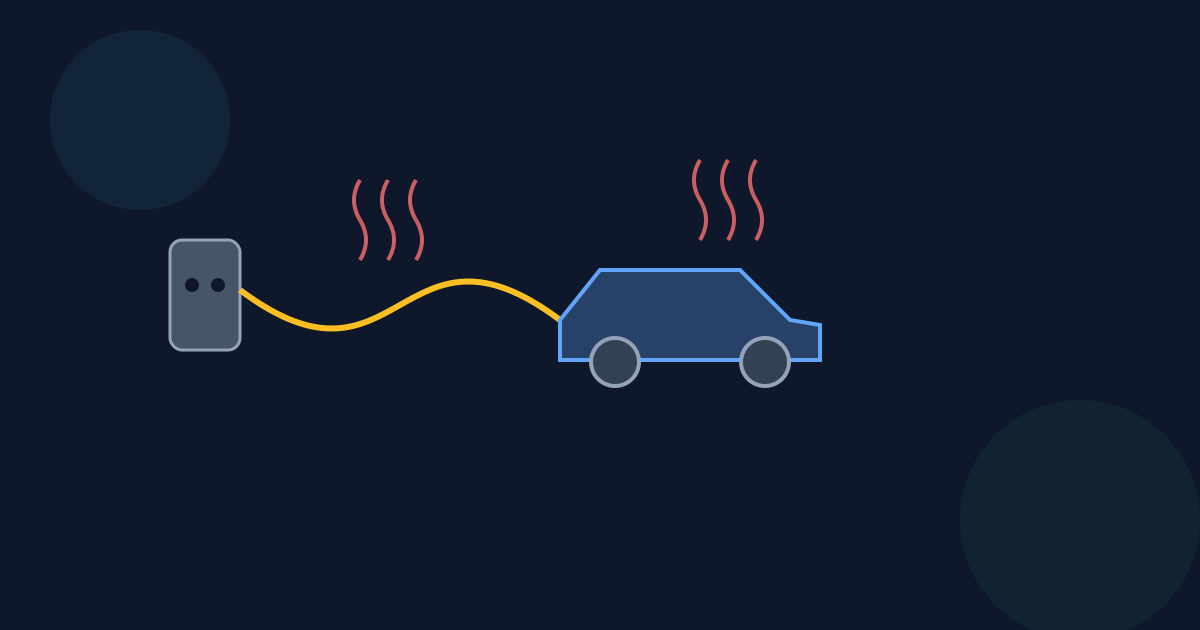
Charging efficiency is the share of electricity from the grid that ends up stored in the battery. The rest becomes heat or powers the car while it charges.
Ready to try the tool this guide describes?
The definition
Charging efficiency = energy into the battery ÷ electricity from the grid. If the meter counts 60 kWh and the battery gains 54 kWh, the efficiency is 54 ÷ 60 = 90%.
Where the electricity goes
- The car’s onboard charger converts household AC to DC for the battery, and the conversion gives off heat.
- Cables and connections lose a little to resistance.
- The battery itself warms slightly as it charges.
- The car’s computers, pumps, and fans stay on while it charges, and may heat or cool the battery.
What an efficiency figure means
| Charging efficiency | Lost per 100 kWh from the grid | Grid kWh per battery kWh |
|---|---|---|
| 95% | 5 kWh | 1.053 |
| 90% | 10 kWh | 1.111 |
| 85% | 15 kWh | 1.176 |
| 80% | 20 kWh | 1.25 |
Measuring your own
Compare two readings for the same charge: the electricity counted by your home charger’s app or a dedicated meter, and the energy added reported by the car. If the charger shows 33 kWh and the car shows 30 kWh, your efficiency for that charge was 30 ÷ 33 = 90.91%. Several charges give a better average than one.
Typical ranges
Published estimates commonly put home Level 2 charging somewhere around 85–95%, with Level 1 (120 V) charging often lower because the car stays awake longer for each kWh. Treat these as rough guides; cars, chargers, and weather vary.
EV Charging Efficiency FAQ
- What is a good EV charging efficiency?
- Around 90% is a common estimate for home Level 2 charging. Higher is better.
- Is charging efficiency the same as vehicle efficiency?
- No. Charging efficiency is about getting energy into the battery; vehicle efficiency (mi/kWh) is about using it to drive.
- How do I measure my charging efficiency?
- Divide the energy added reported by the car by the electricity counted by the charger or meter for the same session.
- Why is Level 1 charging less efficient?
- A slow charge keeps the car’s systems running for longer per kWh stored, and that overhead is a larger share of a small charging power.
- Does cold weather lower charging efficiency?
- Often, because the car may heat the battery while charging, using grid electricity that isn’t stored.
Related guides
- Electricity Lost Charging an EVHow many kWh an EV loses while charging per session and per year at different charging efficiencies, and how Level 1, Level 2, and DC fast charging compare.
- Cost of EV Charging LossesWork out what EV charging losses cost per session and per year, avoid the common percentage mistake, and see what better charging efficiency is worth.
Open the tool
Jump into EV Charging Loss Calculator when you are ready to process your files.