Vehicles & EVs
How Much Electricity Is Lost When Charging an EV?
Charging losses are a few kWh per session — small at first sight, but they add up over a year of driving.
Ready to try the tool this guide describes?
Per session
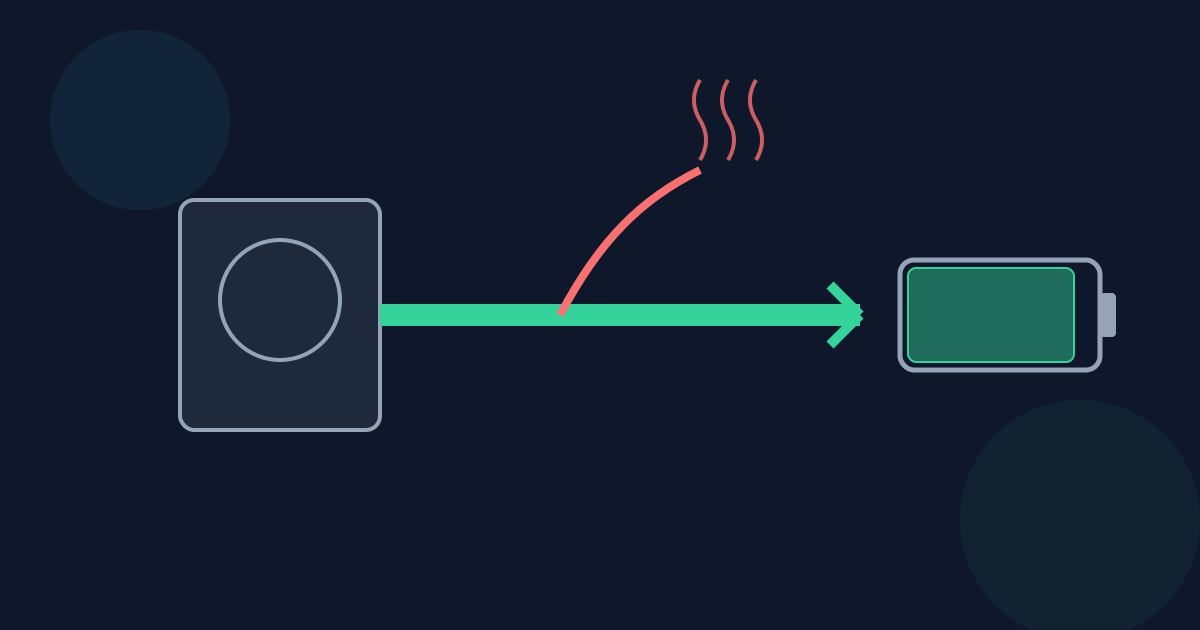
Delivering 54 kWh to the battery at 90% efficiency takes 60 kWh from the grid, so 6 kWh is lost — 10% of the electricity drawn. At 85% the same charge takes 63.53 kWh and loses 9.53 kWh.
Over a year
12,000 miles at 3.5 mi/kWh uses about 3,428.57 kWh from the battery:
| Charging efficiency | From the grid per year | Lost per year |
|---|---|---|
| 90% | 3,809.52 kWh | 380.95 kWh |
| 85% | 4,033.61 kWh | 605.04 kWh |
| 80% | 4,285.71 kWh | 857.14 kWh |
Level 1, Level 2, and DC fast charging
These are approximate ranges. Your car, charger, and climate set the actual figure.
- Level 1 (120 V): slow, so the car’s own systems run for many hours per charge; losses are often the highest share.
- Level 2 (240 V): the usual home and workplace charger; commonly estimated at around 85–95% efficient.
- DC fast charging: the AC-to-DC conversion happens in the station, often before its meter, and the battery may be heated or cooled while charging.
Measure the loss against the grid
The loss share is the energy lost ÷ the electricity drawn. 6 kWh out of 60 kWh is 10%. Dividing by the 54 kWh delivered instead gives 11.1%, which overstates it — the grid electricity is what you paid for.
Reducing losses
- Charge at 240 V rather than 120 V where you can.
- Charge soon after driving in cold weather, while the battery is still warm.
- Keep the charging equipment and connectors in good condition.
Electricity Lost Charging an EV FAQ
- How much energy is lost when charging an EV?
- At 90% efficiency, 10% of the grid electricity: 6 kWh out of 60 kWh drawn.
- How many kWh are lost per year?
- About 380.95 kWh for 12,000 miles at 3.5 mi/kWh and 90% efficiency; about 857.14 kWh at 80%.
- Is Level 2 charging more efficient than Level 1?
- Usually, because the car’s overhead runs for fewer hours per kWh stored.
- Are losses higher when it is cold?
- Often, because the car may warm the battery during charging.
- Should the loss percentage use the battery or grid figure?
- The grid figure — the electricity you drew and pay for.
Related guides
- EV Charging EfficiencyWhat EV charging efficiency means, where the electricity goes between the meter and the battery, and how to measure your own efficiency.
- Cost of EV Charging LossesWork out what EV charging losses cost per session and per year, avoid the common percentage mistake, and see what better charging efficiency is worth.
Open the tool
Jump into EV Charging Loss Calculator when you are ready to process your files.