Work, pay & shifts
Setting Aside Taxes as a Freelancer
No employer withholds tax from freelance income, so part of every payment belongs to the tax authorities before you see it. Setting a rate from the take-home pay you want means grossing it up for tax first — and the obvious way to do that is wrong. This guide covers the arithmetic and some practical habits. It is not tax advice: what you actually owe depends on where you live and how your business is set up.
Ready to try the tool this guide describes?
Gross up by dividing, not multiplying
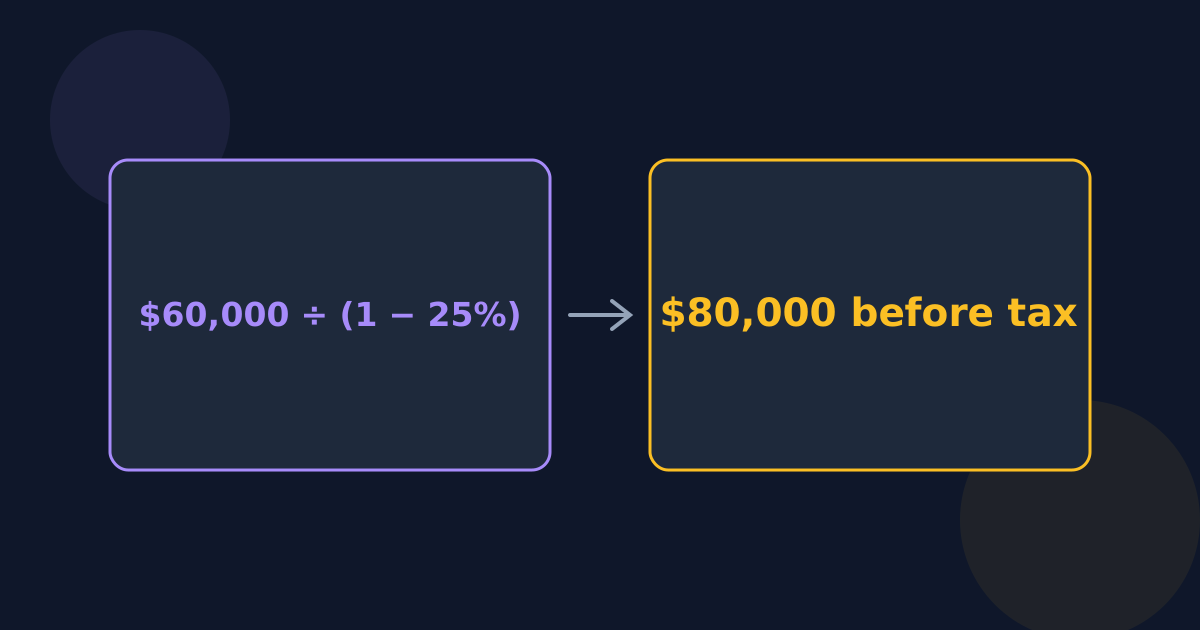
To take home $60,000 after setting aside 25%, you need $60,000 ÷ (1 − 25%) = $80,000 before tax: 25% of $80,000 is $20,000, leaving $60,000. Adding 25% instead — $60,000 × 1.25 = $75,000 — leaves only $56,250 after the 25% set-aside, $3,750 short.
Different set-aside rates
Income needed before tax for $60,000 of take-home pay:
| Set-aside rate | Income before tax | Set aside |
|---|---|---|
| 20% | $75,000.00 | $15,000.00 |
| 25% | $80,000.00 | $20,000.00 |
| 30% | $85,714.29 | $25,714.29 |
| 35% | $92,307.69 | $32,307.69 |
Choosing a set-aside rate
- Income tax, plus any self-employment or social-insurance contributions where you live, plus local taxes.
- Last year’s effective rate — total tax ÷ profit — is a reasonable starting point.
- An accountant can estimate it for your situation; when in doubt, set aside a little more.
- A single rate is a simplification. Real taxes have brackets, allowances, and deductions this arithmetic ignores.
Putting the money aside
- Open a separate account just for tax.
- Move your set-aside percentage of each client payment into it when the payment arrives.
- Pay any estimated or advance tax installments your jurisdiction requires from that account.
- Compare the balance with your actual tax bill each year and adjust the percentage.
Freelance Tax Set-Aside FAQ
- What percentage should freelancers set aside for taxes?
- There isn’t one figure that fits everyone. It depends on your income, your expenses, where you live, and your business structure — an accountant or last year’s return is the best guide.
- Is the set-aside on revenue or profit?
- Tax is usually on profit — revenue less allowable expenses. The Freelance Hourly Rate Calculator applies the set-aside to your income goal, after expenses.
- Does a profit buffer get taxed too?
- If it ends up as profit, usually yes. The calculator doesn’t add tax on the buffer, so the buffer slightly overstates what you keep.
- Why not just add the tax percentage to my income?
- Because tax is taken from the larger, pre-tax amount. Adding 25% to $60,000 gives $75,000, and setting 25% of that aside leaves $56,250, not $60,000.
- Is this the same as estimated tax payments?
- No. The set-aside is money you keep ready; estimated or advance payments are what you actually pay, when your tax authority requires them.
Related guides
- Freelance Hourly RateThe freelance hourly rate formula, a step-by-step example, why dividing by 2,080 hours underprices you, and how billable hours change the minimum rate.
- Freelance ExpensesThe business costs a freelance rate has to cover that an employer used to pay: an example $12,000 budget, what each line adds per billable hour, and how to spread big purchases.
Open the tool
Jump into Freelance Hourly Rate Calculator when you are ready to process your files.