Work, pay & shifts
Freelance Business Expenses to Include in Your Rate
As an employee, someone else pays for your laptop, software, insurance, and the accountant. As a freelancer, your rate does. Leaving these out is one of the commonest reasons a rate that looked fine turns out not to be. This guide lists what to include and shows what it adds to each billable hour.
Ready to try the tool this guide describes?
Costs an employer used to cover
- Equipment: computer, phone, peripherals, and their replacement.
- Software and subscriptions.
- Insurance: professional liability, equipment, and — where it isn’t provided publicly — health cover.
- Accounting, bookkeeping, and legal help.
- Internet and phone.
- Workspace: a coworking membership or the business share of a home office.
- Marketing: website, portfolio, listings.
- Training and professional memberships.
- Payment and platform fees.
An example budget
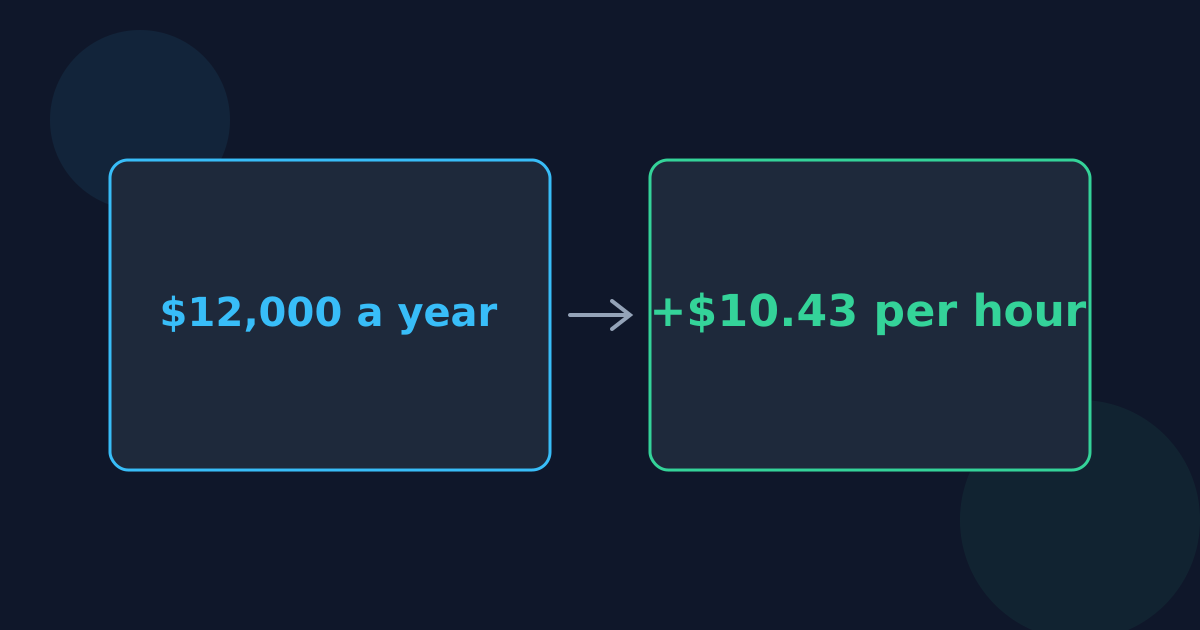
What each line adds per hour at 1,150 billable hours a year:
| Expense | A year | Per billable hour |
|---|---|---|
| Software and subscriptions | $1,800.00 | $1.57 |
| Equipment (spread over 3 years) | $1,000.00 | $0.87 |
| Health insurance | $6,000.00 | $5.22 |
| Professional insurance | $600.00 | $0.52 |
| Accounting | $1,200.00 | $1.04 |
| Internet and phone | $900.00 | $0.78 |
| Marketing and website | $500.00 | $0.43 |
| Total | $12,000.00 | $10.43 |
Every figure is an illustration — use your own.
Spreading large purchases
A $3,000 computer you replace every three years costs $1,000 a year. Put the yearly figure in your budget so the rate saves for the next one, rather than taking a hit the year you buy it.
Costs that grow with revenue
Payment-processing and platform fees are a percentage of what you bill. At 3% on $92,000 of invoices, that is $2,760 a year — enter an estimate as a yearly amount, and revisit it if your revenue changes a lot.
Expenses, buffer, and tax are different
- Expenses are costs you expect to pay.
- A buffer covers what you can’t predict: slow months, late payers, a broken laptop.
- Tax is a share of your profit, worked out separately — don’t list it as an expense.
Freelance Expenses FAQ
- Is health insurance a business expense?
- For tax purposes that depends on where you live and how your business is set up. For your rate, include it either way — the rate has to pay for it.
- Should taxes count as an expense?
- No. Tax depends on profit, so it is set aside from income rather than listed as a cost.
- What about a home office?
- Include the share of rent, energy, and internet the business uses, however you estimate it.
- Should I include a salary for myself as an expense?
- No — that is the income goal. Expenses are the costs of running the business on top of what you pay yourself.
- What if my expenses vary a lot from year to year?
- Use an average of recent years, and put the uncertainty into a buffer rather than the expense figure.
Related guides
- Freelance Hourly RateThe freelance hourly rate formula, a step-by-step example, why dividing by 2,080 hours underprices you, and how billable hours change the minimum rate.
- Freelance Tax Set-AsideHow to gross up a take-home income goal for tax, why multiplying by 1.25 comes up short, a table of set-aside rates, and practical ways to put the money aside. Not tax advice.
Open the tool
Jump into Freelance Hourly Rate Calculator when you are ready to process your files.