Work, pay & shifts
Revenue Target vs Take-Home Pay
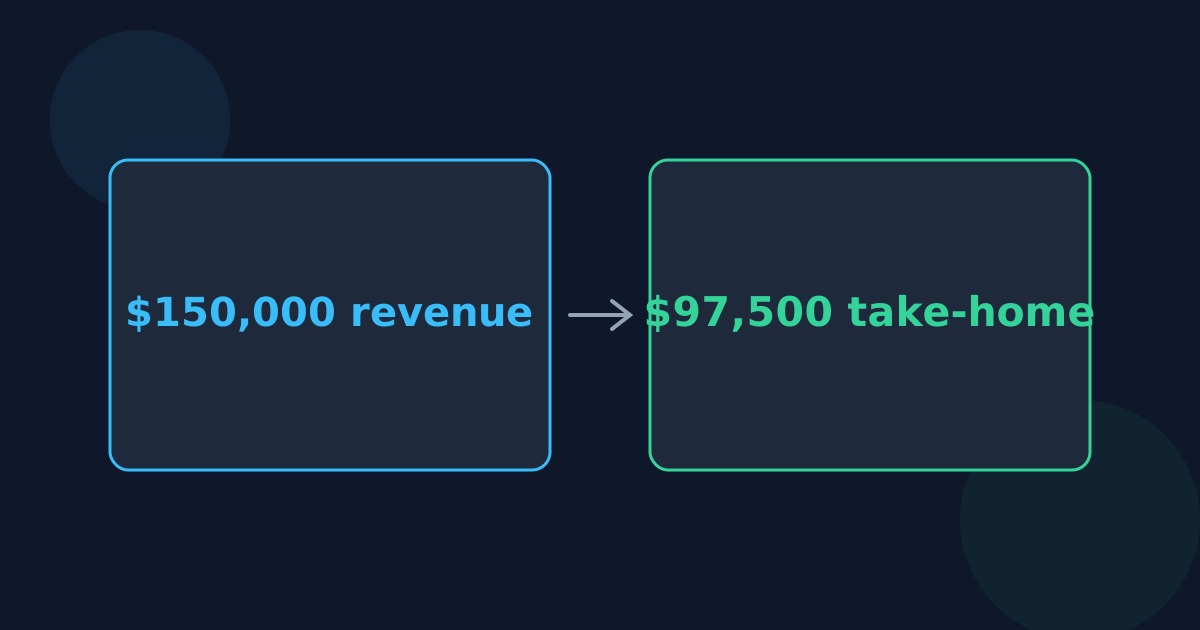
“I want to make $150,000” can mean three very different targets for someone who bills clients: revenue, income after business expenses, or take-home pay after tax. Planning to the wrong one can leave a third of the goal missing. This guide separates them and shows how to convert from one to another.
Ready to try the tool this guide describes?
Three different numbers
- Revenue: what clients pay you.
- Income after expenses (profit): revenue less business expenses.
- Take-home pay: income after expenses, less the tax on it.
From revenue down to take-home
| Step | Amount |
|---|---|
| Revenue | $150,000.00 |
| Less business expenses | −$20,000.00 |
| Income before tax | $130,000.00 |
| Less a 25% tax set-aside | −$32,500.00 |
| Take-home | $97,500.00 |
The 25% set-aside is an example of a single rate you might choose, not a tax calculation.
Working back up from take-home
- Start with the take-home pay you want: $97,500.
- Gross it up for tax by dividing: $97,500 ÷ (1 − 25%) = $130,000.
- Add business expenses: $130,000 + $20,000 = $150,000 of revenue.
- Divide by your rate: $150,000 ÷ $100 = 1,500 billable hours.
Picking the right target type
In the Billable Hours Target Calculator, a gross revenue target of $150,000 at $100 an hour needs 1,500 hours. The same $150,000 as income after $20,000 of expenses needs $170,000 of revenue — 1,700 hours. Neither includes tax; to start from the take-home pay you want, the Freelance Hourly Rate Calculator includes a tax set-aside.
Revenue vs Take-Home FAQ
- Is revenue the same as salary?
- No. A salary is closer to income before tax with no business expenses to pay. Comparing a salary with revenue overstates what billing work pays.
- Why divide for tax instead of multiplying?
- Because the tax is a share of the larger, pre-tax amount. $97,500 × 1.25 is $121,875, and 25% of that leaves only $91,406.25.
- Should savings be part of the target?
- If they come out of take-home pay, they are already included. A buffer for slow months is usually better added on top of expenses.
- What tax rate should I use?
- Your own estimate, ideally from last year’s return or an accountant. The figures here use 25% only as an example.
- Do expenses reduce my tax?
- Often, because tax is usually charged on profit rather than revenue. That is why the set-aside is applied to income after expenses.
Related guides
- Billable Hours NeededTurn a revenue goal into billable hours: the formula, a rate-by-rate table for a $120,000 target, what to do when the hours don’t fit, and how booked work changes the plan.
- Billable Hours and Time OffTime off doesn’t reduce a revenue target — it squeezes the same billable hours into fewer weeks. See how 0 to 8 weeks off changes weekly hours and utilization, and how paid and unpaid leave differ.
Open the tool
Jump into Billable Hours Target Calculator when you are ready to process your files.