Work, pay & shifts
PTO Payout: Gross vs Net and Tax Withholding
The payout figure in an offer letter or HR email is almost always the gross amount. What reaches your bank account is less, because a PTO payout is paid as wages and taxed like them — sometimes with a larger withholding than a normal paycheck. This guide explains the gap between gross and net, using US withholding as the example.
Ready to try the tool this guide describes?
Why the deposit is smaller
- Federal income tax withholding.
- Social Security (6.2%) and Medicare (1.45%).
- State and local income tax, where they apply.
- Any deductions your benefits or retirement plan take from wages.
Two ways federal tax is withheld
A payout is usually treated as supplemental wages. If it is paid separately from your regular pay, employers may withhold federal income tax at a flat 22% (37% on supplemental wages over $1 million in a year). If it is added to a regular paycheck, they may instead withhold on the combined amount as if you earned it every pay period, which can push the withholding higher.
A worked example
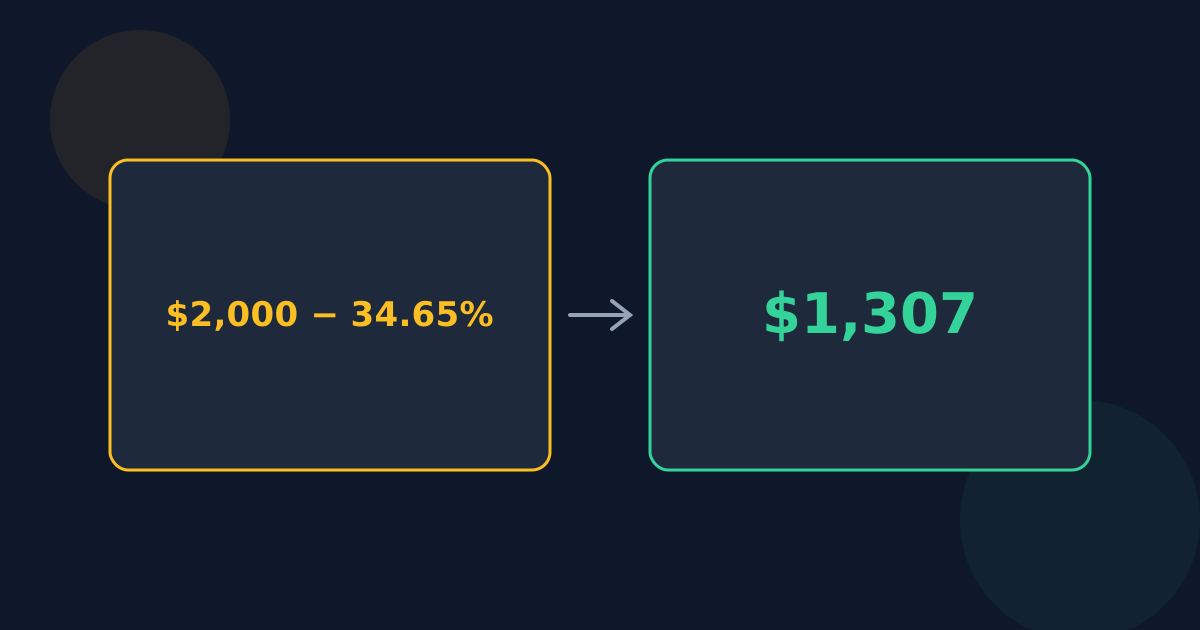
A $2,000 payout with a flat 22% federal withholding and a 5% state income tax:
| Item | Rate | Amount |
|---|---|---|
| Gross payout | $2,000.00 | |
| Federal income tax | 22% | −$440.00 |
| Social Security | 6.2% | −$124.00 |
| Medicare | 1.45% | −$29.00 |
| State income tax | 5% | −$100.00 |
| Estimated deposit | 34.65% withheld | $1,307.00 |
The 5% state rate is only for illustration. Use the rates from your own pay stub.
Withholding isn’t your final tax
Withholding is an advance payment. When you file your return, the payout is added to your other income and taxed at your actual rates. If 22% was more than your real rate, the difference comes back as part of a refund; if it was less, you owe the rest.
Retirement plan contributions
Whether 401(k) or similar contributions are taken from a payout depends on how your plan defines eligible pay. Some plans include it, some exclude it, and a payout after you leave may fall outside the plan’s rules entirely.
PTO Payout Gross vs Net FAQ
- Is a PTO payout taxed at a higher rate?
- It is taxed as ordinary income at your normal rates. It can look higher because withholding on it may be a flat 22% or calculated as if you were paid that much every period.
- Is a PTO payout subject to Social Security and Medicare?
- Yes. It is wages, so the usual 6.2% Social Security and 1.45% Medicare apply, up to the yearly Social Security wage limit.
- Why was more taken from my payout than from my paycheck?
- Your employer may have combined it with your regular pay, which withholds as though that larger amount were your normal pay for every period.
- Can my PTO payout go into my 401(k)?
- Only if your plan counts it as eligible pay and it is paid while you are still covered by the plan. Ask the plan administrator.
- Does the PTO Payout Calculator estimate taxes?
- No. It shows the gross amount and subtracts only the percentages or amounts you enter, so you can use the rates on your own pay stub.
Related guides
- Calculating a PTO PayoutThe PTO payout formula with day-to-hour and salary-to-hourly conversions, partial-payout policies, maximums, and which hourly rate is used.
- Unused PTO When You LeaveHow state law and your employer’s written policy decide whether unused PTO is paid when you leave, and what to ask HR before you resign.
Open the tool
Jump into PTO Payout Calculator when you are ready to process your files.