Calculators & everyday math
Percentage Increases in Pay, Prices, and Markup
Percentage increases show up on pay slips, price tags, and recipe cards, and in how businesses set prices. The arithmetic is always the same, but each setting has its own trap. Here are the common ones, with worked numbers.
Ready to try the tool this guide describes?
A pay rise
A 4% raise on an hourly rate of $22.50 adds $0.90, giving $23.40 an hour. Over a 40-hour week that is $36 more before any deductions. Check whether a raise is quoted on hourly, weekly, or yearly pay — the percentage is the same, but the dollar figures are not.
A price rise
If a $3.80 item goes up 5%, the new price is $3.99. Small percentages on small prices hide easily: 5% of $3.80 is just $0.19.
Scaling a recipe
To make 50% more of a recipe, multiply every ingredient by 1.5: 240 g of flour becomes 360 g and 3 eggs become 4.5 — round to what is practical. Cooking times don’t scale the same way, so check the dish rather than multiplying the time.
Markup is not margin
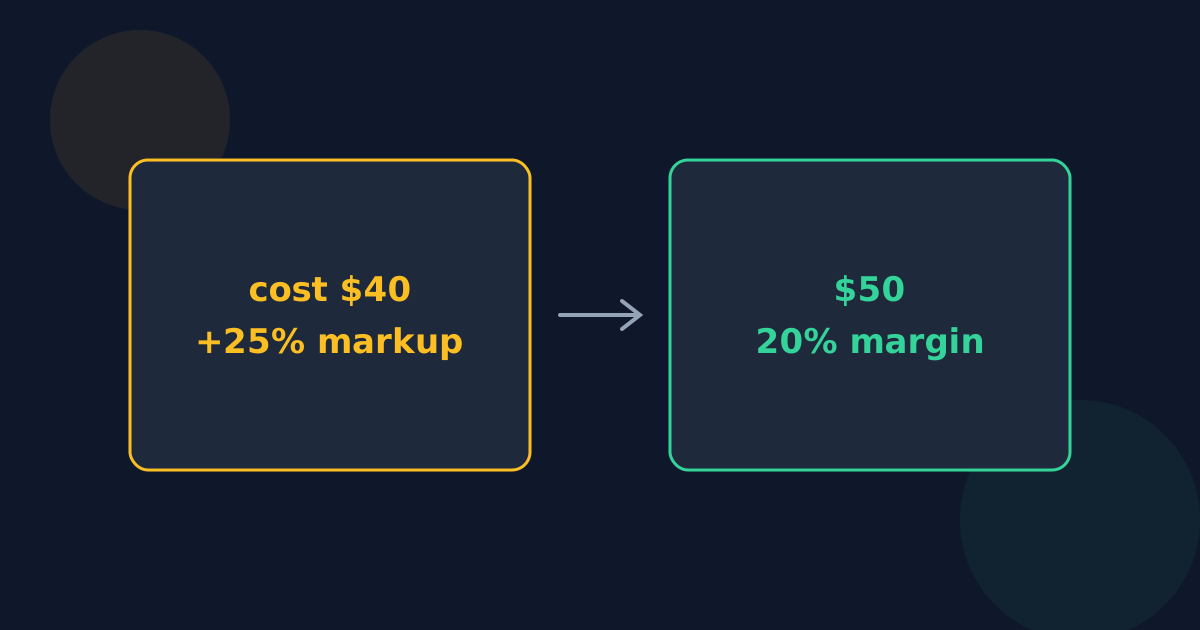
Adding a percentage to a cost is a markup. A 25% markup on an item that costs $40 gives a price of $50. The $10 profit is 25% of the cost but only 20% of the $50 price — that 20% is the margin. Markup is measured from the cost and margin from the price, so the same sale always has a bigger markup than margin.
| Markup on cost | Price from a $40 cost | Margin on price |
|---|---|---|
| 20% | $48.00 | 16.67% |
| 25% | $50.00 | 20% |
| 50% | $60.00 | 33.33% |
| 100% | $80.00 | 50% |
Undoing an increase
To find the value before a known increase, divide by the multiplier. $23.40 after a 4% raise came from $23.40 ÷ 1.04 = $22.50. Taking 4% off $23.40 would give $22.46 — slightly wrong, because the 4% was worked out on the smaller number.
Pay, Prices, and Markup FAQ
- How do I work out a pay rise?
- Multiply the current pay by 1 plus the raise ÷ 100. A 3% raise on $50,000 a year is $50,000 × 1.03 = $51,500. To find a raise’s percentage, divide the difference by the old pay and multiply by 100.
- What is the difference between markup and margin?
- Markup is profit as a percentage of cost; margin is profit as a percentage of the selling price. A $40 item sold for $50 has a 25% markup and a 20% margin.
- How do I convert a markup to a margin?
- Margin = markup ÷ (100 + markup) × 100. A 25% markup is 25 ÷ 125 × 100 = 20% margin.
- How do I remove a percentage increase to find the original price?
- Divide by 1 + the percentage ÷ 100. $57.50 after a 15% increase was $57.50 ÷ 1.15 = $50.
- Does a percentage increase depend on the currency?
- No. Percentages are ratios, so the arithmetic is the same in any currency or unit.
Related guides
- Increase by a PercentageAdd a percentage to a number in two steps or one, with a multiplier table, how chained increases compound, and ways to check the answer.
- Increase vs. ChangeAdding a known percentage to a value and measuring how much a value grew are different calculations. How to tell them apart and which to use.
Open the tool
Jump into Percentage Increase Calculator when you are ready to process your files.