Calculators & everyday math
Percentage Increase vs. Percentage Change
“Percentage increase” is used for two different calculations: adding a known percentage to a value, and measuring how much a value grew. They use the same numbers in opposite directions, and mixing them up gives wrong answers. This guide separates the two.
Ready to try the tool this guide describes?
Two questions, one relationship
| Question | You know | You find | Working |
|---|---|---|---|
| What is 80 increased by 25%? | Start and percentage | New value | 80 × (1 + 25 ÷ 100) = 100 |
| By what percent did 80 grow to 100? | Start and new value | Percentage | (100 − 80) ÷ 80 × 100 = 25% |
Which calculator to use
- The Percentage Increase Calculator, when the percentage is given — a rise that has been announced, a markup you are applying, a target to hit.
- The Percentage Change Calculator, when both values are known and the percentage is what you want — how much sales grew or how much a price went up.
Change can go either way
Percentage change can come out negative (a decrease) or zero. A percentage increase, as the Percentage Increase Calculator uses the term, always adds. If a growth calculation comes out negative, the value actually fell — you want percentage change or percentage decrease.
The base is always the starting value
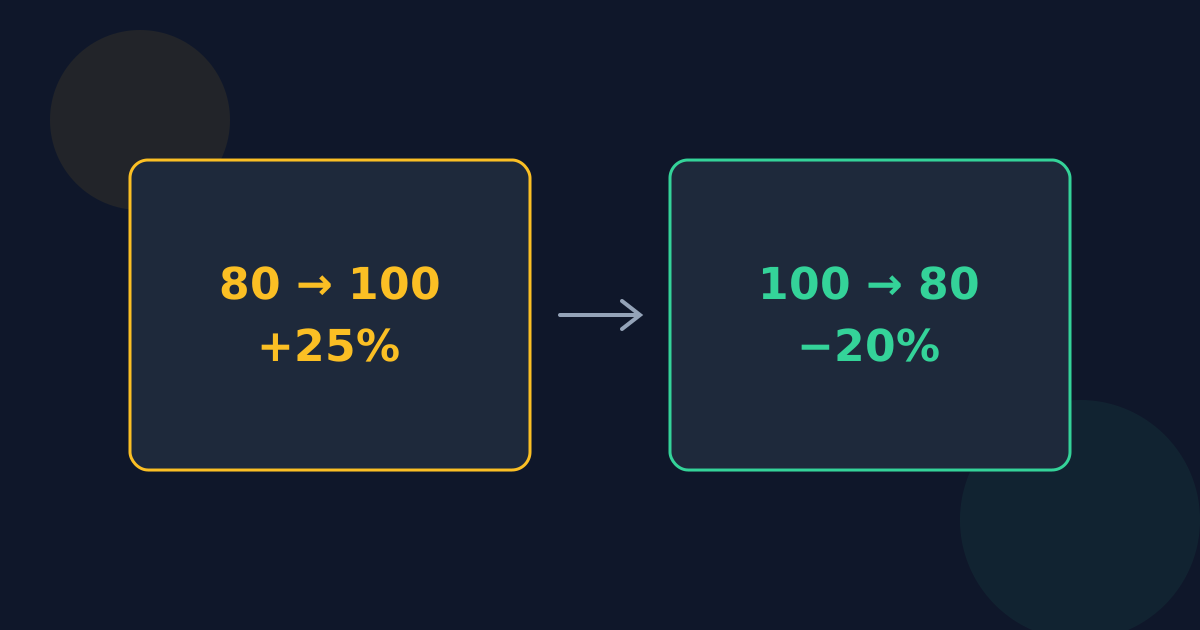
In both calculations the percentage is measured against the starting value. That is why 80 to 100 is +25%, while 100 back to 80 is −20%: the same difference of 20 is compared with 80 in one case and with 100 in the other.
Increase vs. Change FAQ
- Is percentage increase the same as percentage change?
- A percentage increase is a positive percentage change. The difference is the direction of the question: applying a known increase to a value, or finding the percentage between two values.
- How do I find the percentage increase between two numbers?
- Subtract the old value from the new one, divide by the old value, and multiply by 100. From 80 to 100: 20 ÷ 80 × 100 = 25%.
- Why is 80 → 100 a 25% increase but 100 → 80 only a 20% decrease?
- Each is measured from its own starting value: 20 is 25% of 80 but only 20% of 100.
- Can a percentage increase be negative?
- Not as something you apply — a negative increase is really a decrease. A percentage change, though, can be negative.
- What if the starting value is 0?
- Growth from 0 has no percentage, because the formula divides by the starting value. You can still describe the change in plain numbers.
Related guides
- Increase by a PercentageAdd a percentage to a number in two steps or one, with a multiplier table, how chained increases compound, and ways to check the answer.
- Calculate Percentage ChangeThe percentage change formula with worked examples, how to read positive and negative results, a spreadsheet formula, and checks that catch errors.
Open the tool
Jump into Percentage Increase Calculator when you are ready to process your files.