Work, pay & shifts
Night Differential and Shift Premium Terms Explained
Job postings, pay stubs, and handbooks use a tangle of names for extra shift pay: shift differential, night differential, night premium, graveyard pay, shift premium. Most of them describe the same idea — extra money for working at less popular times — but they are not interchangeable with overtime or with a pay multiplier. This guide sorts out what each term usually means and the questions to ask when a policy uses one.
Ready to try the tool this guide describes?
Shift differential: the umbrella term
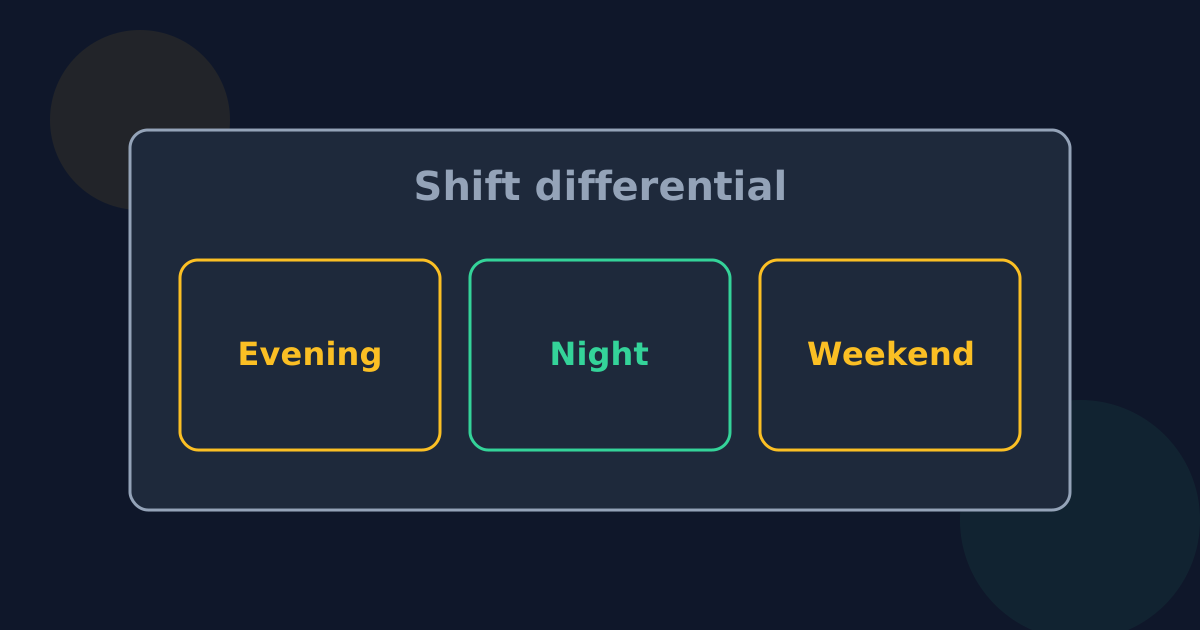
“Shift differential” is the broadest name. It covers extra pay tied to when you work: evenings (often called second shift), nights (third shift), weekends, and sometimes holidays or rotating shifts. A job may have several differentials at once, such as one rate for evenings and a higher one for nights.
Night differential and night premium
These usually mean the same thing: a shift differential for overnight hours. Which word appears depends on the employer or industry, not on how it is calculated. Both are normally stated as a flat amount per hour or a percentage of the base rate, and both are usually paid on hours inside a defined night window.
Other names you may see
| Term | Usually refers to |
|---|---|
| Evening or second-shift differential | Extra pay for afternoon-to-late-evening shifts |
| Graveyard or third-shift pay | Extra pay for overnight shifts |
| Weekend premium or weekend differential | Extra pay for Saturday and Sunday hours |
| Shift premium | Any of the above, often used interchangeably with differential |
| Rotating-shift differential | Extra pay for working a schedule that rotates between shifts |
A premium is not overtime
A shift premium is tied to when you work. Overtime is tied to how many hours you work. They are separate calculations and usually separate lines on a pay stub. Whether and how they interact — for instance, whether a premium is included in the rate used for overtime — depends on your employer’s rules and the law where you work, so check the policy rather than assuming.
A premium is not always a multiplier
“Time-and-a-half” and “double time” are multipliers of the base rate. A premium is an amount added on top. They convert easily — 1.5 × the base rate is the same as a 50% premium — but a flat premium such as $2.00 an hour isn’t a fixed multiplier: it is 1.1 × a $20.00 rate and about 1.07 × a $30.00 rate.
Questions to ask about any shift premium
- Is it a flat amount per hour, a percentage of the base rate, or both?
- Which hours earn it — only hours inside a window, or every hour of a qualifying shift?
- Is it paid on leave, training, or on-call hours?
- How does it show up on the pay stub, and how does it interact with overtime?
Shift Premium Terms FAQ
- Is a night differential the same as a shift differential?
- A night differential is one kind of shift differential — the one for overnight hours. “Shift differential” can also cover evenings and weekends.
- What is graveyard shift pay?
- Another name for a night or third-shift differential: extra pay for working overnight.
- Is a shift premium the same as overtime?
- No. A premium depends on when you work; overtime depends on how many hours you work. They are calculated separately.
- Is time-and-a-half a premium?
- It is a multiplier, but it equals a 50% premium: base rate plus half the base rate.
- Are night premiums always a percentage?
- No. Many are a flat amount per hour, some are a percentage of the base rate, and some combine both.
Related guides
- Counting Night HoursFind the hours of a shift that fall inside a night-premium window, including shifts that cross midnight, unpaid breaks, and whole-shift rules.
- Night Premium Over a YearScale a night premium from one hour to a shift, a week, and a year, with tables for flat and percentage premiums and weeks off.
Open the tool
Jump into Night Shift Premium Calculator when you are ready to process your files.