Work, pay & shifts
How to Count Night Hours in an Overnight Shift
A night premium is usually paid on the hours that fall inside a set window, such as 11 p.m. to 7 a.m. — not automatically on every hour of a shift that happens to be overnight. Counting those hours is the step people most often get wrong, especially when a shift crosses midnight. This guide shows how to find the overlap between a shift and a premium window, with examples, breaks, and the “whole shift” rules some employers use instead.
Ready to try the tool this guide describes?
Night hours are the overlap
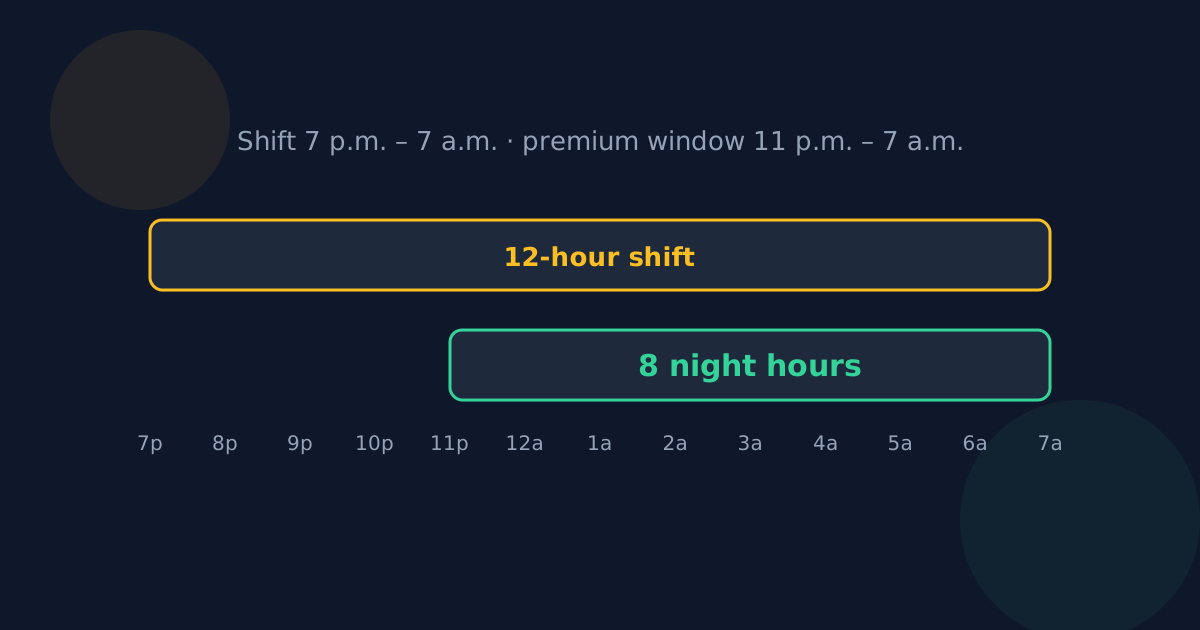
Write down two time spans: when your shift runs, and when the premium window runs. The night hours are the part of the shift that falls inside the window. A 7 p.m. to 7 a.m. shift and an 11 p.m. to 7 a.m. window overlap from 11 p.m. to 7 a.m. — 8 hours — so 8 of the 12 hours earn the premium.
Counting across midnight
If the later start comes after the earlier end, the shift misses the window and there are no night hours. The Hours Between Times Calculator counts spans that cross midnight if you want to check a step.
- Find the later of the two start times. For a 10 p.m. shift and an 11 p.m. window, that is 11 p.m.
- Find the earlier of the two end times. For a 6:30 a.m. finish and a 7 a.m. window end, that is 6:30 a.m.
- Count from the first to the second, rolling past midnight: 11 p.m. to 6:30 a.m. is 7 hours 30 minutes.
- Convert minutes to decimal hours by dividing by 60: 7 hours 30 minutes is 7.5 hours.
Examples
| Shift | Premium window | Night hours |
|---|---|---|
| 7 p.m. – 7 a.m. | 11 p.m. – 7 a.m. | 8 |
| 10 p.m. – 6:30 a.m. | 11 p.m. – 7 a.m. | 7.5 |
| 3 p.m. – 11:30 p.m. | 11 p.m. – 7 a.m. | 0.5 |
| 6 a.m. – 6 p.m. | 11 p.m. – 7 a.m. | 1 |
| 7 p.m. – 7 a.m. | 6 p.m. – 6 a.m. | 11 |
Unpaid breaks inside the window
An unpaid break is not paid time, so it doesn’t earn a premium either. Subtract only the part of the break that falls inside the window: a 30-minute unpaid meal break at 2 a.m. during a 7 p.m. to 7 a.m. shift leaves 7.5 night hours. A break at 9 p.m. is outside the window and leaves the 8 night hours unchanged.
Whole-shift and majority rules
Not every employer counts the overlap. Some pay the night premium on every hour of a shift if most of it falls in the window, and some on every hour of any shift that starts after a certain time. Under a “majority” rule, the 7 p.m. to 7 a.m. shift above — 8 of 12 hours in the window — would earn the premium on all 12. Check which rule your policy uses before counting.
Counting Night Hours FAQ
- How many night hours are in a 7 p.m. to 7 a.m. shift?
- With an 11 p.m. to 7 a.m. premium window, 8. With a 6 p.m. to 6 a.m. window, 11. It depends on the window, not the shift alone.
- How do I count hours that cross midnight?
- Count to midnight, then from midnight: 11 p.m. to 6:30 a.m. is 1 hour before midnight plus 6.5 after, 7.5 hours in all.
- Do unpaid breaks count as night hours?
- No. Subtract any unpaid break time that falls inside the premium window.
- How do I turn 7 hours 45 minutes into decimal hours?
- Divide the minutes by 60: 45 ÷ 60 = 0.75, so it is 7.75 hours.
- Does my whole shift get the night premium?
- Only if your employer’s policy says so. Many count only the hours inside the window; others pay on the whole shift when most of it is overnight.
Related guides
- Night Premium Over a YearScale a night premium from one hour to a shift, a week, and a year, with tables for flat and percentage premiums and weeks off.
- Shift Premium TermsWhat night differential, night premium, shift differential, graveyard pay, and similar terms usually mean, and how they differ from overtime and multipliers.
Open the tool
Jump into Night Shift Premium Calculator when you are ready to process your files.