Home, moving & space
Moving Furniture Around a Stair Landing
A staircase with a landing — turning 90° in an L, or doubling back 180° in a U — adds a corner in the middle of the climb. That corner is harder than a hallway one, because the item arrives tilted on one flight and leaves tilted on another. This guide explains what makes a landing turn work, the simplest case to check, and the options when it is too tight.
Ready to try the tool this guide describes?
Why landings are harder than hallways
On a hallway corner the item stays level. On a landing it comes up one flight tilted to the stairs, has to level out onto the landing, turn, and tilt again onto the next flight — often with a handrail and the next flight’s steps in the way. The floor of the landing, the steps above and below, and the ceiling all constrain it at once.
The case that clearly works
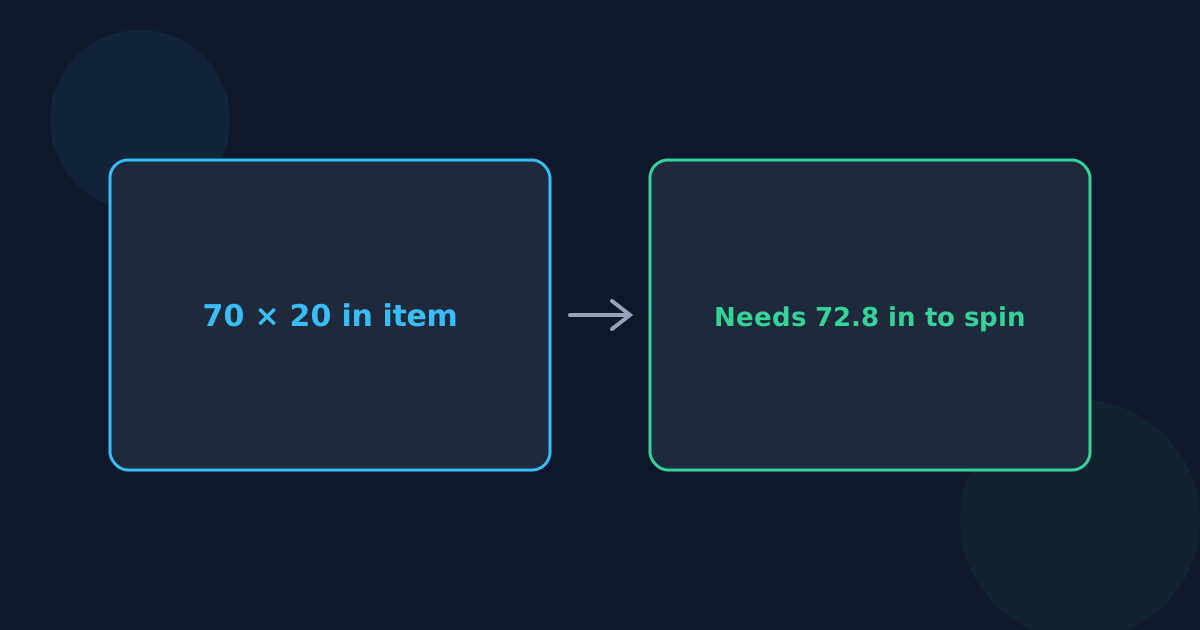
If the item fits entirely on the landing and can be spun round there, the turn is straightforward: carry it up, set it down, rotate it, and carry it on. Spinning a footprint L long and W wide needs √(L² + W²) of floor in every direction — the landing’s smaller side must be at least that.
| Footprint (L × W) | Landing side needed to spin it |
|---|---|
| 60 × 20 in | 63.25 in |
| 70 × 20 in | 72.8 in |
| 72 × 30 in | 78 in |
| 80 × 36 in | 87.73 in |
| 84 × 38 in | 92.2 in |
The footprint is the item as carried along the stairs: its length and the side that goes across the stair width.
When the landing is smaller
All of these are 3D manoeuvres that depend on exactly where the rail, the steps, and the ceiling are. They can work, but a handful of measurements can’t prove it — measure the landing area carefully and get experienced help.
- Movers stand the item more upright on the landing, so its footprint is smaller, and pivot it over the steps of the next flight.
- Some items can be passed over the handrail or banister where the flights double back.
- Long items may need to go up on their end in a U-shaped stairwell, if the stairwell is open above.
Measure the landing
- Width and depth of the landing floor, wall to wall or wall to rail.
- Headroom above the landing, to the lowest point.
- The width of each flight at the landing, and the height of the handrail.
- Anything on the walls: light switches, windowsills, radiators.
Stair Landing Turns FAQ
- How big a landing do I need to turn a sofa?
- To spin it flat on the landing, a square at least √(length² + width²) — over 90 in for a full-size sofa. Most landings are smaller, so sofas usually need a 3D pivot.
- Is a U-shaped staircase harder than an L-shaped one?
- Usually, because the item turns 180° and the next flight starts right beside the one it came up.
- Can I take the handrail off?
- Some rails unscrew from brackets; balustrades are usually fixed. Re-measure the width if a rail comes off.
- What if the item is too long to stand up on the landing?
- It needs the open space above the stairs, or another route — some large items are hoisted through a window or balcony instead.
- Do winder stairs count as a landing?
- No — winders turn while they climb, with no flat landing, and are harder still.
Related guides
- Stair Width and HeadroomMeasure a staircase for moving furniture: usable width at the handrail, rise, run, and headroom, and how to turn measured headroom into the room an item has along the slope.
- Stair Steepness and ClearanceHow a steeper staircase reduces the headroom an item can use and sharpens the bend at the foot and head of the stairs, with figures for pitches from 30° to 45°.
Open the tool
Jump into Stairwell Furniture Clearance Calculator when you are ready to process your files.