Calculators & everyday math
Loan Principal vs. Interest: Where Each Payment Goes
Every payment on a fixed-rate loan is the same size, but what it pays for changes month by month. Early payments go mostly to interest; later ones go mostly to the principal. This guide explains why, using the first months of a typical mortgage.
Ready to try the tool this guide describes?
Principal and interest
- Principal is the amount borrowed that is still owed.
- Interest is the charge for borrowing, worked out each month on the principal still owed.
- Whatever part of a payment isn’t interest reduces the principal.
The first six payments of a mortgage
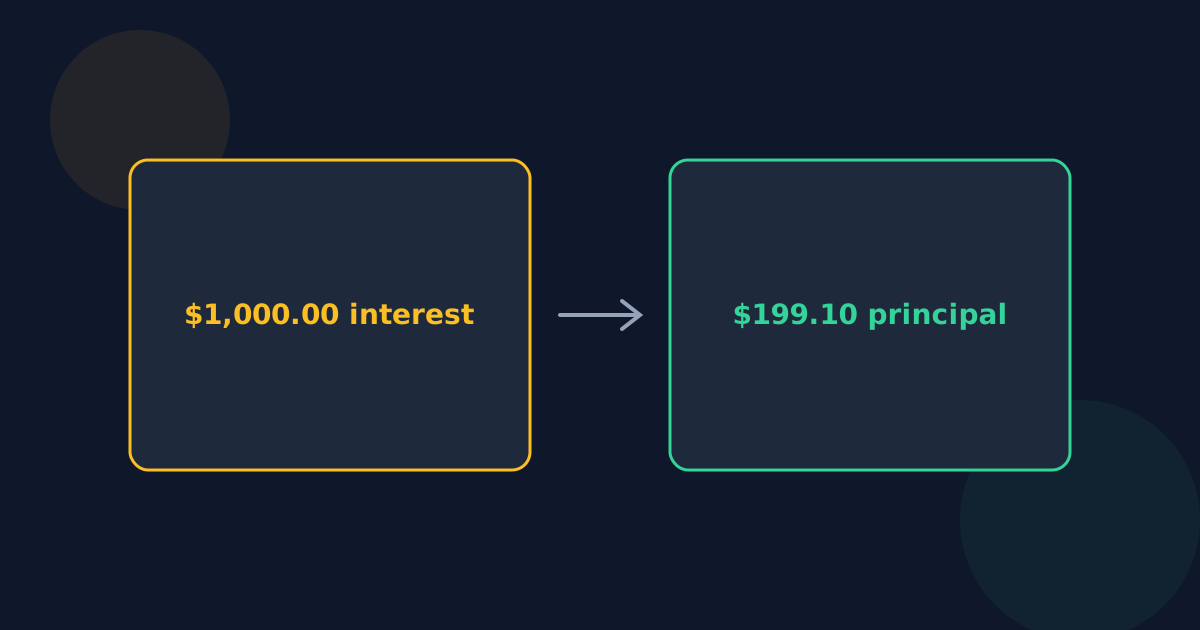
$200,000 at 6% for 30 years has a payment of $1,199.10. The monthly rate is 0.5%, so the first month’s interest is $200,000 × 0.005 = $1,000.00.
| Payment | Interest | Principal | Balance after |
|---|---|---|---|
| 1 | $1,000.00 | $199.10 | $199,800.90 |
| 2 | $999.00 | $200.10 | $199,600.80 |
| 3 | $998.00 | $201.10 | $199,399.71 |
| 4 | $997.00 | $202.10 | $199,197.60 |
| 5 | $995.99 | $203.11 | $198,994.49 |
| 6 | $994.97 | $204.13 | $198,790.36 |
Amounts are rounded to the cent for display; the schedule itself is calculated at full precision.
How the split shifts
Each payment lowers the balance a little, so the next month’s interest is a little smaller and a little more of the fixed payment goes to principal. On this loan, the principal portion first exceeds the interest portion at payment 223 — more than 18 years in. After 10 years the balance is still $167,371.45, and after 15 years it is $142,097.69.
The total over the whole loan
Over 360 payments this loan repays $431,676.38: the $200,000 borrowed plus $231,676.38 of interest.
What changes the interest paid
- A lower rate lowers every month’s interest charge.
- A shorter term pays the balance down faster, so less interest builds up.
- Paying extra toward principal lowers the balance sooner, so later interest charges are smaller. The Loan Payment Calculator doesn’t model extra payments.
Principal vs. Interest FAQ
- Why is so much of my early payment interest?
- Because interest is charged on the balance, and the balance is largest at the start.
- How is each month’s interest calculated?
- Balance still owed × annual rate ÷ 12.
- What is an amortization schedule?
- A table showing, for every payment, how much goes to interest, how much to principal, and the balance left.
- Does the payment amount change as the balance falls?
- Not on a fixed-rate loan. The payment stays the same; only the split between interest and principal changes.
- When does most of a payment go to principal?
- It depends on the rate and term. For $200,000 at 6% over 30 years, from payment 223 onward.
Related guides
- How Loan Payments WorkThe fixed-payment formula behind installment loans, each variable explained, a step-by-step worked example, and the 0% interest case.
- Loan Term and InterestWhy a longer term lowers the monthly payment but raises total interest, with worked comparisons for a car loan and a mortgage.
Open the tool
Jump into Loan Payment Calculator when you are ready to process your files.