Calculators & everyday math
How Monthly Loan Payments Are Calculated
Car loans, personal loans, and most fixed-rate mortgages are repaid in equal monthly installments. The size of that installment comes from one standard formula. This guide explains each part of it, works through an example step by step, and covers the special case of a 0% loan.
Ready to try the tool this guide describes?
The formula
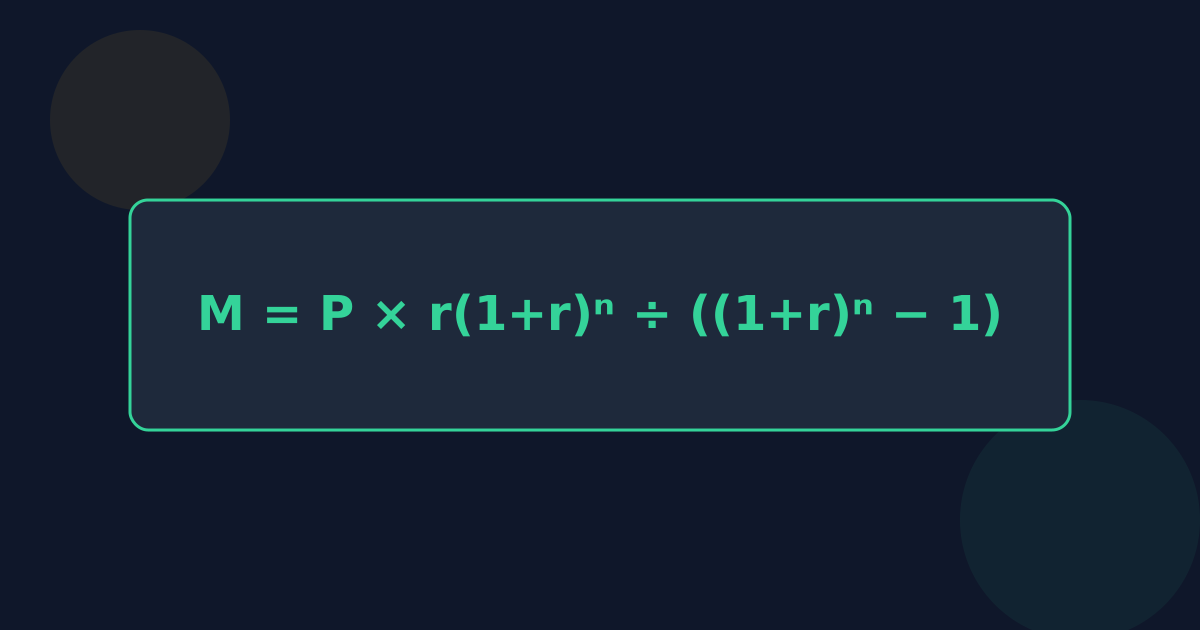
M = P × r(1 + r)^n ÷ ((1 + r)^n − 1)
- M — the monthly payment.
- P — the principal, the amount borrowed.
- r — the monthly interest rate: the annual rate ÷ 100 ÷ 12.
- n — the number of monthly payments: years × 12.
A worked example
Borrow $25,000 at 6.5% a year for 5 years:
- Monthly rate: r = 6.5 ÷ 100 ÷ 12 = 0.0054166667.
- Number of payments: n = 5 × 12 = 60.
- Growth factor: (1 + r)^60 = 1.3828173242.
- Payment: M = 25,000 × 0.0054166667 × 1.3828173242 ÷ (1.3828173242 − 1) = $489.15.
- Total repaid: 60 payments of the unrounded 489.1537 come to $29,349.22, of which $4,349.22 is interest.
Why the formula works
Each month, interest is added on the balance still owed, and the payment is subtracted. The formula finds the single payment that makes the balance land on exactly $0 after the last payment. Equivalently, the payments’ value today, after discounting each one at the monthly rate, adds up to the amount borrowed.
The 0% case
With no interest, the formula would divide 0 by 0, so the payment is simply P ÷ n instead. $12,000 over 48 months is $250.00 a month, and the total repaid equals the amount borrowed.
Why a lender’s figure can differ slightly
- Payments are rounded to the cent, and the final payment is adjusted to clear the balance.
- Some lenders charge interest by the day, so months of different lengths vary a little.
- Fees may be added to the loan or reflected in an APR that is higher than the interest rate.
How Loan Payments Work FAQ
- What does r mean in the loan formula?
- The interest rate per payment period. For monthly payments, it is the annual rate divided by 12, written as a decimal.
- What is the monthly payment on $200,000 at 6% for 30 years?
- $1,199.10, for a total of $431,676.38 over 360 payments.
- How do I calculate a 0% loan payment?
- Divide the amount borrowed by the number of payments.
- Is APR the same as the interest rate?
- Not always. APR can include certain fees on top of interest, so it can be higher than the rate used to work out the payment.
- Can I use the formula in a spreadsheet?
- Yes. Spreadsheet PMT functions use the same formula, for example =PMT(6.5%/12, 60, -25000) for the example above.
Related guides
- Principal vs. InterestHow each fixed loan payment splits into interest and principal, an amortization example, and why the split shifts over the life of a loan.
- Loan Term and InterestWhy a longer term lowers the monthly payment but raises total interest, with worked comparisons for a car loan and a mortgage.
Open the tool
Jump into Loan Payment Calculator when you are ready to process your files.