Calculators & everyday math
How to Calculate the Time to Reach a Savings Goal
How long a savings goal takes comes down to three numbers: the target, what is already saved, and how much goes in each month. This guide shows the calculation step by step, explains why the answer is rounded up, and shows how a goal month is found — all without assuming any interest.
Ready to try the tool this guide describes?
The calculation
- Amount still needed = goal − current savings.
- Months = amount still needed ÷ monthly contribution.
- Round up to a whole month.
- Split into years and months by dividing by 12.
A worked example
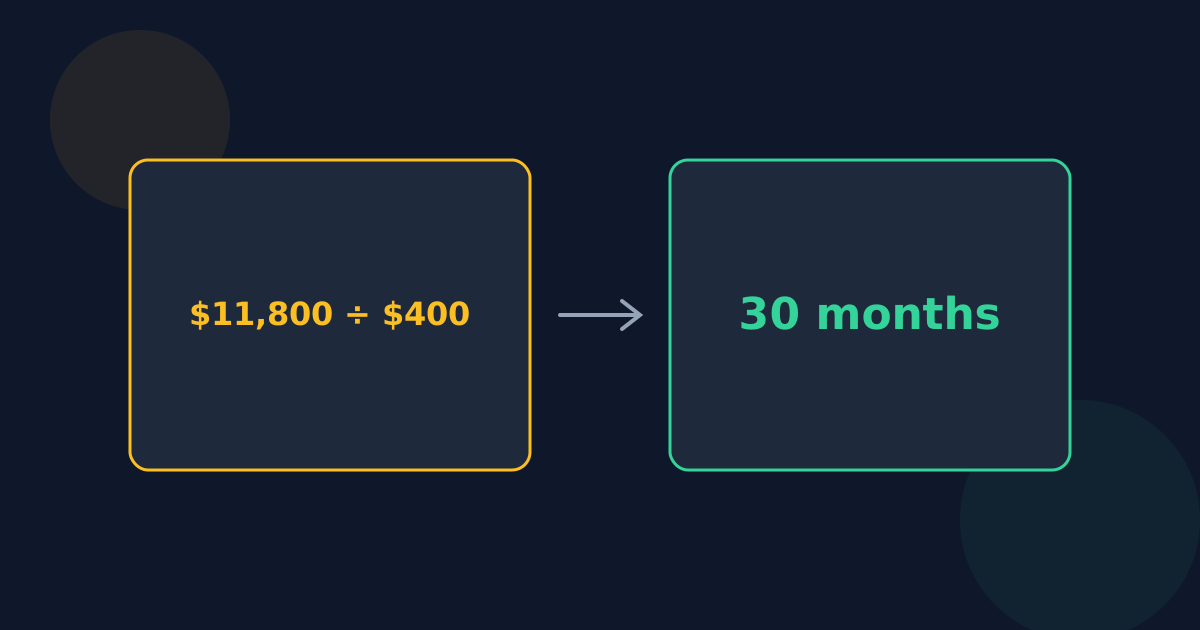
A $15,000 goal with $3,200 already saved and $400 added each month: $15,000 − $3,200 = $11,800 still needed. $11,800 ÷ $400 = 29.5, which rounds up to 30 months — 2 years 6 months. After 29 full contributions, $200 is still needed, so the 30th month only needs $200.
Why round up
A fraction of a month still needs a contribution, and the goal isn’t reached until that last contribution is made. Rounding down would show a date when the savings are still short.
Finding the goal month
Counting from the current month, add the number of contributions. If the first contribution is made one month from now, a plan that takes 30 contributions and starts in September 2026 reaches the goal in March 2029. The Savings Goal Calculator uses exactly this convention.
In a spreadsheet
With the goal in A1, current savings in B1, and the monthly amount in C1: =ROUNDUP((A1 − B1) / C1, 0) gives the months, and =EDATE(TODAY(), that result) gives a date in the goal month.
What this leaves out
- Interest or investment growth, which would shorten the time. For growth on a balance, see the Compound Interest Calculator.
- Missed or irregular contributions.
- Inflation, which can raise the cost of whatever the goal is for.
Time to a Savings Goal FAQ
- How do I calculate how many months to save?
- Subtract what you have saved from the goal, divide by the monthly amount, and round up.
- What if the result is a fraction?
- Round up to the next whole month; the last month only needs the remainder.
- How long does $10,000 take at $300 a month with $2,500 saved?
- 25 months — 2 years 1 month — to cover the $7,500 still needed.
- Does the calculation include interest?
- No. It counts contributions only, so the result doesn’t depend on a rate that may change.
- What if I already have enough?
- If current savings meet or exceed the goal, there is nothing left to save and no months are needed.
Related guides
- Contributions and Goal DatesHow raising or lowering a monthly contribution moves a savings goal date, why the first increases save the most time, and changing amounts part-way.
- Monthly Amounts for a TargetTurn a savings target and a deadline into a monthly amount, why to round up to the cent, and how to count the months to a deadline.
Open the tool
Jump into Savings Goal Calculator when you are ready to process your files.